
Thailand's 'Quick Big Win' Cuts At-Risk Nominee Company Registrations by 60% in Q1 2026
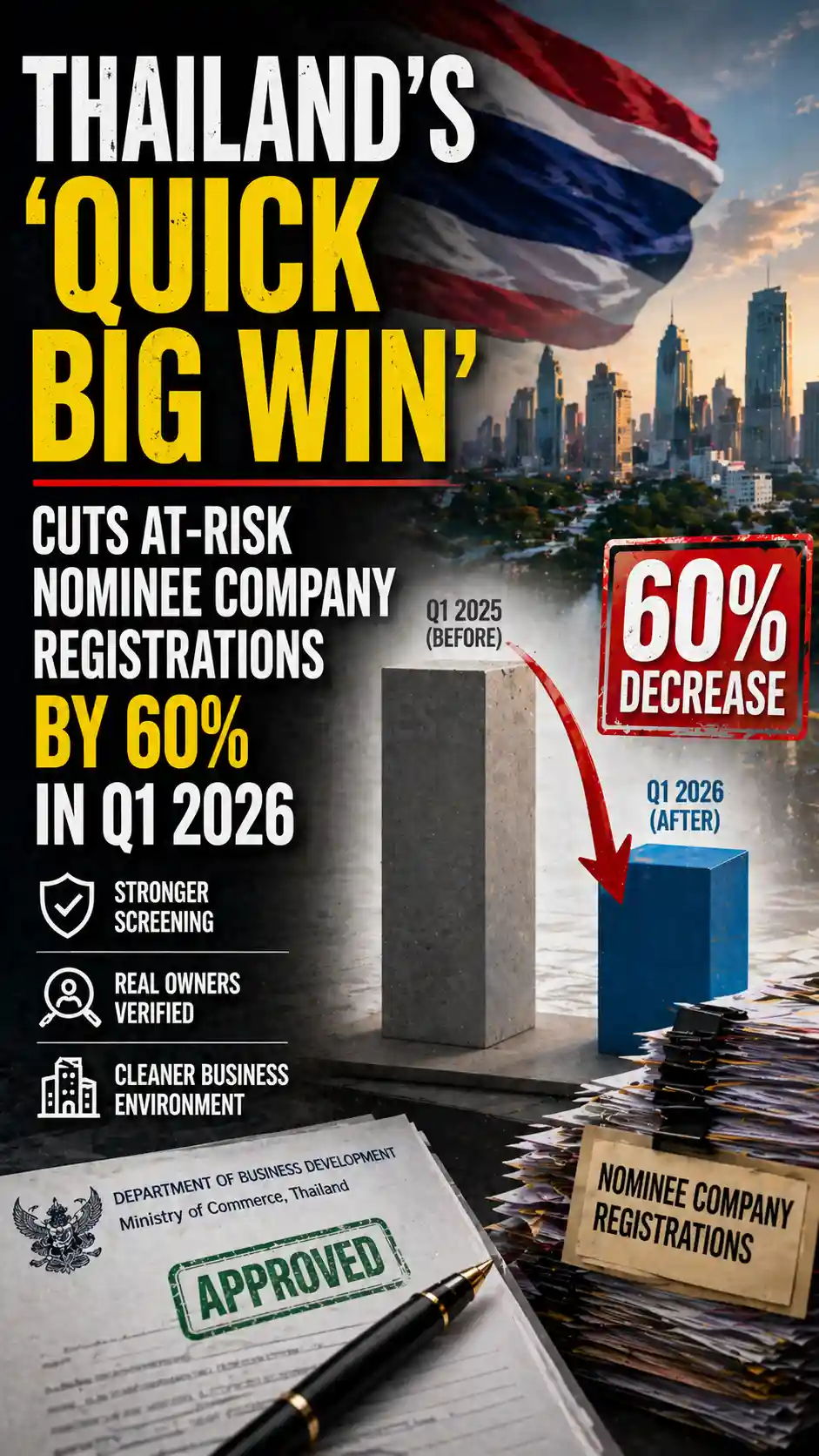
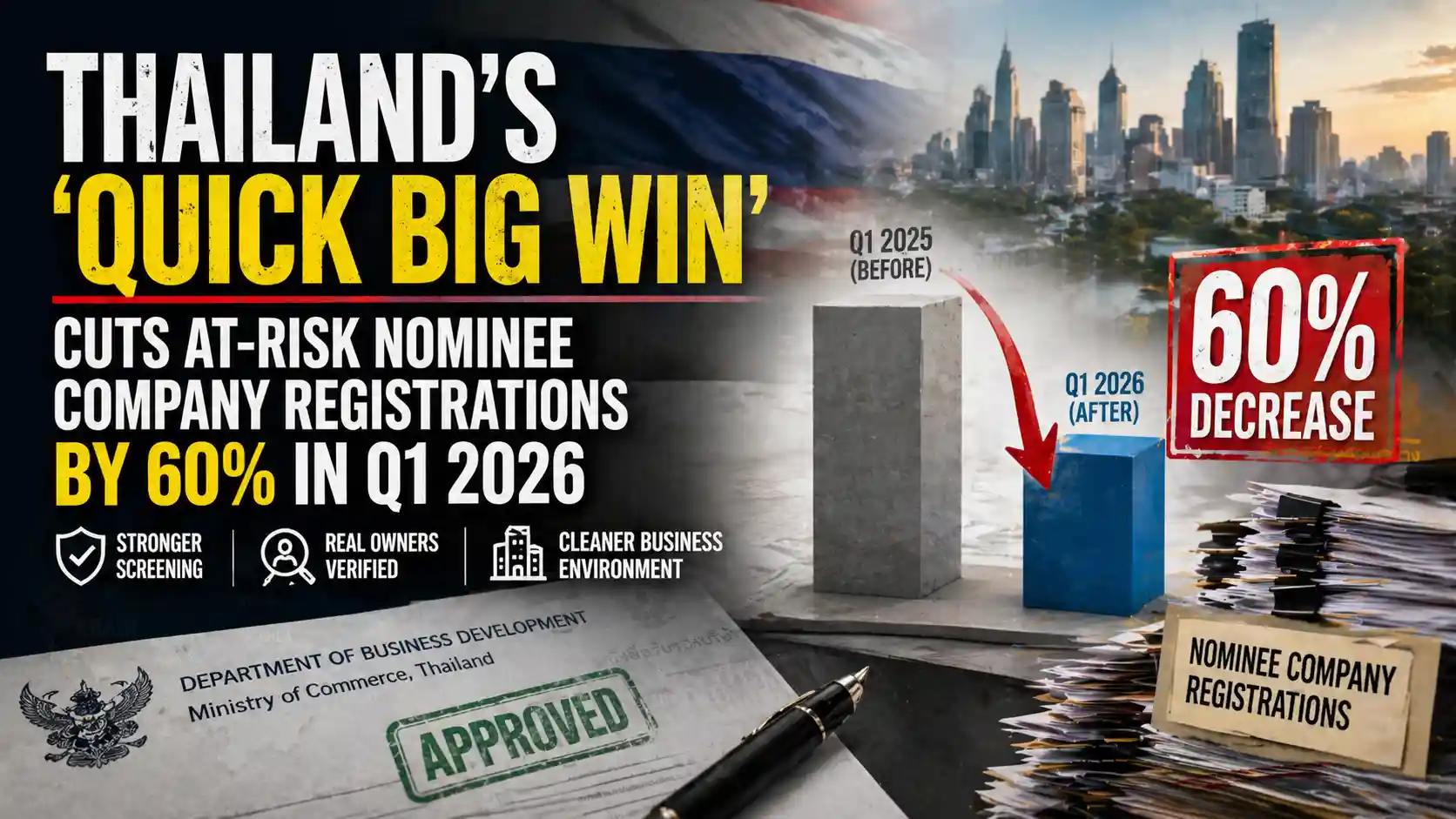
Thailand's Quick Big Win policy cut at-risk nominee company registrations 60% in Q1 2026, with tightened laws, expanded probes and inter-agency data sharing.
Thailand's "Quick Big Win" Cuts At-Risk Nominee Company Registrations by 60% in Q1 2026 #
Government doubles down on nominee enforcement: tighter laws, expanded investigations and inter-agency data sharing now produce measurable results #
The Thai government has confirmed that its "Quick Big Win" enforcement policy delivered a 60% reduction in newly registered companies classified as at risk of nominee structures in the first quarter of 2026, with PM's Office spokeswoman Rachada Dhnadirek announcing on 26 April 2026 that the wider campaign against foreign nominee business holdings and money laundering is now being intensified through tighter legislation, expanded investigations and strengthened data sharing between state agencies.1
Key takeaways
- At-risk nominee company registrations fell 60% in Q1 2026, dropping from 3,511 in Q1 2025 to 1,373 in the same period this year, according to PM's Office spokeswoman Rachada Dhnadirek.1
- The "Quick Big Win" policy focuses on swift enforcement and early measurable results, targeting practices the government identifies as harmful to Thailand's business environment, including the misuse of Thai nominees by foreign operators.1
- Inter-agency data sharing between the Department of Business Development, the Anti-Money Laundering Office, the Revenue Department and the Royal Thai Police is now operational, with AI pattern recognition flagging suspicious ownership clusters in real time.
- Better-than-Freehold® provides a fully compliant ownership structure that eliminates nominee exposure entirely, ensuring AMLA compliance whilst maintaining secure, registered property rights and access to offshore financing up to 50% LTV.
How Big Was the Q1 2026 Drop in At-Risk Nominee Company Registrations? #
- How Big Was the Q1 2026 Drop in At-Risk Nominee Company Registrations?
- What Happened
- How "Quick Big Win" Connects to Earlier DBD Orders
- Who Is Affected
- Legal and Compliance Context
- What Happens Next
- How Better-than-Freehold® Addresses This Enforcement Environment
- FAQ Section
- Related Terms
- Expert Guidance
What Happened #
PM's Office spokeswoman Rachada Dhnadirek announced on 26 April 2026 that the government is intensifying its enforcement campaign against foreign nominee business holdings and money laundering. The latest measures build on the "Quick Big Win" policy, which was launched to deliver swift, measurable enforcement outcomes against practices considered harmful to Thailand's business environment, including the misuse of Thai nominees by foreign business operators.1
Under the policy, firms classified as at risk of nominee structures have been required, since 1 January 2026, to submit additional financial documents during the registration process. According to Ms Rachada, this single procedural change drove a 60% drop in such companies in the first quarter of 2026, with 1,373 at-risk registrations recorded compared with 3,511 in the same period last year.1
The announcement frames this reduction as proof of concept rather than the conclusion of the campaign. The next phase tightens primary legislation, expands the investigative perimeter beyond company formation into ongoing operations, and formalises data sharing between the DBD, the Anti-Money Laundering Office (AMLO), the Revenue Department, the Land Department and the Royal Thai Police.
How "Quick Big Win" Connects to Earlier DBD Orders #
The Q1 2026 drop did not happen in isolation. It is the direct result of DBD Order No. 1/2026, issued by the Office of the Central Company and Partnership Registration, which took effect on 1 April 2026 and tightened registration requirements for companies with foreign involvement. That order requires managing partners or authorised directors to certify that all shareholders or partners have genuinely invested with their own funds and are not assisting foreign nationals as nominees.2
This builds on DBD Order No. 2/2568 (2025), which came into force on 1 January 2026 and required high-risk applicants, including those with foreign shareholding under 50% or with foreign directors, to provide bank statements and other financial evidence proving the source of capital. The combined effect of these orders is that the registration counter has become the first line of nominee enforcement, with applications now subject to forensic-level scrutiny before any company name is issued.
The deputy government spokeswoman Lalida Persvivatana described the Order No. 1/2026 changes as "a stricter level of scrutiny" beyond the previous regime, which had only required financial evidence for businesses considered high risk.2 The new requirement applies to a much wider population of registrations.
Who Is Affected #
Three constituencies face direct exposure under the intensified enforcement environment.
The first is prospective applicants seeking to form Thai companies with any foreign involvement. The Sworn Income Declaration and source-of-funds certification mean that Thai partners and directors must now prove personal financial capacity matching their stated investment. A Thai national declaring a modest monthly income whilst claiming to have funded millions of baht of share capital triggers immediate registrar refusal.
The second is existing nominee structures, which remain firmly within the enforcement perimeter. The same registration changes that block new nominee formations also retrospectively constrain existing companies on the share register. Any transfer of shares, addition of foreign directors, capital increase or sale of the company now triggers the same capital requirements and proof tests. In effect, anyone in an existing nominee structure cannot exit, restructure or transfer without satisfying the new compliance gates.
The third is professional facilitators, including lawyers, accountants and corporate service providers who structure or maintain nominee arrangements. The government's enforcement architecture under AMLA already scrutinises gatekeepers; the expanded inter-agency data sharing now exposes those professionals to systematic detection rather than incidental investigation.
Legal and Compliance Context #
Thailand's Foreign Business Act (FBA) continues to constrain foreign shareholdings to no more than 49% in most non-Schedule sectors and prohibits foreign participation entirely in Schedule 1 occupations, including land trading. The enforcement intensification announced on 26 April 2026 does not alter these constraints; it sharpens the tools used to detect circumvention.
Under Section 36 of the FBA, foreigners using Thai nominees to circumvent ownership constraints face imprisonment of up to three years, fines of THB 100,000 to 1,000,000, or both. Thai nominees face identical penalties. Where the conduct is treated as a predicate offence under the Anti-Money Laundering Act, penalties escalate sharply, with imprisonment up to 10 years and fines reaching 10 million baht, alongside asset forfeiture under AMLO authority.
The "Quick Big Win" framing matters because it positions enforcement as a deliverable government output rather than a discretionary investigation programme. Spokeswoman Rachada specifically described the policy as focused on "swift enforcement and early, measurable results" against practices that harm Thailand's business environment.1 Once a policy is calibrated against quarterly performance metrics, the political incentive to demonstrate continued progress rises with each reporting cycle.
What Happens Next #
The 26 April announcement signals three near-term directions.
First, legislative tightening. The government has flagged ongoing work to amend relevant statutes, with proposals including a standalone Nominee Transactions Act creating national and provincial oversight committees, independent investigation authority and tiered criminal penalties. AMLA amendments approved by Cabinet remain on the legislative track for reintroduction by the new Parliament.
Second, expanded investigations. The DBD has signalled targeted inspections in tourism, real estate, hotels and resorts, transport and logistics, and e-commerce platforms and warehouses, with high-risk provinces including Phuket, Samui, Phangan, Krabi, Phang Nga, Chiang Mai and the eastern fruit-trade corridor of Rayong, Chanthaburi and Trat. Cumulative enforcement now spans 29,000+ legal cases and 852 prosecutions since the campaign intensified in 2025.
Third, strengthened inter-agency data sharing. The DBD's Biz Regist platform is being integrated more tightly with Revenue Department tax filings, Land Department records and AMLO suspicious transaction reports. AI-driven pattern recognition is already operational, flagging clusters of companies sharing the same passive Thai shareholders, mismatches between declared income and capital contributions, and disguised management fee structures used to extract economic value to foreign principals.
For foreign investors and existing structure holders, the practical implication is that the runway for voluntary restructuring is shortening. Detection capacity is expanding faster than the industry has adapted, and the government's continued use of measurable headline metrics, like the 60% Q1 2026 drop, increases pressure to keep producing visible results.
How Better-than-Freehold® Addresses This Enforcement Environment #
Better-than-Freehold® is engineered to operate entirely outside the structural risk that the "Quick Big Win" policy is designed to eliminate. Because the structure does not rely on foreign equity in a Thai operating company, it does not engage the FBA constraints that nominee structures are designed to circumvent.
How does the BtF structure avoid these constraints? #
The structure separates legal title from contractual rights. Thailand Investor Network (TIN) operates as a genuinely independent Thai entity without foreign funding or control, holding legal title to property. SPH Trustees, a Labuan FSA-regulated trust company, holds the registered lease, option to renew, mortgage and pledge rights on behalf of the foreign investor. Clear Blue Security Agents (CBSA) registers all contracts with Thai authorities and provides independent mediation and enforcement without court dependency. Siam Venture Capital (SVC) provides offshore lending up to 50% LTV.
Because no foreign person holds equity in a Thai company, no "foreign person" definition under the FBA is triggered, and the structure falls entirely outside the regulatory framework that the new DBD orders are tightening.
How does conversion from a nominee structure work? #
Existing nominee company holders cannot avoid the new registration constraints by attempting to amend their existing structures, because every share transfer, director change or capital amendment now triggers the same proof tests. A managed conversion to Better-than-Freehold® unwinds the nominee company in parallel with establishing compliant title under TIN and registered rights under SPH Trustees. The typical conversion timeline runs 6–8 weeks, and voluntary restructuring is materially less costly than restructuring under investigation or following asset seizure.
Compliance Comparison #
| Feature | Nominee Company | Long-Term Lease Only | Better-than-Freehold® |
|---|---|---|---|
| AMLA compliance | Criminal exposure | Compliant | Fully compliant |
| FBA exposure | Direct violation | None | None |
| Registered security | None | Lease only | Lease, option, mortgage, pledge |
| Independent enforcement | Court only | Court only | CBSA, contract-based |
| Offshore financing | None available | None typically | Up to 50% LTV via SVC |
| Conversion pathway | Severe constraints | Limited extension | Full structure transfer |
FAQ Section #
Related Terms #
- Krabi Ghost Office Raid Exposes 500+ Nominee Companies - Southern Thailand raid, ghost office pattern and Rule of Five context
- DBD Tightens Foreign Business Registration: Nominee Crackdown 2026 - Detailed analysis of DBD Order No. 2/2568 and the new registration regime
- DBD Targets 110,000 Companies in Nominee Shell Account Investigation - Scope and methodology of the systematic investigation programme
- Nominee Company Investigation Thailand 2026 - Background on the inter-agency enforcement framework and AMLA exposure
- Nominee Structure Conversion: Legal Process in Thailand - Step-by-step pathway from nominee company to compliant ownership
Expert Guidance #
Immediate Action Required #
A 60% reduction in at-risk nominee company registrations within a single quarter reflects both a procedural barrier at the registration counter and a deterrent among applicants who see nominee risk as unsustainable. Foreign property investors holding through Thai company structures should treat the announcement as confirmation that the runway for voluntary restructuring is closing. Contact the Better-than-Freehold® advisory team for a confidential compliance assessment.
Long-term Security Strategy #
Better-than-Freehold® provides registered, financeable property rights without FBA nominee exposure: no equity in a Thai operating company, no registration proof tests on every amendment, and alignment with AMLA expectations whilst preserving transactional flexibility if you convert before investigation.
Conclusion #
The 26 April 2026 announcement crystallises what has been visible in Thailand's enforcement data for the past 12 months: nominee structures are no longer a peripheral compliance concern but a central enforcement priority backed by quarterly performance metrics, inter-agency data sharing and AI-driven detection. The 60% Q1 2026 drop in at-risk registrations is the first time the government has framed this as a measurable policy success, and the framing matters more than the headline number. "Quick Big Win" is now a public commitment that the enforcement curve continues to bend in the same direction.
For foreign investors, the practical question has shifted from "will enforcement reach my structure?" to "how much time remains to restructure voluntarily before it does?". Better-than-Freehold® exists precisely because Thailand's compliance environment now requires structures engineered to operate outside the framework being tightened, rather than within the constraints being enforced.
If you're considering Thai property investment - or already hold property through a nominee structure - register to watch our free video to see how Better-than-Freehold® addresses these risks: https://app.betterthanfreehold.com/register
References #
This article is provided for general information only and does not constitute legal, tax, or investment advice. Laws and enforcement practices change; obtain advice tailored to your situation before acting.
Footnotes #
-
Bangkok Post. (2026, April 27). "Thailand ramps up crackdown on nominee businesses." https://www.bangkokpost.com/thailand/general/3244294/thailand-ramps-up-crackdown-on-nominee-businesses ↩ ↩2 ↩3 ↩4 ↩5 ↩6 ↩7
-
Bangkok Post. (2026, March 25). "Crackdown targets use of Thai proxies." https://www.bangkokpost.com/business/general/3223664/crackdown-targets-use-of-thai-proxies ↩ ↩2
About the Author: Andrew Moore FPFS, CDir
Chairman, Better than Freehold

Andrew Moore has been an active investor in Thai property since 2004. He is a Chartered Director and a Fellow of the Personal Finance Society. He has invested in and built properties in several countries since the late 90's and first invested in Thailand 20 years ago. Having owned residencies in Bangkok, Samui, Phangan and Phuket he can offer a unique perspective on the island's property markets together with past and future trends in both ownership and investor opportunities.