What Happens When Your Nominee Company Gets Investigated - Thailand 2026
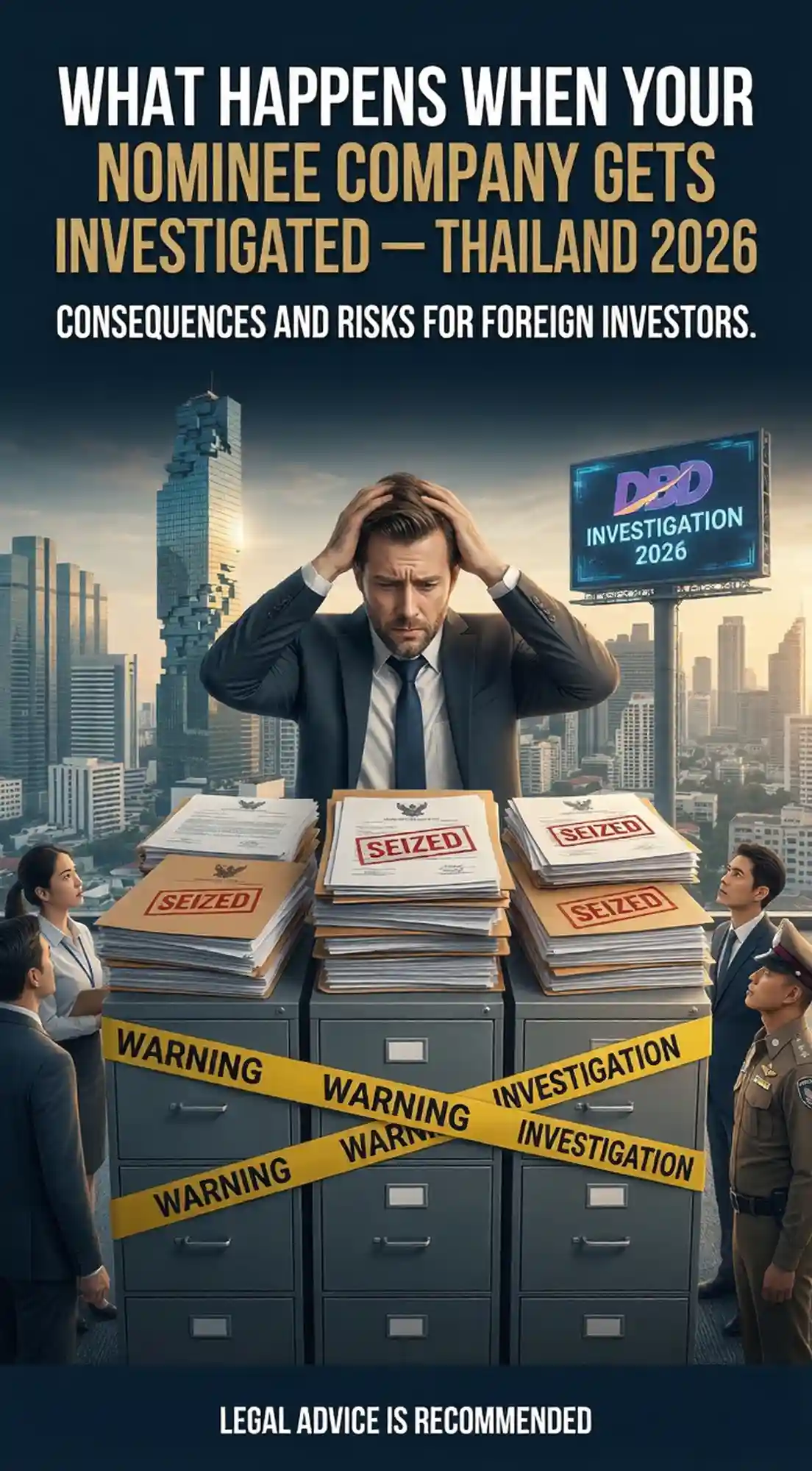

Step-by-step guide to what happens when Thailand's DBD investigates your nominee company. Triggers, process, consequences, and how to respond before it is too late.
What Happens When Your Nominee Company Gets Investigated - Thailand 2026 #
The Step-by-Step Process From DBD Flagging to Criminal Prosecution, and What You Can Still Do About It #
Key Takeaways
- Thailand's nominee investigations follow a two-stage enforcement model: immediate arrests for clear violations, followed by evidence-based corporate investigations referred to specialist agencies, including AMLO, ECSD, and the Criminal Investigation Bureau.
- AI-driven screening is now identifying companies automatically, with the DBD Biz Regist platform cross-referencing shareholding patterns, tax filings, and director profiles across 46,918 entities nationally targeted for enhanced review.
- Consequences extend beyond fines to criminal prosecution, including imprisonment up to 3 years under the Foreign Business Act (Section 36/37) or up to 10 years where AMLA money laundering charges are established; asset freezing without court order, company dissolution, and visa blacklisting; and facilitating professionals face criminal exposure under the same provisions.
- Better-than-Freehold™ eliminates investigation exposure entirely by legally removing nominee shareholders, foreign control indicators, and every structural element that triggers DBD screening algorithms.
Quick Answer
Quick Answer: A DBD investigation is typically triggered by AI screening flags on the Biz Regist platform, inter-agency referrals from the Revenue Department or AMLO, provincial task force inspections, or whistleblower reports (incentivised by a 10% bounty on seized assets). Once flagged, the investigation follows a defined two-stage process that can escalate from corporate review to criminal prosecution within weeks.
- Investigation Triggers and Detection Methods
- Stage One: Initial Screening and Flagging
- Stage Two: Evidence-Based Investigation
- What Happens During the Investigation
- Consequences of an Adverse Finding
- Real Enforcement Examples
- Better-than-Freehold™ Solution
- FAQ Section
- Related Terms
- Expert Recommendations
What triggers a DBD investigation into a nominee company? #
Thailand's Department of Business Development now operates a technology-driven detection system that identifies suspected nominee structures through automated pattern recognition, inter-agency data sharing, and targeted provincial investigations. With 29,000+ legal cases initiated and 852 companies prosecuted during 2025–2026, investigations are no longer rare events; they are systematic, province-by-province operations covering the entire country.
Investigation Triggers and Detection Methods #
| Trigger | How It Works | Risk Level |
|---|---|---|
| AI pattern recognition | DBD Biz Regist platform flags companies where foreigners hold 0.001%–49.99% of shares | Highest, automated, continuous |
| Tax filing mismatch | Revenue Department cross-references company tax filings against shareholder income declarations | High, systematic |
| Same passive shareholders | Algorithms detect the same Thai individuals appearing as shareholders across multiple companies | High, pattern-based |
| Whistleblower reports | Informants receive a reward under AMLA Section 58 (up to 10% of forfeited assets); includes disgruntled nominees, competitors, and former employees | Moderate, unpredictable |
| Provincial task force | Inter-agency inspections targeting specific geographic areas (Phuket, Samui, Hua Hin, Phangan) | Variable, depends on location |
| Disguised management fees | Revenue Department identifies fee structures concealing foreign operational control | Moderate, requires deeper analysis |
Stage One: Initial Screening and Flagging #
The first stage operates largely without the company's knowledge. The DBD Biz Regist platform maintains a centralised digital footprint for every registered company, including shareholders, directors, and registered capital, which is cross-verified with Revenue Department tax filings in real time.
How does the screening process work? #
AI algorithms screen the entire corporate registry continuously, flagging companies that match high-risk indicators. The new screening criteria target companies where foreigners hold 0.001%–49.99% of shares, capturing the standard 49:51 nominee structure threshold that was previously considered safe, whilst also flagging companies with foreign authorised directors even where no foreign equity exists. 46,918 entities have been identified nationally under this screening, with approximately 1,000 prioritised for immediate investigation.
DBD Order 2/2568 (effective 1 January 2026) has further tightened the gateway. New company registrations now require Thai shareholders to prove their capital with three months of bank statements. Existing companies face retrospective exposure: any future share transfer or company sale triggers the same capital proof requirements, meaning the screening net captures both new and established nominee structures, with further amendments due to come into force during 2026
The company receives no notification during Stage One. Flagging is an internal administrative process. The first indication of an investigation might be a request for documents, a visit from provincial inspectors, or, in clear-cut cases, an unannounced raid.
Stage Two: Evidence-Based Investigation #
Companies flagged at Stage One enter a structured investigation process coordinated across multiple agencies. The two-stage enforcement model separates immediate enforcement actions from longer-term corporate investigations.
What does Stage Two involve? #
For clear violations, Stage One can escalate directly to arrests and asset seizure. The July 2025 Phuket operation demonstrated this: 200+ suspects detained, 96 juristic persons charged, and THB 1.5 billion in assets seized in a coordinated multi-agency raid.
For more complex structures, the investigation is referred to specialist agencies. AMLO leads complex money laundering investigations with asset tracing capability. The Economic Crime Suppression Division (ECSD) handles large-scale nominee networks, as demonstrated by the THB 2 billion luxury condo project dismantled in Rayong and Chonburi in May 2025. The Criminal Investigation Bureau (CIB) pursues criminal prosecution of individuals.
Investigators examine: funding sources for Thai shareholder capital, operational control patterns (who actually make decisions), profit distribution to foreign parties, management fee structures concealing foreign control, and tax filing consistency between the company, its Thai shareholders, and any connected foreign individuals, whilst also assessing whether company registration documentation complies with Order 2/2568 requirements.
What Happens During the Investigation #
The practical experience for the foreign investor and Thai nominees is disruptive, stressful, and legally dangerous.
What should you expect? #
Document demands come first. The DBD or investigating agency requests company records, including shareholder registers, balance sheets, bank statements, board minutes, and management contracts. Companies with 3–4 years of filing arrears face additional risk of cancellation by the DBD before the investigation even concludes.
Bank accounts might be frozen. AMLO has the existing authority to freeze assets without a court order where money laundering is suspected. Where proceeds flow through nominee structures from a listed AMLA predicate offence (such as fraud or tax evasion), AMLO can issue a temporary freeze order for up to 90 days without a prior court order.
Thai nominees face personal criminal exposure. Nominees are typically the first to be interrogated, and many are now cooperating with investigators rather than protecting the foreign investor. Multiple sources report nominees turning on foreign principals, demanding additional payments or asserting ownership rights, with investors having no legal recourse.
The investigation does not stop if the foreign investor leaves Thailand. The Catherine Delacote case on Koh Samui demonstrated that enforcement continues beyond the lifetime of the investor; her death triggered a 7-month investigation revealing a nominee-held luxury villa worth THB 50 million.
Consequences of an Adverse Finding #
An adverse finding triggers cascading consequences affecting the foreign investor, Thai nominees, facilitating professionals, and the property itself.
What are the specific penalties? #
Criminal prosecution under the Foreign Business Act (Sections 36–37) carries imprisonment up to 3 years and fines of 100,000–1,000,000 baht; where AMLA money laundering charges are established, imprisonment reaches up to 10 years. Facilitating professionals face criminal exposure under the same provisions, plus professional licence sanctions under separate legislation. The Phuket landmark case (Criminal Court Case No. A.2812/2567, September 2024) convicted 23 defendants, including foreigners, Thai nominees, lawyers, and accountants.
AMLO can issue temporary asset freeze orders without a prior court order for up to 90 days where a listed predicate offence is suspected; permanent confiscation requires a Civil Court order under AMLA Section 51. Total identified economic damages across current enforcement exceed THB 15.1 billion.
Company dissolution under CCC Section 1237 (unlawful object or mode of operation) eliminates the corporate vehicle entirely, leaving the foreign investor with no legal claim to the property. Visa blacklisting prevents re-entry to Thailand. Professional sanctions extend to lawyers, accountants, and real estate agents who facilitated the nominee structure, including licence revocation and personal criminal liability.
The property does not transfer to the foreign investor upon dissolution. It reverts to the Thai shareholders of record or becomes subject to court-ordered disposal. The foreign investor's entire investment is at risk of total loss.
Real Enforcement Examples #
These are not hypothetical scenarios. Each represents an actual enforcement operation demonstrating the current investigation process.
Phuket (September 2024): 23 defendants convicted in Criminal Court Case No. A.2812/2567; companies dissolved; the reference case for all subsequent enforcement. Samut Prakan (March 2025): 15 nominee companies linked to Chinese nationals dismantled; 21 Chinese and 51 Thais arrested. Koh Samui/Phangan (October 2025): 7,000+ businesses flagged; 89 companies investigated; THB 152 million in tax evasion identified. Hua Hin (January 2026): DBD systematic investigations ongoing; Prachuap Khiri Khan identified as a heightened scrutiny province.
Better-than-Freehold™ Solution #
Better-than-Freehold™ eliminates every element that triggers DBD investigation because the structure contains no nominee shareholders, no foreign-funded Thai capital, and no disguised control mechanisms.
How does the BtF structure avoid investigation triggers? #
Thailand Investor Network operates as a genuinely independent Thai entity with legitimate Thai ownership and capitalisation. No foreign investor capital flows through Thai shareholder accounts, eliminating the funding source mismatch that AI screening is designed to detect.
SPH Trustees holds lease rights and options on behalf of foreign investors through a regulated Labuan trust, creating registered security interests through Land Office documentation rather than corporate shareholding. The structure is transparent by design, with all leases, options, mortgages, and pledges registered publicly, whilst providing asset protection, confidentiality, and financing access through the trust framework.
Clear Blue Security Agents provides independent contract enforcement without court dependency, ensuring that the foreign investor's rights are protected through registered mechanisms rather than reliance on Thai shareholder cooperation.
For investors currently in nominee structures, conversion to Better-than-Freehold™ spans approximately 6–8 weeks and can be financed through SPH Trustees. The conversion process is detailed in our guide to nominee structure conversion.
FAQ Section #
What triggers a DBD investigation into a nominee company?˅
Investigations are triggered by multiple detection methods, including AI pattern recognition on the DBD Biz Regist platform, Revenue Department tax filing cross-referencing, provincial task force inspections, and whistleblower reports incentivised by a 10% bounty on seized assets. The screening net now captures companies where foreigners hold 0.001%–49.99% of shares.
Will I be notified before an investigation begins?˅
Stage One screening is an internal administrative process with no notification to the company. The first indication might be a document request, a provincial inspection visit, or, in clear-cut cases, an unannounced raid with immediate arrests and asset seizure.
Can I restructure my company during an investigation?˅
Restructuring during an active investigation is extremely risky and might be interpreted as evidence of guilt or an attempt to obstruct justice. Legal advice should be sought immediately, but the optimal time to convert to a compliant structure is before any investigation begins.
What happens to my property if the company is dissolved?˅
The property does not transfer to the foreign investor. Upon dissolution, assets revert to Thai shareholders of record or become subject to court-ordered disposal. The foreign investor's entire investment is at risk of total loss, with no legal mechanism to recover it.
Are Thai nominees also prosecuted?˅
Yes, Thai nominees face identical criminal exposure. The Phuket landmark case convicted Thai nominees alongside foreign investors. Many nominees are now cooperating with investigators rather than protecting foreign principals, recognising that their own criminal liability requires them to demonstrate compliance.
Can AMLO seize assets without a court order?˅
AMLO can issue temporary freeze orders without a prior court order for up to 90 days where a listed predicate offence (such as fraud or tax evasion) is suspected, and nominee structures are the vehicle through which proceeds flow. Permanent confiscation requires a Civil Court order. Total identified economic damages exceed THB 15.1 billion.
Does the investigation stop if I leave Thailand?˅
No, enforcement continues regardless of the investor's location. The Catherine Delacote case demonstrated that investigations proceed even after the investor's death. Criminal proceedings can be conducted in absentia, and Interpol cooperation enables cross-border enforcement.
How does Better-than-Freehold™ prevent investigation exposure?˅
Better-than-Freehold™ legally eliminates every structural element that triggers DBD screening algorithms: no nominee shareholders, no foreign-funded Thai capital, no disguised control mechanisms. The structure is designed for transparency, with all contracts registered publicly at the Land Office and DBD.
Related Terms #
- Nominee Company Risks Thailand 2025 - Criminal prosecution and penalties for illegal nominee structures under current enforcement
- Anti-Money Laundering Act Thailand - AMLA compliance framework and predicate offence classifications
- DBD Order 2/2568 - New registration rules strengthening the investigation gateway
- Nominee Structure Conversion - Step-by-step guide to converting from nominee to compliant structure
Expert Recommendations #
Understanding the investigation process is not an academic exercise; it is practical preparation for an event that is now statistically likely for nominee company holders in enforcement hotspot provinces.
Professional Guidance Essential #
If you receive any contact from the DBD, AMLO, or provincial authorities regarding your company, seek specialist legal advice immediately. Do not respond to document requests, attend interviews, or make any statements without professional representation. The investigation process creates criminal exposure from the first interaction.
Immediate Action Required #
The optimal response to investigation risk is prevention through structural conversion. With 46,918 entities under enhanced screening and investigations accelerating province by province, waiting for notification is not a strategy. Better-than-Freehold™ conversion spans 6–8 weeks; a criminal investigation can result in asset seizure within days.
Long-term Security Strategy #
Better-than-Freehold™ provides the only structure that eliminates investigation triggers entirely whilst delivering registered security interests, offshore financing access, and lifetime investment protection. Every day spent in a nominee structure is a day of unnecessary criminal exposure.
If you're considering Thai property investment - or already hold property through a nominee structure - register to watch our free video to see how Better-than-Freehold™ addresses these risks.
Conclusion #
The question is no longer whether your nominee company will be investigated, but when. AI-driven screening is continuous, provincial task forces are expanding, whistleblower incentives are generating reports, and inter-agency coordination is ensuring that flagged companies cannot escape detection by falling between bureaucratic gaps.
The investigation process is designed to be comprehensive and consequential. From automated screening through multi-agency investigation to criminal prosecution, asset seizure, and company dissolution, the enforcement pipeline leaves no viable exit for non-compliant structures.
Conversion to Better-than-Freehold™ before investigation begins is the only strategy that preserves both the investment and the investor's freedom. Once an investigation is active, restructuring options narrow dramatically, legal costs escalate, and the risk of total asset loss becomes immediate rather than theoretical.
Legal Disclaimer
This article is for informational purposes only and does not constitute legal advice. Nominee structure enforcement and Thai property law are complex and subject to change. For specific guidance regarding individual circumstances, consult qualified legal professionals familiar with Thai property law and Better-than-Freehold™ compliance solutions.
About the Author: Andrew Moore

Andrew Moore has been an active investor in Thai property since 2004. He is a Chartered Director and a Fellow of the Personal Finance Society. He has invested in and built properties in several countries since the late 90's and first invested in Thailand 20 years ago. Having owned residencies in Bangkok, Samui, Phangan and Phuket he can offer a unique perspective on the island's property markets together with past and future trends in both ownership and investor opportunities.