Registered and official
Your 30-year lease and a first-priority mortgage are registered at the Thai Land Office, with the Option Agreement appended to the mortgage and a share pledge alongside, ensuring transparency.

This section offers a straightforward look at how Better-than-Freehold™ works. We'll walk you through the four main entities involved, explain the agreements that connect them, and show you how these elements combine to create a secure lease for your property.

Your 30-year lease and a first-priority mortgage are registered at the Thai Land Office, with the Option Agreement appended to the mortgage and a share pledge alongside, ensuring transparency.
Unlike bare leases, the BtF™ lease is underpinned by registered security instruments held by an independent offshore trustee. Defaults trigger predefined remedies.
The property is legally held by a regulated Thai company, while your usage rights are secured in an offshore trust for protection under two legal systems.
A Thai lawyer-led Security Agent has independent enforcement rights for both parties, facilitating fast-track arbitration as an alternative to conventional litigation.
Better-than-Freehold™ is a smart legal and financial system that allows foreign investors to safely acquire, use, and profit from property rights in Thailand. It replaces legacy nominee companies and simple 30-year leases with a securitised lease that aligns with Thai Civil and Commercial Code, the Foreign Business Act, and the Land Code.
A registered 30-year lease granted by a highly capitalised, Thai-funded, Thai-owned, and Thai-managed property holding and management company to an offshore trustee whose Labuan FSA licence is in progress, supported by a registered first-priority mortgage and a 100% share pledge over the holding company. An independent Thai lawyer-led Security Agent enforces the structure on behalf of the parties, while investor rights are held through a simple bare trust with seamless succession planning.
Large international companies pay millions for similar setups. Better-than-Freehold™ offers the same high level of security through economy of scale, in a ready-made package for individual investors.
It does not give freehold land ownership to foreigners in Thailand; at its core it is a registered lease with security added. It is not a nominee structure: the lessor, Thailand Investor Network, is 100% Thai-owned and Thai-funded, with no foreign funding or control. Better-than-Freehold™ is a brand name, not a Thai legal classification. It delivers the core benefits buyers seek, long-term security, straightforward inheritance and a share in any gain on sale, within a framework designed to comply with Thai law. Financing is a future workstream, expected from H1 2027.
This securitised lease protects your asset usage rights in ways direct freehold does not, including ring-fencing from entity liabilities, automatic succession, offshore assignment without Land Office re-registration, and a security package designed to be bankable. Tax treatment depends on the investor and current law.
A standard Thai lease is often personal, can expire if you die, offers no renewal mechanism, and cannot be financed. Better-than-Freehold™ adds a registered mortgage, a share pledge, and an Option Agreement appended to the mortgage.
Better-than-Freehold™ works by dividing tasks that are usually handled by one party into four separate entities. Each entity is a distinct legal body with its own governance and oversight and a clear role in the contracts.
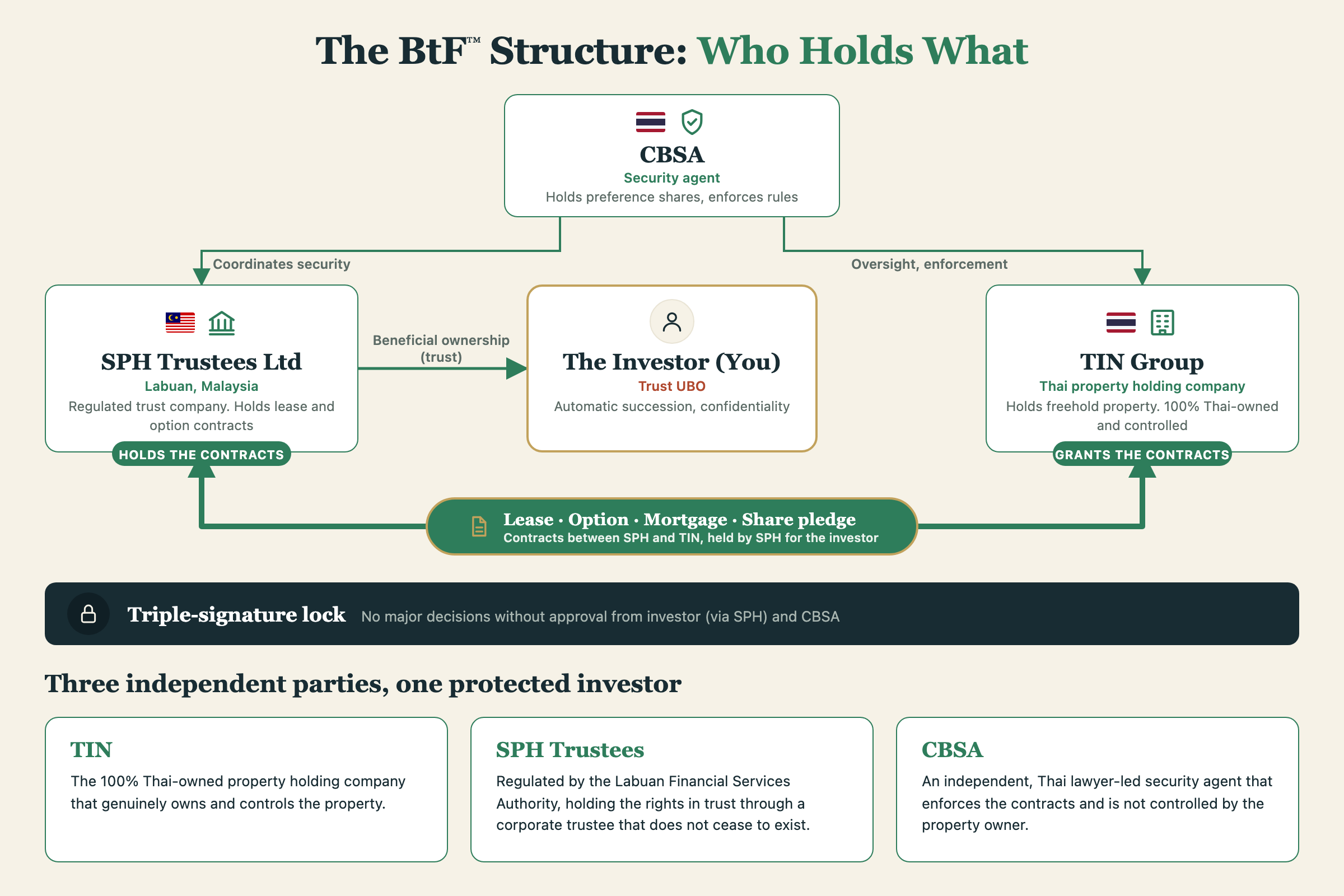
Onshore · Thailand · 100% Thai-owned property holding and management company
Offshore · Labuan, Malaysia · FSA licence in progress
Onshore · Thailand · Thai lawyer-led security agency
Offshore · Lending platform for Better-than-Freehold™ packages
All four entities have undergone legal and regulatory review by leading tier-one regional and Thai counsel and a leading global tax advisory firm (tax review), supported by bespoke cover issued by Thai public listed insurers.
A standard lease involves one agreement. Better-than-Freehold™ uses four interconnected contracts that operate simultaneously between the property owner (Lessor) and the leaseholder (Lessee). Each has its own legal standing, registration, and ways to resolve issues.
Holds legal title to the property; grants the lease and option
Holds the lease, option rights, and security positions on behalf of the investor
Holds enforcement rights for both parties. Triggers structural remedies, controls option execution, and is the first point of dispute settlement, with THAC arbitration as the backstop. Mortgage enforcement still requires a Thai court.
In development; first loan products expected from H1 2027. When live, would take additional security over the lease and option package offshore, alongside the security held by the trust.
These four instruments are distinct and non-interchangeable. Each addresses a different risk that typical property structures often overlook. Each has its own registration, remedies, and objective. Together, they create a strong security package that turns a simple lease into a secure investment.
The foundational instrument. Registered with the Thai Land Office under standard Land Code provisions. Grants the Lessee the right to use, possess, and benefit from the property for the term. Survives changes in beneficial ownership of the trust because the Lessee, the trust company, does not change. The premium and term are recorded on the title.
A contract appended to the registered mortgage that runs in parallel to the lease. Sets out the agreed contractual Year-30 arrangements, including negotiation of a new lease on known terms, sale to a legally qualified purchaser, or refund of the option premium. Each is framed as a contractual right under Thai contract law, and none requires a pre-locked future premium, the feature that has failed in court for prepaid renewals.
Registered at the Land Office in favour of the trust over the property itself, providing an additional security layer. The initial mortgage amount is set case by case and may increase over time. In the event of default, insolvency, or attempted disposition by the Lessor, the mortgage may provide remedies against the property directly, ahead of unsecured creditors of the Lessor.
Granted in favour of the trust over 100% of the shares of TIN's holding company. Provides a corporate-level remedy in addition to the property-level remedy of the mortgage. If the property cannot be reached for any reason, the share pledge enables the trust to take control of the asset-holding entity itself, preserving the Lessee's position.
Many ownership structures start strong and weaken over time. Better-than-Freehold™ is designed to maintain consistent performance throughout its entire lifespan, with clear actions defined for every major event, including events that typical leases handle poorly or not at all.
TIN acquires the property at the Land Office. The lease and mortgage are registered, with the Option Agreement appended to the mortgage, and the share pledge is executed. The trust is settled.
The investor has full use and benefit through a sub-licence from the trust. Annual compliance review keeps the structure aligned. Beneficial interest can be assigned offshore without Land Office re-registration; tax treatment depends on the investor and current law.
Beneficial interest in the trust is reassigned to nominated heirs. The Land Office sees no change in the registered Lessee. No probate, no re-registration battle.
The investor or their heirs choose: negotiation of a new lease on known terms, sale to a legally qualified purchaser, or refund of the option premium, as set out in the Option Agreement.
If any party fails to perform, CBSA triggers structural remedies. CBSA is the first point of dispute settlement, with THAC arbitration as the backstop. Mortgage and pledge can then be enforced, and enforcing the mortgage still requires a Thai court.
Thai courts carefully examine foreign property structures. Better-than-Freehold™ is built to meet these legal tests directly, not to avoid them. Each of the four principles below is a key area a Thai court would review, and the structure is designed to pass each one.
Thai courts look at who really controls an asset, not what the paperwork claims. Nominee structures fail this test because the substance, foreign control, contradicts the form, Thai shareholders. Better-than-Freehold™ aligns substance and form: TIN genuinely owns and operates the property as a Thai entity, and the foreign investor genuinely holds contractual rights, not hidden ownership.
Applied through the Civil and Commercial Code and reinforced under the 2026 enforcement regime.
Thai contract law renders agreements unenforceable where they contravene national policy, including the policy that foreign control of land is restricted. Better-than-Freehold™ does not seek to circumvent this policy. It works within it by separating use rights and economic benefit (which foreigners may legally hold under contract) from ownership and control of the land itself (which they may not).
Civil and Commercial Code, public interest doctrine.
Rather than relying on corporate structures that the Foreign Business Act regime is now actively dismantling, Better-than-Freehold™ relies on registered rights under the Thai Land Code: leases, mortgages, and pledges. These instruments are foundational, well-tested, and used daily by Thai banks and major Thai corporates. Their enforceability is not in question.
Thai Land Code lease provisions, Civil and Commercial Code mortgage and pledge provisions.
Labuan trust law, drawn from English common law and adapted for international wealth management, recognises the separation of legal and beneficial ownership. SPH Trustees holds legal title to the lease, option, and security positions; the investor holds the beneficial interest. The trust does not die when the investor does, eliminating the catch-22 that destroys personal-name leases on death.
Labuan Trusts Act, Labuan Financial Services Authority regulation.
Many complex structures marketed to foreign buyers rely on offshore companies holding minority interests in Thai land-owning entities. The Ministry of Commerce has clearly stated that the 2026 reforms aim to eliminate these structures. Better-than-Freehold™ employs an entirely distinct architectural philosophy.
| Feature | Better-than-Freehold™ | Collective-control structures |
|---|---|---|
| Legal strategy | Asset security under registered Land Code rights - lease and mortgage | Corporate control through proxy or cross-holding shareholding arrangements |
| 2026 FBA reform exposure | Zero - no nominee company; the Lessor is a high-capital, compliant Thai entity | High - explicitly targeted by the proposed circular-ownership and look-through definitions |
| Enforcement protection | Registered first-priority mortgage is designed to prevent administrative seizure without a court order | None - the underlying land may be subject to forced sale under the Land Code, and the shareholding to court-ordered cessation under FBA s.36 |
| Succession | Automatic offshore reassignment of beneficial interest | Complex - requires transfer of offshore shares and management of the Thai company |
| Validity of underlying lease | Independent of the Lessor's corporate structure | Dependent on the Lessor surviving FBA enforcement |
Every row reflects a specific legal, contractual, or regulatory position, not a marketing claim.
Register free and tell us where you stand. You'll get your choices and an indicative quotation, with support at hand if you need us.
Free · No obligation · Your decision at every stage