
Nominee Structure Conversion: Legal Process Thailand
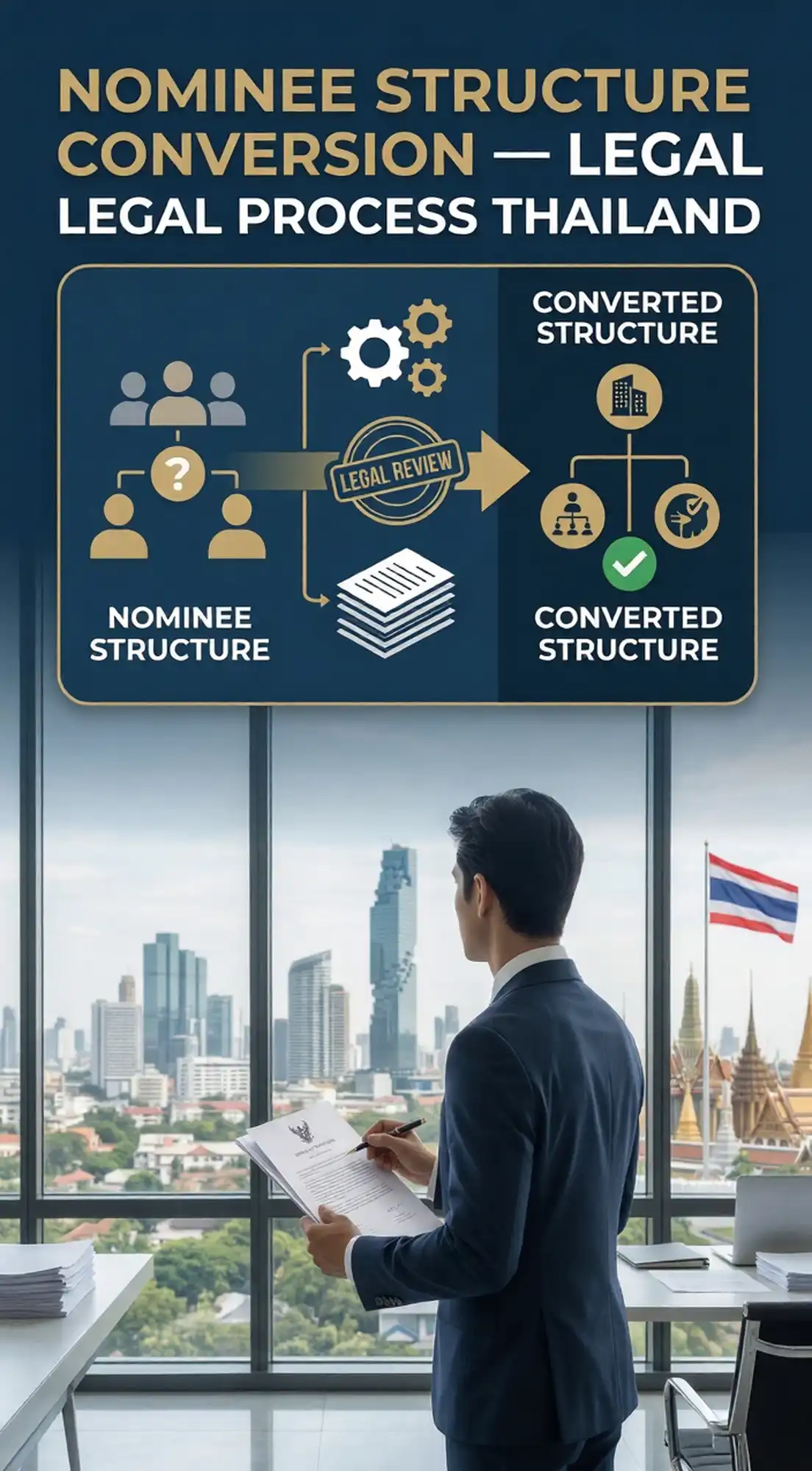
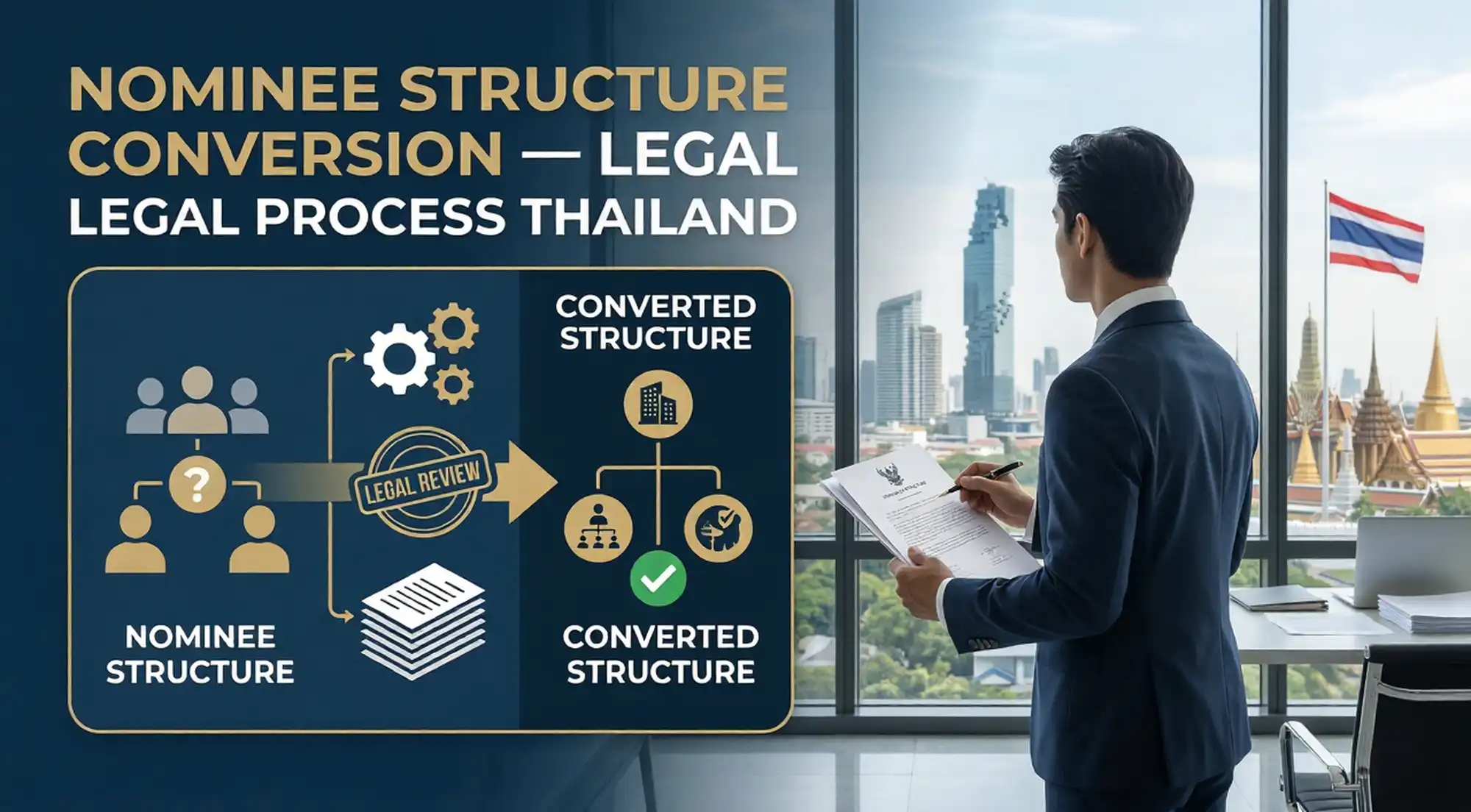
Step-by-step guide to converting nominee company structures to compliant Better-than-Freehold™ alternatives. Timeline, process, costs, and what happens during conversion.
How to Move From an Illegal Nominee Company to a Compliant Structure Before Enforcement Reaches You #
Key takeaways
- Nominee structure conversion is designed to avoid criminal exposure by replacing illegal Thai shareholders with a genuinely independent entity, supporting AMLA compliance through documented source of funds and KYC records rather than concealing control mechanisms.
- The conversion process follows four core legal steps typically spanning eight to sixteen weeks (expected to reduce to under four weeks as Better-than-Freehold™ grows), including due diligence, shareholder removal, Articles of Association amendment, and registration of the lease and mortgage at the Land Office.
- The single biggest blocker is nominee cooperation, because existing Thai shareholders must provide signed transfer documents; investors who delay conversion risk nominees asserting ownership rights that Thai courts consistently uphold.
- Better-than-Freehold™ gives the converted structure registered security and independent enforcement. Lending through SPH Trustees is a future workstream, expected from H1 2027 and not yet live, so conversion costs should be planned as an upfront outlay.
- Conversion Process Overview
- Why Conversion Cannot Wait
- The Four Core Legal Steps
- The Nominee Cooperation Problem
- Due Diligence and Documentation
- Tax Considerations
- Better-than-Freehold™ Solution
- FAQ Section
- Related Terms
- Expert Recommendations
What does nominee structure conversion involve, and why is it urgent? #
Nominee structure conversion is the legal process of removing the Thai shareholders who hold shares for the benefit of a foreign investor from a company that holds property, and replacing that control with a registered lease and a registered first-priority mortgage, with the Option Agreement appended to the mortgage, plus a share pledge, all held by SPH Trustees Ltd for the investor. In 2025 the DBD set an inspection target list of 46,918 high-risk companies.
Conversion Process Overview #
| Phase | Activity | Timeline |
|---|---|---|
| Due diligence | Land Office title verification; company balance sheet review at DBD | 1 to 2 weeks |
| Documentation | AML checks, trust application, tax clearance, and share transfer preparation | 2 to 4 weeks (concurrent) |
| Execution Day 1 | Nominee shares transferred to TIN; director changed; Articles of Association amended at DBD | 1 day |
| Execution Day 1 to 2 | Lease registered at Land Office; mortgage registered in favour of SPH Trustees with the Option Agreement appended | 1 to 2 days |
| Tax clearance completion | Foreign shareholder shares transferred to TIN; promissory notes cancelled | On clearance |
Why Conversion Cannot Wait #
Every day a foreign investor remains in a nominee structure, the risk of detection increases. The DBD Biz Regist platform now maintains centralised digital records for every registered company, cross-verified with Revenue Department tax filings in real time. AI pattern recognition flags high-risk indicators, including the same passive Thai shareholders appearing across multiple companies, tax mismatches, and disguised management fee structures.
What happens if you do nothing? #
Thai courts consistently rule against foreign investors in nominee disputes. Any agreement between a nominee company and its nominee shareholders, including pre-signed share transfer forms, can and will be voided by the courts. Thai Supreme Court jurisprudence consistently upholds Thai nominees as legal shareholders and has not recognised the foreign investor's position in established nominee disputes. The foreign investor's property asset is, in legal terms, entirely in the hands of the nominee shareholders.
Separately, DBD Order 2/2568 (effective 1 January 2026) tightened registration, and Central Registrar Order 2/2569, which replaced DBD Orders 2/2568 and 1/2569 from 1 August 2026, keeps the three-month Thai shareholder bank statements at incorporation. It does not extend source-of-funds proof to every later change, but adding a foreign authorised director to an all-Thai board needs a written investment letter, and a company incorporated on or after 1 August 2026 that changes directors within one year must show its registered capital was received. The conversion window is narrowing from both directions: enforcement is accelerating whilst the regulatory barriers to restructuring are increasing.
The Four Core Legal Steps #
The conversion follows a defined four-step process that transforms an illegal nominee structure into a compliant Better-than-Freehold™ framework.
What are the four steps? #
Step one: remove nominee Thai shareholders from the company. This requires the nominees to provide signed share transfer forms, signed share sale and purchase agreements, signed acknowledgement of the foreign investor's loan, and authority to pay share sale proceeds.
Step two: amend the Articles of Association. Clear Blue Security Agents (CBSA) pays for and subscribes to a preference shareholding of 0.1% to 1% in the TIN holding company, which lets it exercise its rights and veto reserved matters set out in the Master Security Agreement and the Articles of Association, and any foreign shares are converted to non-voting. This structural amendment is registered at the DBD.
Step three: Change the company director to TIN (Thailand Investor Network). Once TIN holds 51% with independent voting control, the Articles of Association are amended, and all security instruments are in place, the structure is designed to satisfy FBA compliance requirements.
Step four: put the security in place. A 30-year lease is registered at the Land Office, a first-priority mortgage is registered in favour of SPH Trustees with the Option Agreement appended to it, and a share pledge over 100% of the ordinary shares in TIN's holding company is granted in favour of SPH Trustees.
The Nominee Cooperation Problem #
The single biggest anticipated blocker is tracking down and obtaining cooperation from existing Thai nominees. This is the practical reality that many investors underestimate, and the reason why early action is critical.
Why are nominees becoming harder to manage? #
Multiple sources now report that nominees themselves are turning on foreign investors, demanding additional benefits or asserting control, with investors having no legal recourse. A nominee who recognises the enforcement environment might reasonably conclude that cooperation carries more risk than assertion. If a nominee refuses to sign transfer documents, the foreign investor has no legal mechanism to compel them, because the nominee is, under Thai law, the legitimate shareholder.
Structural modifications cannot eliminate fundamental compliance violations. Thai courts apply "substance over form" analysis; enhanced documentation or revised shareholding percentages do not address the underlying illegality. The only solution is complete structural conversion.
Due Diligence and Documentation #
Conversion requires two parallel due diligence tracks before execution can proceed.
What due diligence is required? #
Land Office due diligence verifies the title, access rights, and building permits. This typically takes one day. Company due diligence reviews balance sheets at the DBD; companies with 3 to 4 years of filing arrears risk cancellation by the DBD, which can take 1 to 2 years to resolve through the courts. Overall, due diligence spans 1 to 2 weeks. Because that complexity drives both fee and duration, our guide to what actually drives divestment costs and timelines explains why a high-risk property-owning company carrying outstanding debt, multiple Thai shareholders, or incomplete records commonly runs to sixteen weeks rather than eight, and why no adviser can quote a fixed price before reviewing the existing structure.
Owner documentation requirements include: AML documents (passport/ID, proof of address within 3 months, source of funds declaration), a trust application form completed online and returned to SPH Trustees, tax documents for Thai Revenue Department clearance, share transfer documents, a shareholder agreement to change the Articles of Association, a share pledge to SPH Trustees, and a director resignation letter.
Tax Considerations #
Thai resident versus non-resident status must be established early in the conversion process, because non-residents face withholding tax obligations that may require tax clearance spanning 4 to 6 weeks.
What if tax clearance cannot be obtained? #
An Employee Benefit Trust (EBT) is one example of a mechanism that can provide an alternative pathway where standard tax clearance is not achievable. Once the investor is on the trust platform, beneficial interest assignments may reduce immediate Land Office transfer tax exposure; however, tax treatment is subject to Thai Revenue Department interpretation, and independent professional tax advice is essential.
Better-than-Freehold™ Solution #
The conversion outcome is a Better-than-Freehold™ structure structured in accordance with the applicable Thai legal and regulatory frameworks, providing registered security and independent enforcement, neither of which existed under a nominee structure.
What does the Better-than-Freehold™ structure deliver post-conversion? #
Security mechanisms include a registered 30-year lease with contractual year-30 mechanisms, a first-priority registered mortgage with the year-30 Option Agreement appended to it, a share pledge over the ordinary shares in the TIN holding company, granted in favour of SPH Trustees Ltd, and CBSA as security agent, which mediates and enforces, with mortgage enforcement still requiring a Thai court as the last resort.
SPH Trustees Ltd accepts and manages security rights, then distributes them to individual investors, whilst providing asset protection and confidentiality. Security rights, such as share pledges and security agent rights, cannot be shared between multiple investors without this intermediate trust structure.
Offshore financing through Siam Venture Capital is being developed as a future workstream, with lending up to 50% loan-to-value secured by trust assets expected from H1 2027. Until then, conversion costs should be planned as an upfront outlay.
Free to start · No obligation · Your decision at every stage
FAQ Section #
Related Terms #
- Nominee Company Risks Thailand 2025: Criminal prosecution and penalties for illegal nominee structures under current enforcement
- What is Better-than-Freehold™: Definition and legal guide to the compliant leasehold and security framework
- Anti-Money Laundering Act Thailand: AMLA compliance framework and gatekeeper obligations
- DBD Order 2/2568: Registration-stage source-of-funds rules, since consolidated into Central Registrar Order 2/2569
Expert Recommendations #
Nominee structure conversion is the most time-sensitive compliance action available to foreign property owners in Thailand. The enforcement environment is accelerating, nominee cooperation is becoming harder to secure, and regulatory barriers to restructuring are increasing.
Professional Guidance Essential #
The conversion process requires coordinated legal, tax, and corporate expertise spanning Thai and offshore jurisdictions. Attempting conversion without professional coordination risks triggering enforcement scrutiny, creating tax liabilities, or losing nominee cooperation at critical execution points.
Immediate Action Required #
Every week of delay increases three risks simultaneously: enforcement detection through the DBD Biz Regist platform and AI screening, nominee non-cooperation as Thai shareholders recognise their leverage, and regulatory barriers through Central Registrar Order 2/2569's documentation requirements at incorporation and on director changes. In July 2026, the Ministry of Commerce reported that police economic crime investigators had taken legal action against 2,257 suspected nominee entities referred by the Department of Business Development; the enforcement pipeline is busy.
Long-term Security Strategy #
Better-than-Freehold™ is a conversion pathway delivering registered security interests, structured to support AMLA compliance. The structure is designed to avoid vulnerabilities inherent in nominee ownership whilst providing investment advantages that the nominee model never offered.
If you're considering Thai property investment, or already hold property through a nominee structure, find out whether Better-than-Freehold™ is right for your situation.
Free to start · No obligation · Your decision at every stage
Conclusion #
Nominee structure conversion is not a future planning exercise; it is an immediate compliance necessity. The combination of AI-driven enforcement, inter-agency coordination, nominee instability, and tighter registration rules through Order 2/2568, now carried forward by Central Registrar Order 2/2569, creates an environment where delay compounds risk from every direction.
The conversion process is set out in four defined steps. Expected to span eight to sixteen weeks, they are designed to move an illegal nominee structure into a compliant Better-than-Freehold™ framework providing registered security and independent enforcement.
The only variable is nominee cooperation, and that window is closing. Foreign investors who act now retain the ability to negotiate with nominees from a position of relative strength. Those who wait risk nominees asserting ownership, enforcement agencies investigating, and regulatory barriers preventing restructuring entirely.
This article is provided for general information only and does not constitute legal, tax, or investment advice. Laws and enforcement practices change; obtain advice tailored to your situation before acting.
About the Author: Andrew Moore FPFS, CDir
Chairman, Better-than-Freehold™

Andrew Moore has been an active investor in Thai property since 2004. He is a Chartered Director and a Fellow of the Personal Finance Society. He has invested in and built properties in several countries since the late 1990s and first invested in Thailand in 2004. Having owned homes in Bangkok, Samui, Phangan and Phuket he can offer a unique perspective on Thailand's property markets together with past and future trends in both ownership and investor opportunities.