DBD Tightens Foreign Business Registration Rules – New Nominee Order Takes Effect April 2026

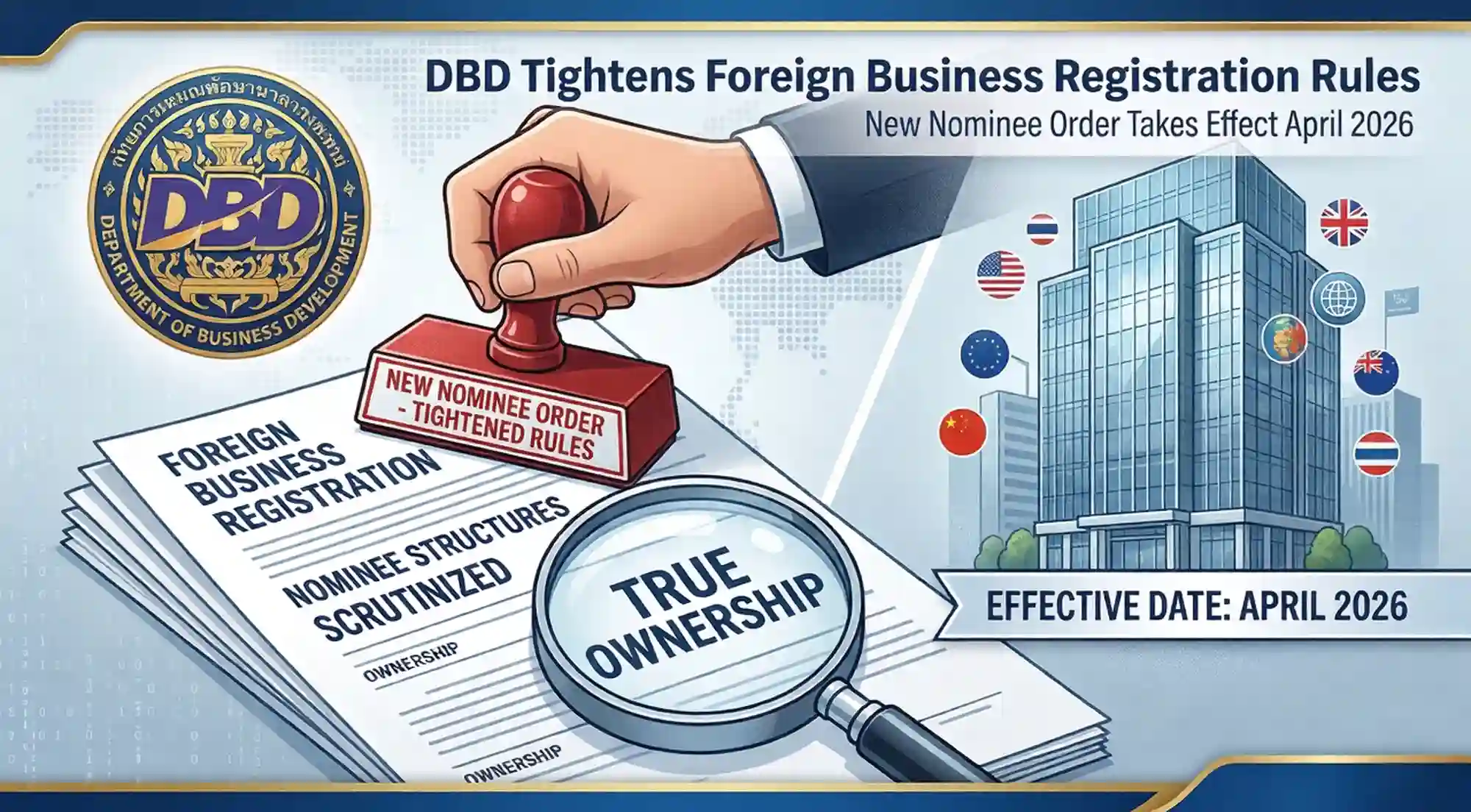
Thailand's DBD is preparing stricter registration rules targeting nominee structures. New order expected mid-March 2026, effective 1 April. What foreign property owners need to know.
DBD Tightens Foreign Business Registration Rules – New Nominee Order Takes Effect April 2026 #
Thailand's Department of Business Development is preparing a follow-up order to close remaining loopholes in nominee company registration, with enforcement beginning 1 April 2026 #
Key Takeaways
- New registration order imminent: The DBD will issue a new order in mid-March 2026, taking effect on 1 April, that further tightens scrutiny of foreign involvement in Thai company registrations.1
- 118,000 companies already flagged: Of 782,542 active companies in Thailand, the DBD estimates that more than 80% of the 118,016 with foreign shareholding between 0.01% and 49.99% might involve nominee structures.1
- Previous order cut registrations by 65%: Order No. 2/2568 (2025), which took effect on 1 January 2026, already reduced new nominee company registrations by over 65%, but circumvention attempts persist.1
- Penalties remain severe: Offenders face up to three years' imprisonment, fines between THB 100,000 and THB 1 million, and daily penalties of THB 10,000–50,000 for ongoing non-compliance.1
What is the DBD's new registration order? #
Quick Answer
Quick Answer: The Department of Business Development is preparing additional registration constraints that will govern how foreigners are added as partners in partnerships or authorised signatories in limited companies. The order builds on the existing financial evidence requirements introduced on 1 January 2026 and is designed to close the loopholes that some applicants have used to circumvent those controls.
- What Happened
- Who Is Affected
- How Does This Connect to Previous Enforcement
- What Does This Mean for Existing Nominee Holders
- How Better-than-Freehold™ Addresses This Risk
- FAQ Section
- Related Terms
- Expert Guidance
What Happened #
The DBD's Director-General, Poonpong Naiyanapakorn, confirmed that the department has completed consultations with more than 17 leading Thai law firms to develop stronger measures targeting nominee structures.1 These consultations focused on identifying practical approaches to prevent Thai nationals from holding shares on behalf of foreign investors in violation of the Foreign Business Act BE 2542 (1999).
The resulting order will establish new rules and procedures for registration in cases involving amendments to designate foreigners as partners or authorised signatories.1 The DBD expects to issue the order in mid-March 2026, with enforcement commencing on 1 April 2026.1
Poonpong stated that nominee structures represent a significant threat to Thailand's business competition framework, making it necessary to strengthen supervisory mechanisms and coordination between public and private sector agencies.1
Who Is Affected #
The scale of the problem is substantial. Thailand currently has 782,542 active companies. Of these, 118,016 are classified as Thai companies despite having foreign shareholding ranging from 0.01% to 49.99%.1 The DBD's own estimate suggests that more than 80% of these entities might involve Thai shareholders holding shares on behalf of foreign investors, effectively operating as nominee structures.1
This means the department is looking at potentially 94,000+ companies that might be operating outside the law, and at this stage, only those that are the simplest to identify. Foreign property owners, investors, and business operators who rely on Thai company structures to hold assets are directly in the crosshairs of this expanded scrutiny.
The new rules will apply to anyone seeking to amend company registrations to add foreign partners or signatories, but the practical effect extends far beyond new registrations. Existing companies seeking any form of corporate amendment, including share transfers, director changes, or capital restructuring, will face the same enhanced scrutiny.
How Does This Connect to Previous Enforcement #
This new order is the next step in an escalating enforcement campaign. The DBD previously issued Order No. 2/2568 (2025), which took effect on 1 January 2026 and required applicants to submit financial evidence, including bank statements, when registering companies with foreign involvement.1
That order produced immediate results, reducing new nominee company registrations by more than 65%.1 However, the DBD acknowledges that attempts to circumvent these requirements continue, which is precisely why additional measures are now being prepared.1
The broader enforcement context is equally significant. Thailand has now initiated 29,000+ legal cases for nominee violations, with 852 companies prosecuted across 2025–2026. The DBD's digital Biz Regist platform uses AI-driven pattern recognition to flag high-risk corporate structures, cross-referencing shareholder data with Revenue Department tax filings in real time. Nationally, 46,918 entities have been identified for investigation under the expanded screening criteria that capture companies with foreign shareholding as low as 0.001%.
The consultation with 17 law firms signals that the DBD is not operating in isolation. The department is actively seeking private sector input to ensure its measures are both effective and enforceable, whilst ensuring that genuine foreign investment is not obstructed.1
What Does This Mean for Existing Nominee Holders #
This is where the second-order consequences demand attention. The new order does not simply affect future registrations. Anyone currently operating through a nominee structure faces a tightening regulatory environment where every corporate transaction triggers enhanced scrutiny.
Consider the practical implications. If a foreign investor currently holds property through a Thai company with nominee shareholders and needs to transfer shares, change directors, or restructure capital, the new registration requirements will apply to those amendments. The financial evidence requirements introduced under Order No. 2/2568 already made this difficult; the forthcoming order will make it harder still.
The penalties for those caught are not theoretical. Under Sections 36 and 37 of the Foreign Business Act, Thai nationals who assist nominee structures and foreigners operating without permission face imprisonment of up to three years, fines between THB 100,000 and THB 1 million, or both.1 Courts might also impose daily fines of THB 10,000 to 50,000 until the violation ceases.1
Separately, the same tightening of registration rules retrospectively constrains nominees already on the share register of existing companies. Any transfer of shares or sale of the company is now subject to the same capital requirement and proof tests that apply to new registrations. In practical terms, this locks existing nominee structures in place, making them progressively harder to unwind through conventional corporate mechanisms.
How Better-than-Freehold™ Addresses This Risk #
The escalating enforcement environment makes compliant ownership structures essential rather than optional. Better-than-Freehold™ provides a framework that operates entirely independently of the nominee model, eliminating the registration risks that the DBD's new order targets.
Unlike nominee structures, Better-than-Freehold™ uses genuine Thai ownership through its commercial partnership with Thailand Investor Network (TIN), combined with registered contracts at the Land Office that protect the foreign investor's economic interests. Because the structure does not rely on foreign shareholders holding equity through Thai nominees, it falls entirely outside the scope of both Order No. 2/2568 and the forthcoming April 2026 order.
The structure also provides access to offshore financing at up to 50% LTV, registered security through Clear Blue Security Agents (CBSA) as an independent enforcement agency, and a conversion pathway from existing nominee structures that can typically be completed within 6–8 weeks.
For foreign property owners currently exposed to the tightening registration environment, the window to convert to compliant structures is narrowing. Each new DBD order adds additional constraints that make conventional exit strategies, including share transfers and corporate restructuring, more difficult and more visible to enforcement agencies.
FAQ Section #
When does the new DBD registration order take effect?˅
The DBD expects to issue the order in mid-March 2026, with enforcement commencing on 1 April 2026.
How many companies are potentially affected?˅
The DBD identifies 118,016 active Thai companies with foreign shareholding between 0.01% and 49.99%. The department estimates that more than 80% of these, approximately 94,000 entities, might involve nominee structures.
What penalties apply to nominee company violations?˅
Under the Foreign Business Act, offenders face up to three years' imprisonment, fines between THB 100,000 and THB 1 million, or both. Courts might impose daily fines of THB 10,000–50,000 until the violation ceases.
Did the previous DBD order (Order No. 2/2568) reduce nominee registrations?˅
Yes. The financial evidence requirements introduced on 1 January 2026 reduced new nominee company registrations by more than 65%, according to the DBD Director-General.
Does this new order affect existing companies or only new registrations?˅
Whilst the order targets registration procedures, any existing company seeking corporate amendments, including share transfers, director changes, or capital restructuring, will face the same enhanced scrutiny.
How does Better-than-Freehold™ avoid these registration constraints?˅
Better-than-Freehold™ operates through genuine Thai ownership with registered contracts protecting the foreign investor's interests. It does not use nominee shareholders, placing it entirely outside the scope of DBD nominee enforcement.
What should foreign property owners in nominee structures do now?˅
Foreign property owners should seek professional advice on converting to compliant structures before the 1 April 2026 enforcement date. The Better-than-Freehold™ conversion process typically takes 6–8 weeks.
Will the new order affect genuine foreign investment in Thailand?˅
The DBD has stated that enforcement will not obstruct genuine investment or place excessive burdens on the business sector. The measures specifically target structures where Thai nationals hold shares on behalf of foreigners.
Related Terms #
- Nominee Company Risks - Criminal prosecution and penalties for illegal nominee structures in Thailand
- AMLA 2025 Amendments - Enhanced enforcement and compliance requirements affecting property ownership
- DBD Company Investigations Thailand - How the Department of Business Development identifies and investigates suspect companies
- Better-than-Freehold™ Definition - The compliant ownership framework that eliminates nominee risk
Expert Guidance #
Foreign property owners and investors operating through Thai company structures should treat this announcement as an immediate signal to review their compliance position. The DBD's consultation with 17 law firms and the rapid timeline from announcement to enforcement (mid-March order, 1 April commencement) indicates that this is not a distant policy discussion but an operational enforcement measure.
Immediate Action Required #
Professional advice on converting to compliant structures such as Better-than-Freehold™ should be sought before the new order takes effect. Contact the Better-than-Freehold™ advisory team for a confidential compliance assessment.
Long-term Security Strategy #
Better-than-Freehold™ provides the only comprehensive compliance framework ensuring AMLA adherence, registered security interests, and offshore financing access, without requiring any corporate structures that trigger DBD registration scrutiny or ongoing investigation exposure.
Conclusion #
The DBD's forthcoming registration order represents the next phase in Thailand's systematic elimination of nominee structures. Building on the 65% reduction achieved by Order No. 2/2568, the April 2026 measures will further constrain the ability of foreign investors to register or amend companies using Thai nominee shareholders. With 118,016 companies already flagged and enforcement technology identifying patterns in real time, the operational reality for anyone relying on nominee structures has fundamentally changed.
References #
Legal Disclaimer
This article is for informational purposes only and does not constitute legal advice. Nominee structure enforcement and Thai property law are complex and subject to change. For specific guidance regarding individual circumstances, consult qualified legal professionals familiar with Thai property law and Better-than-Freehold™ compliance solutions.
Footnotes #
About the Author: Andrew Moore

Andrew Moore has been an active investor in Thai property since 2004. He is a Chartered Director and a Fellow of the Personal Finance Society. He has invested in and built properties in several countries since the late 90's and first invested in Thailand 20 years ago. Having owned residencies in Bangkok, Samui, Phangan and Phuket he can offer a unique perspective on the island's property markets together with past and future trends in both ownership and investor opportunities.