
Krabi 'Ghost Office' Raid Exposes 500+ Nominee Companies Across Southern Thailand
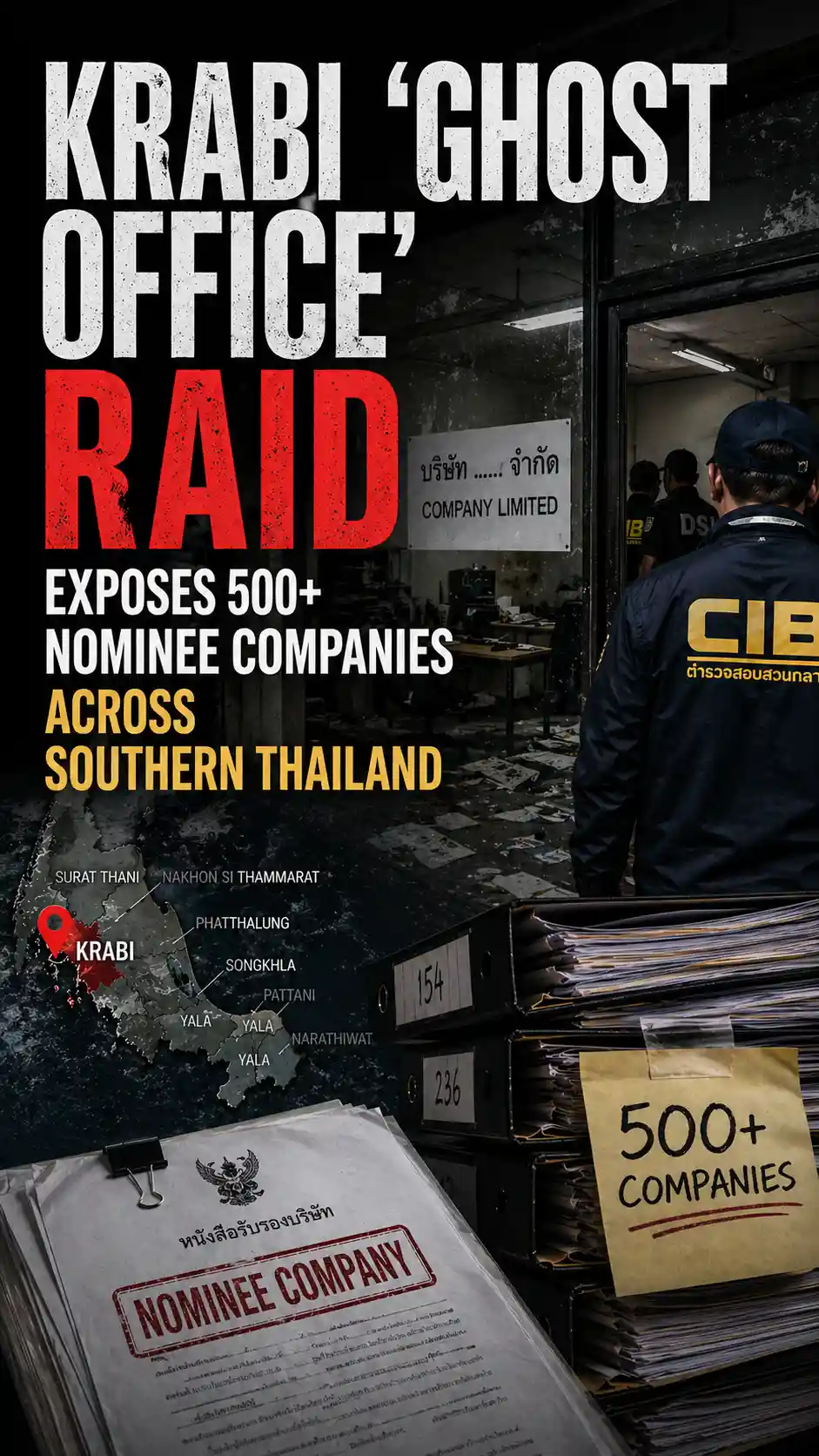
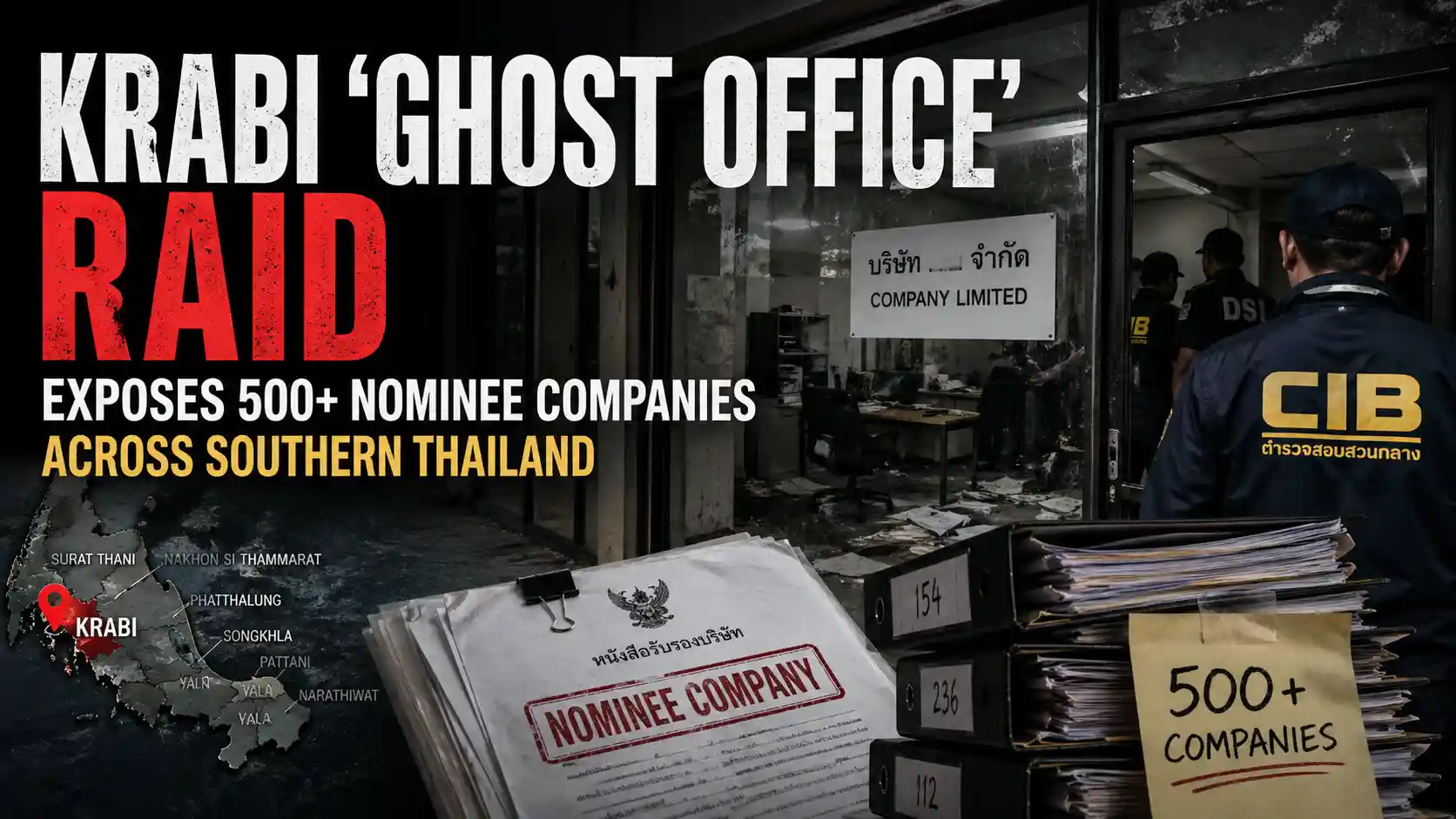
A Krabi police raid has exposed a nominee network of 500+ firms across Krabi, Phuket and Surat Thani, with a staged 'ghost office' and accounting firm at its centre.
Krabi "Ghost Office" Raid Exposes 500+ Nominee Companies Across Southern Thailand #
Police uncover staged office with non-operational computers and 100+ company nameplates as accounting firm at centre of southern nominee network is dismantled #
Police in southern Thailand have raided an accounting firm at the centre of a nominee company network linking more than 500 firms across Krabi, Phuket and Surat Thani, with operational reach extending to Pattaya, Bangkok and Chiang Mai, in what authorities describe as a major breakthrough against illegal foreign business structures.1 The 25 April 2026 operation seized extensive registration documentation and exposed a staged "ghost office" complete with non-operational computers and over 100 company nameplates, apparently set up to mislead inspections.1
Key takeaways
- Police seized documents linking more than 500 firms across Krabi, Phuket and Surat Thani, with extended links to Pattaya, Bangkok and Chiang Mai, in a coordinated raid on an accounting firm allegedly registering companies for foreign nationals using Thai nominees.1
- A staged "ghost office" on the second floor of a building was exposed, fitted with non-operational computers and over 100 company nameplates, with a single address used to register at least six companies as part of a wider three-province network.1
- Charges being pursued include foreign business operations violations, nominee structures, labour offences and tax violations, with two Thai nationals detained as nominees and an Israeli national arrested in a separate but related strand of the investigation.1
- Better-than-Freehold® provides a fully compliant ownership structure that eliminates nominee exposure entirely, ensuring AMLA compliance whilst maintaining secure, registered property rights and access to offshore financing up to 50% LTV.
What Did the Krabi Police Raid Uncover? #
- What Did the Krabi Police Raid Uncover?
- What Happened
- Why the "Ghost Office" Matters
- Who Is Affected
- Legal and Compliance Context
- What Happens Next
- How Better-than-Freehold® Addresses This Enforcement Environment
- FAQ Section
- Related Terms
- Expert Guidance
What Happened #
According to Pattaya Mail, the operation targeted an accounting firm accused of illegally registering companies for foreign nationals using Thai citizens as nominee shareholders. Investigators found that the firm used a single address to register at least six companies, all linked within a wider network spanning three provinces.1 Authorities seized extensive documentation tied to the establishment of hundreds of such entities, alongside evidence suggesting assistance provided to foreigners to work and reside in Thailand unlawfully.1
The most striking discovery was a so-called "ghost office" set up on the second floor of a building. The space had been staged to resemble a functioning workplace, complete with non-operational computers and over 100 company nameplates, apparently intended to mislead inspections.1 The configuration tracks closely with patterns the Department of Business Development has flagged as high-risk indicators under its updated registration framework.
In a related strand of the investigation, immigration police from Region 3 arrested an Israeli national believed to be part of the network. The suspect had registered a business under the guise of offering makeup and nail services, but investigators allege the operation was actually involved in producing and distributing explicit content via the OnlyFans platform.1 Authorities also coordinated with police in Mae Sot to detain two Thai nationals suspected of acting as nominees to help establish multiple companies for foreign clients.1
Police described the operation as a major breakthrough against nominee networks in southern Thailand, noting that similar crackdowns are intensifying in Pattaya, Bangkok and Chiang Mai as authorities expand efforts to dismantle illegal business structures nationwide.1
Why the "Ghost Office" Matters #
The staged office is not an incidental detail. It is the operational infrastructure that the Department of Business Development's recent registration tightening was specifically designed to detect and prevent.
DBD enforcement guidance issued earlier in 2026 introduced what officials have termed the "Rule of Five" for office addresses: where five or more companies are registered at a single address, the address triggers an automatic red flag. Registrants under the new regime must provide a formal letter of consent from the property owner, detailed floor plans, and clear evidence that they have the right to use the space. The Krabi raid demonstrates exactly the practice the rule was written to defeat - at least six companies registered to a single ghost address, with over 100 nameplates apparently maintained at one location to provide superficial cover for far more.
The implication for foreign investors is stark. Many existing nominee structures rely on shared addresses provided by accounting firms or corporate service providers. Those addresses are now the easiest single signal for AI-driven detection systems to flag, and for physical inspections to confirm. Once an address is compromised, every company registered at it inherits the exposure regardless of the legitimacy of any individual entity.
Who Is Affected #
Three constituencies face immediate exposure following the Krabi raid.
The first is foreign nationals using or considering nominee structures across southern Thailand. The geographic footprint of the network spans Krabi, Phuket, Surat Thani, Pattaya, Bangkok and Chiang Mai, with police explicitly signalling that similar operations are intensifying in those locations.1 The southern tourist corridor, including Koh Samui, Koh Phangan, Phuket and Krabi, has been the focus of sustained enforcement throughout 2025 and 2026.
The second is accounting firms, law offices and corporate service providers that establish or maintain nominee companies. The Krabi accounting firm at the centre of this case is precisely the type of professional facilitator that government policy now treats as a primary target rather than an incidental party. Where a single firm registers hundreds of companies through nominee structures, prosecutors can pursue the firm and its principals directly under the Foreign Business Act and AMLA, alongside the underlying clients.
The third is Thai nominees themselves. The two Thai nationals detained in Mae Sot, suspected of acting as nominee shareholders for multiple companies, illustrate that the criminal exposure runs in both directions. Thai nominees face the same penalties as the foreign principals they front for, and recent cases show prosecutors are willing to pursue both sides of the structure.
Legal and Compliance Context #
The conduct alleged in the Krabi raid sits squarely within several overlapping legal frameworks.
Under Section 36 of the Foreign Business Act, foreigners using Thai nominees to circumvent foreign ownership constraints face imprisonment of up to three years, fines of THB 100,000 to 1,000,000, or both. Thai nominees face identical penalties. Where the underlying business is a Schedule 1 prohibited occupation, including land trading, or where the structure has been used to hold real estate beyond legal foreign ownership thresholds, separate violations of the Land Code may also apply.
Under the Anti-Money Laundering Act, where nominee conduct is treated as a predicate offence, penalties escalate to imprisonment up to 10 years, fines reaching 10 million baht, and asset forfeiture under AMLO authority. The expanded inter-agency data sharing announced by the PM's Office on 26 April 2026 means that information seized in operations such as the Krabi raid flows directly to AMLO, the Revenue Department, the Land Department and the DBD for parallel investigation rather than remaining within a single police case file.
The Krabi raid also illustrates the labour and immigration dimension of nominee structures. Where foreign principals operate businesses without proper work permits, or where the underlying business activity is itself unlawful, additional charges accumulate. The Israeli national arrested in the related strand faces exposure across foreign business operations, work permit violations and the substantive offence of unauthorised content distribution.
What Happens Next #
Police described the investigation as ongoing, with efforts focused on tracing financial flows and pursuing charges relating to foreign business operations, nominee arrangements, labour violations and tax offences.1 Three near-term developments are predictable from the announcement and the surrounding enforcement environment.
First, expansion of the documentary trail. Documentation seized from the Krabi accounting firm is sufficient to map every company the firm has registered, every nominee deployed and every foreign principal served. This gives investigators a ready-made list of secondary targets. Each company on that list now sits in the queue for parallel investigation by the DBD, AMLO and the Revenue Department.
Second, continued pressure on the southern corridor. The Koh Samui–Phangan task force established in late 2025 already had over 7,000 suspected nominee businesses under review. The Krabi network adds a fresh tranche, and the explicit reference to intensified operations in Pattaya, Bangkok and Chiang Mai signals that the geographic perimeter is widening rather than consolidating.1
Third, compounding consequences for existing structures. Authorities have warned that further action will follow to close legal loopholes and protect fair business competition.1 For foreign property investors currently holding through Thai company structures, the practical question is no longer whether their structure faces eventual exposure but how much time remains for voluntary restructuring before detection becomes investigation.
How Better-than-Freehold® Addresses This Enforcement Environment #
Better-than-Freehold® is engineered to operate entirely outside the structural risk that the Krabi raid exposes. Because the structure does not rely on foreign equity in a Thai operating company, it does not engage the FBA constraints that nominee structures are designed to circumvent, and it does not depend on accounting firms or corporate service providers to maintain a façade of Thai ownership.
How does the BtF structure remove ghost-office risk? #
The structure separates legal title from contractual rights without creating any Thai company that requires nominee shareholders. Thailand Investor Network (TIN) operates as a genuinely independent Thai entity without foreign funding or control, holding legal title to property. SPH Trustees, a Labuan FSA-regulated trust company, holds the registered lease, option to renew, mortgage and pledge rights on behalf of the foreign investor. Clear Blue Security Agents (CBSA) registers all contracts with Thai authorities and provides independent mediation and enforcement without court dependency. Siam Venture Capital (SVC) provides offshore lending up to 50% LTV.
Because there is no Thai company to register, no nominee shareholder to declare and no shared registration address to flag, the structural triggers that operations like the Krabi raid rely on simply do not exist.
How does conversion from a nominee structure work? #
Existing nominee company holders are now operating in an environment where the documentary infrastructure they relied on is itself being seized and mapped. A managed conversion to Better-than-Freehold® unwinds the nominee company in parallel with establishing compliant title under TIN and registered rights under SPH Trustees. The typical conversion timeline runs 6–8 weeks, and voluntary restructuring is materially less costly than restructuring under investigation or following asset seizure.
Compliance Comparison #
| Feature | Nominee Company | Long-Term Lease Only | Better-than-Freehold® |
|---|---|---|---|
| AMLA compliance | Criminal exposure | Compliant | Fully compliant |
| FBA exposure | Direct violation | None | None |
| Shared-address risk | High (Rule of Five trigger) | None | None |
| Registered security | None | Lease only | Lease, option, mortgage, pledge |
| Independent enforcement | Court only | Court only | CBSA, contract-based |
| Offshore financing | None available | None typically | Up to 50% LTV via SVC |
| Conversion pathway | Severe constraints | Limited extension | Full structure transfer |
FAQ Section #
Related Terms #
- Thailand's "Quick Big Win" Cuts At-Risk Nominee Company Registrations by 60% in Q1 2026 - Government enforcement framework and Q1 2026 measurable results
- DBD Tightens Foreign Business Registration: Nominee Crackdown 2026 - DBD Order No. 2/2568 and the registration regime targeting ghost offices
- Nominee Company Investigation Thailand 2026 - Inter-agency enforcement framework and AMLA exposure
- Nominee Structure Conversion: Legal Process in Thailand - Step-by-step pathway from nominee company to compliant ownership
Expert Guidance #
Immediate Action Required #
The Krabi case shows how quickly investigators can convert a single seized document set into a multi-province enforcement footprint. Foreign investors holding through Thai company structures should assume that the documentary infrastructure their structures rely on is increasingly fragile and increasingly visible. Contact the Better-than-Freehold® advisory team for a confidential compliance assessment before the next phase of enforcement intensifies.
Long-term Security Strategy #
Better-than-Freehold® provides a comprehensive compliance framework that operates outside nominee registration risk: no shared addresses to trigger the Rule of Five, no FBA nominee exposure, registered security interests and offshore financing without the criminal liability that nominee structures carry under current enforcement.
Conclusion #
The Krabi raid is the visible face of an enforcement model that is now mature enough to convert a single accounting firm into a 500-company case file in a single operation. The "ghost office" is the symbol the headlines will carry, but the operational story is the documentary integration that allows a Krabi seizure to drive Phuket, Surat Thani, Pattaya, Bangkok and Chiang Mai investigations simultaneously. "Quick Big Win" at the registration counter, AI pattern recognition in the back office and physical raids on the ground are no longer separate workstreams; they are the same enforcement programme operating at three layers.
For foreign investors, the practical question has shifted from "will enforcement reach my structure?" to "how much time remains to restructure voluntarily before it does?". Better-than-Freehold® exists precisely because Thailand's compliance environment now requires structures engineered to operate outside the framework being tightened, rather than within the constraints being enforced.
If you're considering Thai property investment - or already hold property through a nominee structure - register to watch our free video to see how Better-than-Freehold® addresses these risks: https://app.betterthanfreehold.com/register
References #
This article is provided for general information only and does not constitute legal, tax, or investment advice. Laws and enforcement practices change; obtain advice tailored to your situation before acting.
Footnotes #
About the Author: Andrew Moore FPFS, CDir
Chairman, Better than Freehold

Andrew Moore has been an active investor in Thai property since 2004. He is a Chartered Director and a Fellow of the Personal Finance Society. He has invested in and built properties in several countries since the late 90's and first invested in Thailand 20 years ago. Having owned residencies in Bangkok, Samui, Phangan and Phuket he can offer a unique perspective on the island's property markets together with past and future trends in both ownership and investor opportunities.