
The Four Principal Instruments: How the Securitisation Works
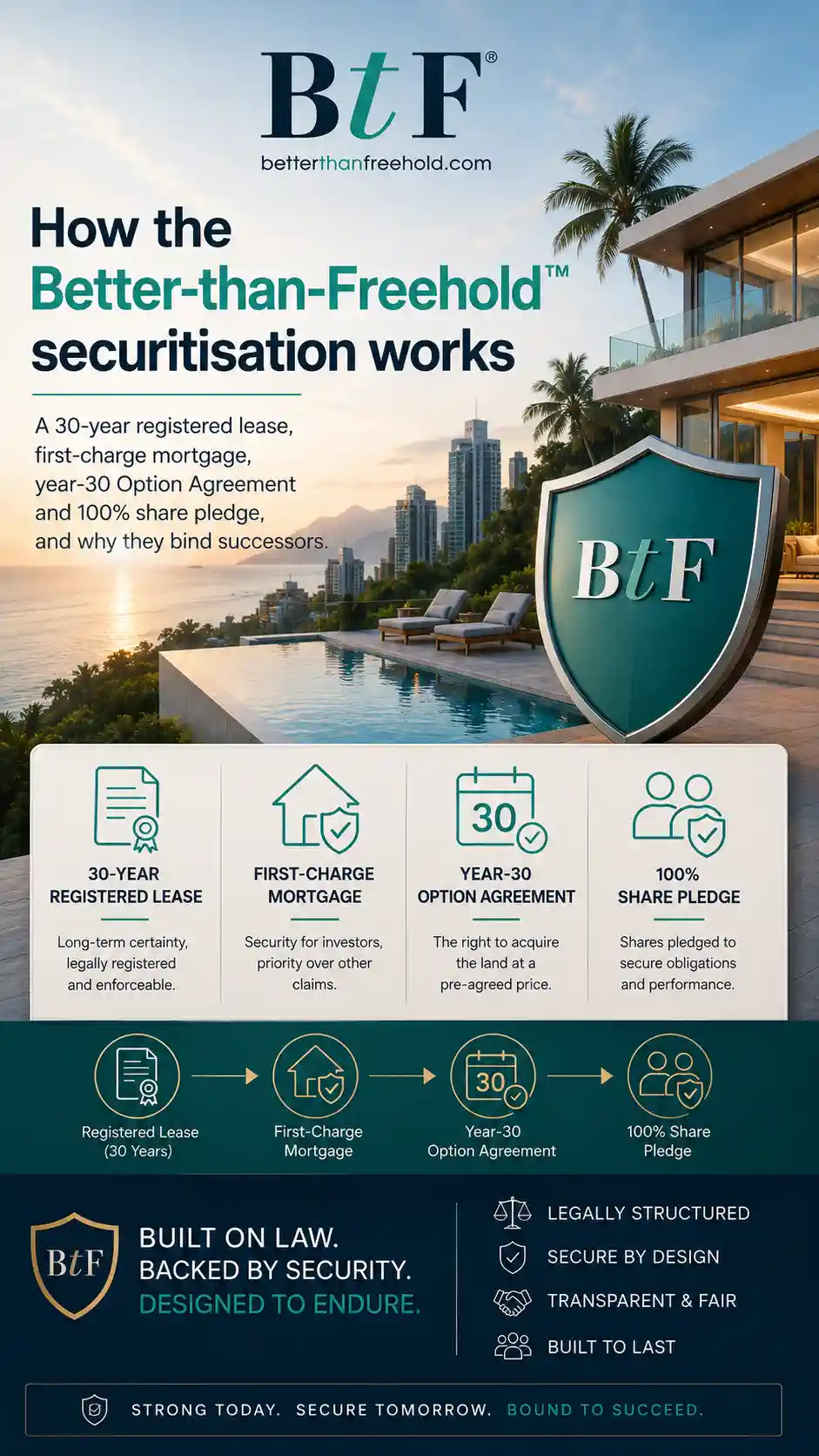
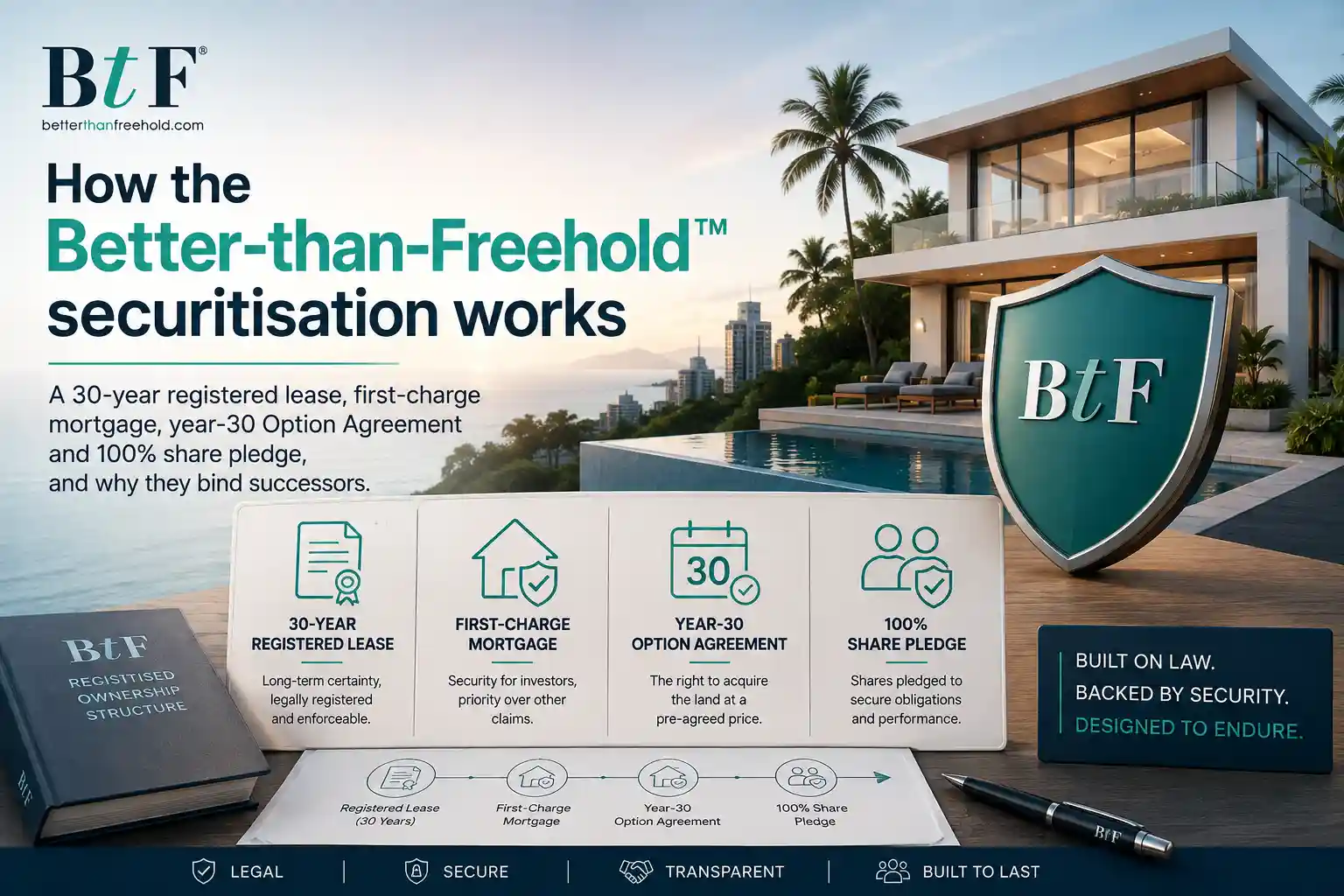
How the Better-than-Freehold™ securitisation works: a 30-year registered lease, first-priority registered mortgage, year-30 Option Agreement and 100% share pledge, and why the registered lease and mortgage bind successors.
How Better-than-Freehold™ layers a 30-year registered lease, year-30 Option Agreement, first-priority registered mortgage, and 100% share pledge into a securitisation stack whose registered lease and mortgage bind successors #
Key takeaways
- Four instruments, four failure points mitigated: the lease, Option Agreement, mortgage, and share pledge each protect a distinct exposure covering use, pathway, asset, and corporate control.
- Registration converts a promise into a real right: the lease and mortgage are recorded at the Land Office, binding on successors rather than only the original signatories.1
- Courts are the last resort: CBSA handles disputes first through the Master Security Agreement, mediation and an expert panel, with THAC Arbitration as the backstop; enforcing a mortgage default through the Thai courts is the last resort.
- A nominee owner holds none of this: no registered instruments, exposure to FBA and AMLA penalties, and forced disposal plus court-ordered cessation of the shareholding if discovered.23
What Are the Four Principal Instruments? #
- How Does the Securitisation Stack Work
- What Does the 30-Year Registered Lease Protect Against
- What Does the Year-30 Option Agreement Add
- What Does the First-Priority Registered Mortgage Secure
- Why Does Better-than-Freehold™ Include a Share Pledge
- What Does Land Office Registration Mean for a Buyer
- Why Doesn't Enforcement Depend on Thai Court Proceedings
- What Does a Nominee Owner Hold by Comparison
- Better-than-Freehold™ Solution
- FAQ Section
- Related Terms
- Expert Guidance
How Does the Securitisation Stack Work? #
Four instruments are in place from completion day: a 30-year registered lease, a year-30 Option Agreement, a first-priority registered mortgage, and a share pledge. Each protects a different potential risk or point of failure and usage right, forming a securitisation stack rather than relying on a single agreement such as a lease only.
Registration under the Land Code, administered by the Department of Lands, separates a real right from a personal one1. A real right binds later freeholders or share subscribers; a personal right binds only the signing parties.
What Does the 30-Year Registered Lease Protect Against? #
The 30-year registered lease grants the Lessee the right to use, possess, and benefit from the property for the full statutory term; the lease is recorded at the Land Office rather than held as a private contract, which protects the lessee against the most basic exposure in Thai property: a foreign occupant with no registered interest in the asset.
Because the lease sits on the title deed, it binds successors in title. A buyer inspecting the chanote sees the registered lease on the title documents directly, without having to rely on the original landlord remaining solvent.
What Does the Year-30 Option Agreement Add? #
The year-30 Option Agreement is a separate agreement running parallel to the lease, setting out the agreed contractual Year-30 arrangements, including negotiation of a new lease on known terms, sale to a legally qualified purchaser, or refund of the option premium. It exists because a 30-year term alone says nothing about what follows, and unregistered renewal promises common elsewhere bind no one but the original signatories. The option holder can also request a freehold sale to a Thai anytime during the 30-year period of the option agreement.
Fixing the pathway at completion removes the primary legal risk and weakness in ordinary long-leases typically marketed or drafted as a "30+30+30" clause depending on a landlord who might not be around in 30 years.
What Does the First-Priority Registered Mortgage Secure? #
The first-priority registered mortgage is registered at the Land Office in favour of SPH Trustees Ltd, the Trustee, over the property itself, securing the Lessor's (TIN) performance (honouring) of both the lease and option terms. It gives the investor a direct claim against the physical asset (the property) if the Lessor fails to do what they have agreed to, such as taking out debt against the property, rather than a claim against an entity with no assets left.
A first-priority position ranks ahead of later encumbrances registered against the same title, which matters most in the scenario any investor should plan for: financial distress of the landlord or the landlord's company.
Why Does Better-than-Freehold™ Include a Share Pledge? #
The share pledge is granted in favour of the Trustee (SPH Trustees Ltd) over 100% of the shares of Thailand Investor Network's holding company, providing equity protection at the corporate level alongside the property-level remedy the mortgage secures. It closes the gap a mortgage alone leaves open: control of the corporate entity itself if anything were to go wrong.
If a dispute reaches all the way up to company ownership (TIN) rather than the property alone, the share pledge allows the trust to step into that ownership structure directly and, with the security of the Agent (CBSA), protect investors' property assets.
What Does Land Office Registration Mean for a Buyer? #
Land Office registration means an instrument (the lease and the mortgage agreements) is entered on the public record maintained by the Thai government, searchable by any future buyer, lender, or court, and binding on whoever subsequently acquires an interest in the land. It converts a private agreement into a legally enforceable right1.
As the lease and the mortgage are officially recorded, the Better-than-Freehold™ framework maintains its transparency; the share pledge sits at the corporate level, granted in favour of the Trustee rather than entered on the land title. A buyer or lender can see the registered instruments directly, rather than taking a seller's word as to whether there are any undisclosed side agreements.
Why Doesn't Enforcement Depend on Thai Court Proceedings? #
CBSA manages disputes through an expert panel, with THAC Arbitration as the contractual backstop, designed to resolve disputes before Thai court proceedings are needed. If a mortgage default cannot be resolved that way, enforcement goes through the Thai courts as the last resort, and because the mortgage is registered, that claim rests on a real right with public standing rather than an informal instruction or undertaking.
Thai civil litigation against a defunct or uncooperative counterparty is inherently slow and frequently ends in an unrecoverable outcome for a foreign claimant without a judgment already secured. Building the enforcement pathway in at registration is a key USP of the Better-than-Freehold™ framework.
What Does a Nominee Owner Hold by Comparison? #
A nominee owner doesn't hold any formally registered instruments in their own name. The Thai shareholder(s) appear on the company registry; the foreigner's actual interest, whatever side letter may record it, has no standing at the Land Office.
The exposure is not theoretical. The Foreign Business Act (FBA) reaches both the Thai nominee and the foreign beneficiary: with up to three years imprisonment, a fine of THB 100,000 to 1,000,000, forced disposal by the Land Department, and court-ordered cessation of the shareholding under FBA s.36; any new company registrations face growing scrutiny at the point of incorporation from the Department of Business Development2. The Anti-Money Laundering Act (AMLA) s.60, administered by AMLO, adds one to ten years imprisonment plus a THB 20,000 to 200,000 fine where the structure amounts to money laundering3. The Cabinet approved the AMLA bill in February 2025 without a nominee clause, and a House committee later proposed adding one; the December 2025 House dissolution interrupted passage, so it remains a direction, not a deadline, and existing penalties already apply.
Better-than-Freehold™ Solution #
Compliance comes first. Thailand Investor Network, a 100% Thai-owned property holding and management company with institutional capital, holds legal title with no foreign funding or control to flag. Security follows. The four instruments and CBSA replace a nominee's lack of registered instruments with a securitisation stack designed to bypass the delays of Thai court proceedings if there are any disputes.
The downstream benefits complete the picture. Financing to 50% loan-to-value is a future workstream, expected from H1 2027 and not yet live, within a restrictive lending environment shaped by Bank of Thailand policy4; resale proceeds by assignment of the trust interest (Better-than-Freehold™ rights), and automatic succession rights without Thai probate.
Free to start · No obligation · Your decision at every stage
FAQ Section #
Related Terms #
- The Four Entities Behind Better-than-Freehold™: TIN, SPH Trustees, CBSA and Siam Venture Capital, each with a stated role and regulator
- What Is Better-than-Freehold™: legal definition of the leasehold and security framework
- Better-than-Freehold™ Implementation Guide: seven-stage process for the lease, Option Agreement, mortgage, and pledge
- Leasehold vs Freehold Thailand: conventional ownership routes compared with securitised alternatives
Expert Guidance #
Comparing a securitisation stack against a nominee structure is a framework analysis exercise, not a brochure read-through. How Better-than-Freehold™ works sets out how the four instruments sit together, and the four entities explain how TIN, SPH Trustees, CBSA and SVC divide compliance, custody, and enforcement.
Immediate Action Required #
If you currently rely on an unregistered lease, a "30+30+30" renewal promise, or a nominee side letter, those instruments do not create the Land Office priority claims described above. A structured review should identify which exposures the four principal instruments would close, and whether divestment is required before any investigation window closes.
Long-term Security Strategy #
Better-than-Freehold™ registers the lease and mortgage at the Land Office and layers the Option Agreement and share pledge so occupancy, year-30 pathway, asset priority, and corporate control are each separately protected. CBSA enforcement with THAC Arbitration as backstop is designed so a breach does not default to years of Thai civil litigation.
For assessment of how these instruments apply to a specific property, contact our expert team today.
Free to start · No obligation · Your decision at every stage
Conclusion #
Four principal instruments, anchored by a registered lease and mortgage on the Land Office record, with the Option Agreement appended to the mortgage, with disputes handled through the Master Security Agreement and mediation before any court enforcement, provide foreign investors with a protected position at every point a nominee structure leaves exposed. The lease, Option Agreement, mortgage, and share pledge each mitigate a different risk. A nominee owner has none of these fallbacks, and existing FBA and AMLA penalties are already exposing this reality.
References #
This article is provided for general information only and does not constitute legal, tax, or investment advice. Laws and enforcement practices change; obtain advice tailored to your situation before acting.
Footnotes #
-
Department of Lands. "Official website." https://www.dol.go.th ↩ ↩2 ↩3
-
Department of Business Development. "Official website." https://www.dbd.go.th ↩ ↩2
-
Anti-Money Laundering Office (AMLO). "Official website." https://www.amlo.go.th ↩ ↩2
-
Bank of Thailand. "Official website." https://www.bot.or.th ↩
About the Author: Andrew Moore FPFS, CDir
Chairman, Better-than-Freehold™

Andrew Moore has been an active investor in Thai property since 2004. He is a Chartered Director and a Fellow of the Personal Finance Society. He has invested in and built properties in several countries since the late 1990s and first invested in Thailand in 2004. Having owned homes in Bangkok, Samui, Phangan and Phuket he can offer a unique perspective on Thailand's property markets together with past and future trends in both ownership and investor opportunities.