
Better-than-Freehold™ Implementation Guide
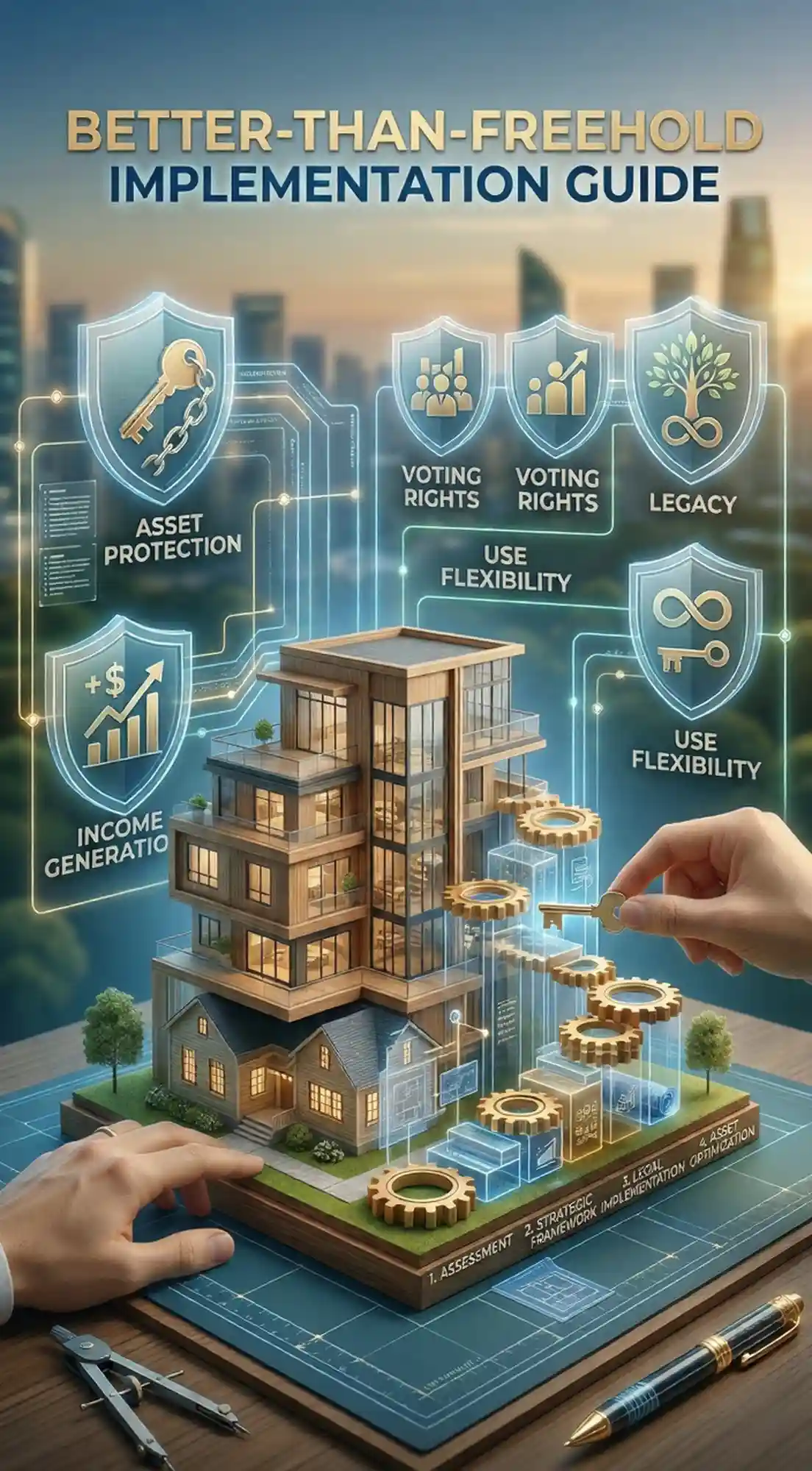

Step-by-step guide to implementing Better-than-Freehold™ for Thai property investment. Covers onboarding, registration, financing, and the eight to sixteen week timeline.
Key takeaways
- Better-than-Freehold™ implementation follows a defined seven-stage process; stages 1 to 6 span eight to sixteen weeks, delivering a 30-year registered lease and a first-priority registered mortgage at the Land Office, with a year-30 Option Agreement appended to the mortgage and a share pledge.
- AMLA safeguards are built into every stage, with KYC/AML checks, transparent registration, and offshore trust structures designed to keep the investor clear of the enforcement risks facing nominee company holders.
- Offshore financing up to 50% loan-to-value is being developed as a future workstream (expected H1 2027), with loans intended to be secured against trust assets through Siam Venture Capital (denominated in USD with multi-currency hedging options).
- Enforcement by Clear Blue Security Agents (CBSA) provides ongoing contract protection through appointed experts and its enforcement and step-in rights; enforcement of the registered mortgage over land requires Civil Court proceedings under CCC Section 728, whilst pledge and trust-level enforcement is achieved through contractual and administrative mechanisms.
Better-than-Freehold™ implementation transforms a property investment from an unprotected position into an enforceable, financeable structure built on a registered lease and mortgage. The process is designed to be systematic, transparent, and structured in accordance with the applicable Thai legal and regulatory frameworks at every stage, ensuring the investor's rights are protected from the first interaction through the lifecycle of tenure.
- Implementation Timeline
- Stage 1: Onboarding and Investor Qualification
- Stage 2: Due Diligence and Property Validation
- Stage 3: Property Acquisition by TIN
- Stage 4: Contract Registration at the Land Office
- Stage 5: Trust Execution With SPH Trustees
- Stage 6: CBSA Appointment and Enforcement
- Stage 7: Financing Through Siam Venture Capital
- FAQ Section
- Related Terms
- Expert Recommendations
Implementation Timeline #
| Stage | Activity |
|---|---|
| 1. Onboarding | KYC/AML checks, investor qualification, and property selection |
| 2. Due diligence | Title verification, valuation, legal and compliance checks |
| 3. Property acquisition | TIN acquires property at the legal official value (LOV) |
| 4. Contract registration | 30-year lease and mortgage registered at the Land Office; Option Agreement appended to the mortgage |
| 5. Trust execution | SPH Trustees establishes trust; investor designated as beneficiary |
| 6. CBSA appointment | Security agent appointed; enforcement mechanisms activated |
| 7. Financing | SVC loan application once lending comes online (expected H1 2027) |
Stages 1 to 6 run in sequence and together typically take eight to sixteen weeks. Financing (stage 7) follows once lending comes online, expected in H1 2027.
Stage 1: Onboarding and Investor Qualification #
Every Better-than-Freehold™ implementation begins with comprehensive compliance checks ensuring the investor meets KYC and AML requirements before any property transaction proceeds.
What documentation is required? #
Investor qualification requires: a passport or national identification, proof of address within the last 3 months, a source of funds declaration, and completion of the investor profile documentation. These requirements align with international AML standards, whilst ensuring the investor's credentials are verified before engaging with Thai regulatory authorities.
Property selection and validation runs concurrently. The investor identifies an eligible Thai property, which must hold a Chanote title deed (the only title class suitable for Better-than-Freehold™ structures). Properties with lesser title classifications are not eligible.
Stage 2: Due Diligence and Property Validation #
Dual-track due diligence verifies both the property and the legal framework surrounding it, ensuring no encumbrances, access issues, or compliance risks exist before acquisition proceeds.
What does due diligence cover? #
Land Office due diligence confirms the Chanote title, verifies access rights, checks for existing encumbrances or mortgages, and confirms building permit validity. Valuation and survey reports establish the property's appraised value, which will determine the loan-to-value ratio once financing comes online (expected H1 2027).
Legal due diligence examines compliance with the Civil and Commercial Code, Foreign Business Act, Land Code, and AMLA provisions, so that the proposed structure is designed to meet current regulatory requirements. For properties currently held through nominee companies, additional company due diligence is required, covering balance sheets and DBD filing compliance, as detailed in our nominee structure conversion guide.
Stage 3: Property Acquisition by TIN #
Thailand Investor Network (TIN) acquires the property independently, undertaking its own due diligence and preparing an offer on commercial terms to SPH Trustees. If accepted, TIN purchases the property, with transfer taxes calculated on the official appraised value (LOV) as required by Land Department practice.
Why does TIN acquire the property? #
TIN operates as a genuinely independent Thai entity without foreign funding or control. This independence is fundamental: it is designed to ensure the acquisition meets Thai ownership requirements without creating the nominee indicators that trigger DBD investigation on the basis that it is a legitimate, legal transaction. All acquisition documents are registered and disclosed to relevant authorities, establishing a transparent ownership chain from the outset. TIN is one of the four entities behind Better-than-Freehold™, each named publicly with a stated role.
Stage 4: Contract Registration at the Land Office #
The core registered security mechanisms are established at this stage, creating the enforceable rights on which the Better-than-Freehold™ structure rests.
What contracts are registered? #
TIN grants a registered 30-year lease to SPH Trustees, together with a year-30 Option Agreement. The lease is drafted according to Thai legal requirements and registered at the Land Office, creating publicly recorded rights that bind successors in title. The Option Agreement sets out the agreed contractual Year-30 arrangements, including negotiation of a new lease on known terms, sale to a legally qualified purchaser, or refund of the option premium.
A first-priority registered mortgage is registered in favour of SPH Trustees, whilst the Option Agreement is appended to that registered first-priority mortgage. Together these instruments create the layered security that enables enforcement. The structure has been reviewed within scope by leading tier-one regional and Thai counsel.
Stage 5: Trust Execution With SPH Trustees #
SPH Trustees, an offshore trustee whose Labuan FSA licence is in progress, holds the lease, option, mortgage, and pledge rights (collectively the beneficial interest) for the investor as beneficiary.
Why is the trust structure essential? #
The trust serves three functions. First, it enables security rights such as share pledges and security agent rights to be shared between multiple investors through a single intermediate entity. Second, it is structured to separate the beneficial owner's interest from direct Thai property ownership, with tax treatment subject to individual advice and Thai Revenue Department interpretation. Third, it provides asset protection and confidentiality under Labuan trust law.
Offshore compliance checks are completed, and the investor is formally designated as the trust beneficiary. The investor controls the trust as the ultimate beneficial owner, retaining the right to direct SPH Trustees to resell the beneficial interest, trigger a property resale, or refinance.
Stage 6: CBSA Appointment and Enforcement #
Clear Blue Security Agents (CBSA) is appointed as independent security agent over the lease, mortgage, Option Agreement and share pledge (the lease and mortgage themselves are registered at the Land Office), establishing the enforcement infrastructure that protects the investor's rights throughout the investment lifecycle.
How does CBSA enforcement work? #
CBSA holds enforcement rights over all assets held through SPH Trustees Ltd and has been granted step-in rights enabling contract enforcement and asset protection from fraud, insolvency, and litigation risk. Court disputes in Thailand are expensive, drawn out, and risky; CBSA provides an alternative pathway, appointing experts to resolve disputes quickly and at lower cost whilst maintaining contractual integrity.
In the event of default or insolvency by any party, CBSA can legally shift control of the asset to a Safe Harbour vehicle through pledge and trust-level enforcement, protecting the investor's interests; enforcement of the registered land mortgage proceeds through Civil Court under CCC Section 728. This enforcement capability is what makes Better-than-Freehold™ genuinely enforceable rather than merely contractual. Registration is what gives that enforcement something to bite on: as our comparison of what actually protects property assets in Thailand sets out, a property already encumbered by a registered lease and mortgage carries priority claims that a seizure authority must address before any transfer or disposal, whilst private side agreements provide no defence at all.
Stage 7: Financing Through Siam Venture Capital #
Siam Venture Capital (SVC) is developing lending to 50% loan-to-value, secured against trust assets rather than the underlying land. This is a future workstream, expected from H1 2027 and not yet live. Loans are intended to be denominated in USD with multi-currency hedging options available.
What are the financing terms? #
Loan terms are intended to be flexible once products launch (expected H1 2027), expected to span 3 to 7 years with options for early repayment or rollover refinancing, with decisions based on asset quality and investor profile.
In the event of default, SVC and CBSA would look to resolve it through trust and contract rights over the trust assets, with CBSA mediation as the first point of dispute settlement and THAC arbitration as the backstop. This enforcement mechanism is designed to protect both the lender and the investor.
Free to start · No obligation · Your decision at every stage
FAQ Section #
Related Terms #
- What is Better-than-Freehold™: Definition and legal guide to the compliant leasehold and security framework
- Nominee Company Risks Thailand 2025: Criminal prosecution risks that Better-than-Freehold™ is designed to avoid
- Foreign Property Ownership Thailand Legal Framework: Complete guide to legitimate ownership structures for foreigners
- Nominee Structure Conversion: Step-by-step conversion guide for existing nominee holders
Expert Recommendations #
Better-than-Freehold™ implementation is a structured pathway available to foreign investors acquiring Thai property rights. The seven-stage process ensures that the lease and mortgage are registered, every entity is named and accountable, and the investor's rights are enforceable from day one.
Professional Guidance Essential #
The implementation process involves coordination across Thai and offshore jurisdictions, requiring specialist expertise in property law, trust law, corporate structuring, and tax planning. Professional coordination ensures each stage is completed efficiently whilst maintaining compliance throughout.
Immediate Action Required #
With enforcement accelerating against nominee structures and alternative options such as Sap-Ing-Sith carrying significant structural limitations, investors entering the Thai property market should engage with the Better-than-Freehold™ process early. The eight to sixteen week timeline means that investors who begin now can have enforceable rights, built on a registered lease and mortgage, in place before many enforcement investigations reach their conclusion.
Long-term Security Strategy #
Better-than-Freehold™ is a structure delivering 30-year registered leases with contractual year-30 mechanisms, registered security interests, and independent enforcement through a single integrated framework. A bare lease or nominee structure ultimately depends on a single 30-year window with no agreed mechanism for what happens next.
For comprehensive assessment and implementation of compliant structures, contact our expert team today.
Free to start · No obligation · Your decision at every stage
Conclusion #
Better-than-Freehold™ implementation is a defined and transparent process delivering registered property rights. Seven stages, the first six spanning eight to sixteen weeks, transform an investment from an unprotected position into an enforceable, financeable, and compliant framework.
The registered instruments are recorded publicly. The lease and the mortgage are recorded at the Land Office, with the Option Agreement appended to that registered mortgage; the share pledge sits alongside them as a separate company-level security, creating an auditable chain of security interests. CBSA provides ongoing mediation and enforcement, with THAC arbitration as the backstop and mortgage enforcement through the Thai courts as the last resort, whilst SPH Trustees delivers asset protection through offshore channels.
The structure is not theoretical. It has been reviewed within scope by leading tier-one regional and Thai counsel, with tax opinions from a leading global tax advisory firm. Better-than-Freehold™ exists because the Thai property market needs a solution that works beyond the next 30 years.
This article is provided for general information only and does not constitute legal, tax, or investment advice. Laws and enforcement practices change; obtain advice tailored to your situation before acting.
About the Author: Andrew Moore FPFS, CDir
Chairman, Better-than-Freehold™

Andrew Moore has been an active investor in Thai property since 2004. He is a Chartered Director and a Fellow of the Personal Finance Society. He has invested in and built properties in several countries since the late 1990s and first invested in Thailand in 2004. Having owned homes in Bangkok, Samui, Phangan and Phuket he can offer a unique perspective on Thailand's property markets together with past and future trends in both ownership and investor opportunities.