
The Four Entities Behind Better-than-Freehold™: TIN, SPH Trustees, CBSA and SVC
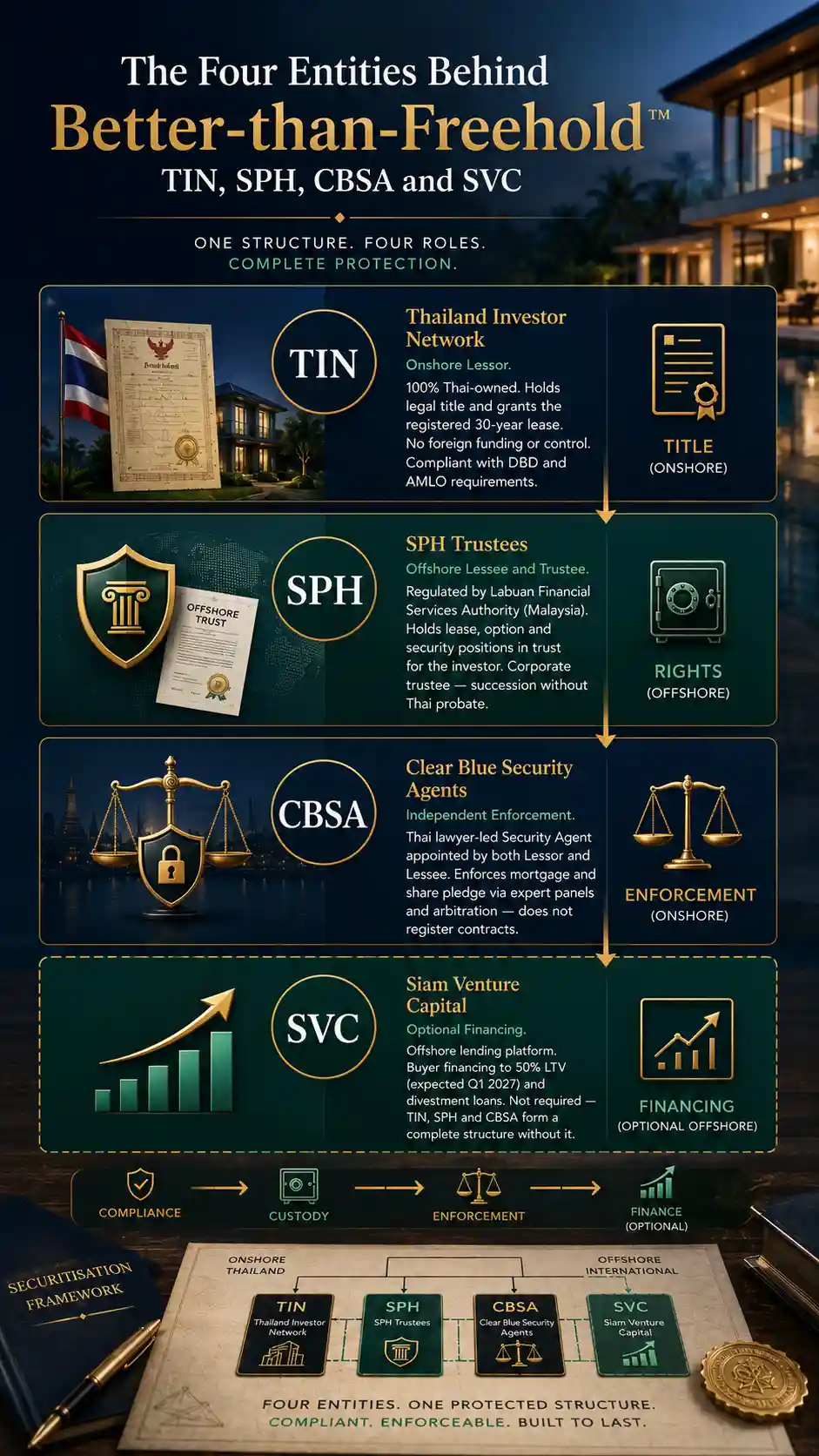
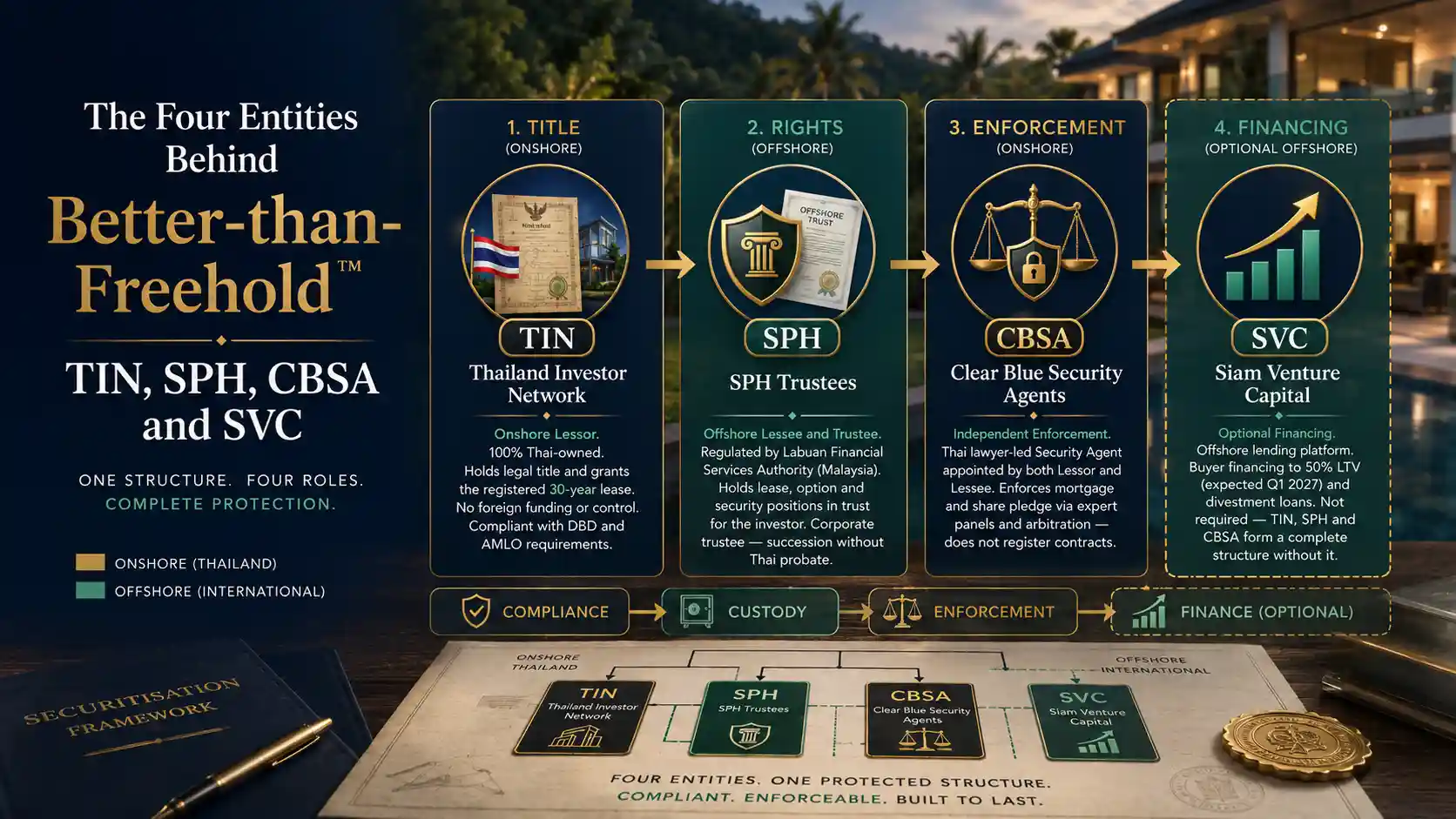
The four entities behind Better-than-Freehold™: Thailand Investor Network, SPH Trustees, Clear Blue Security Agents and Siam Venture Capital, each with a stated role and regulatory status.
Why Better-than-Freehold™ names every entity, its function, and its regulatory status publicly #
Key takeaways
- Four entities, four functions: Thailand Investor Network holds title, SPH Trustees holds the investor's rights, Clear Blue Security Agents enforces, and Siam Venture Capital is developing lending. Each is named and each does one job.
- SPH Trustees will sit under a foreign regulator once licensed: its Labuan Financial Services Authority licence is in progress; once granted, it will give the offshore leg institutional oversight alongside Thai compliance onshore.
- Financing is optional, not structural: Siam Venture Capital is developing financing to 50% LTV as a future workstream (expected H1 2027, not yet live), but TIN, SPH Trustees and CBSA already form a complete structure without it.
- Enforcement does not depend on the courts: CBSA holds enforcement and step-in rights over the mortgage and share pledge, appointed by both Lessor and Lessee.
What are the four entities behind Better-than-Freehold™? #
- Why Name Every Entity in the Structure?
- Thailand Investor Network: The Onshore Lessor
- SPH Trustees: The Offshore Lessee and Trustee
- Clear Blue Security Agents: Independent Enforcement
- Siam Venture Capital: Optional Financing
- The Four Legal Instruments
- Where Compliance, Security and Benefits Meet
- FAQ Section
- Related Terms
- Expert Guidance
Why Name Every Entity in the Structure? #
Nominee company structures conceal who really controls a property behind a Thai shareholder register that does not reflect economic reality; Better-than-Freehold™ takes the opposite approach, naming every entity, its function and its regulatory status so an investor and any enforcement agency can see exactly who does what. Transparency is the point of comparison, not a marketing claim.
Thai enforcement agencies now screen for exactly the pattern nominee structures create: a Thai party on paper, foreign funding and control in substance, and nothing that survives a data review. A structure built from named entities has nothing of that kind to disclose, because there is nothing hidden to begin with.
The four entities divide along the lines that matter to a buyer: who holds title, who holds the investor's rights, who enforces those rights, and who might finance them.
Thailand Investor Network: The Onshore Lessor #
Thailand Investor Network (TIN) is a 100% Thai-owned property holding and management company that holds legal title to the property and acts as Lessor, granting the registered 30-year lease. It operates within Thai law, subject to the Land Code, the Foreign Business Act, the Civil and Commercial Code and Department of Business Development filing requirements, with anti-money laundering compliance overseen by AMLO.
Compliance comes first here. TIN takes no foreign funding and accepts no foreign control, so it presents nothing for the IBAS AI screening system to flag across shareholding, funding, director or advisor clusters. That distinction matters more since DBD Order 2/2568 introduced source-of-funds documentation at registration and DBD Order 1/2569 added a written investment confirmation letter from the signing director when a change brought in a foreign director or a foreign minority partner. Both orders were consolidated into Central Registrar Order 2/2569 from 1 August 2026, which keeps the three-month Thai shareholder bank statements at incorporation, adds a written letter explaining the investment and the receiving director's bank statement, and is stricter in places.
Because TIN genuinely owns the property, without financial or operational involvement from any foreign investor, it is designed to satisfy both the Foreign Business Act and the substance test enforcement agencies now apply administratively.
SPH Trustees: The Offshore Lessee and Trustee #
SPH Trustees is an offshore trustee in Malaysia whose Labuan Financial Services Authority licence is in progress. It acts as Lessee on behalf of the investor, holding the leasehold interest, the option rights and the security positions in trust for the investor.
Security follows compliance in this pairing. Because SPH Trustees is a corporate trustee rather than a private individual, it does not die, so the investor's beneficial interest passes to heirs without Thai probate, a consequence a personal nominee structure can never replicate. Source-of-funds verification applies at onboarding, mirroring the due-diligence standard Thai authorities now expect onshore.
Once SPH Trustees is licensed, holding the investor's rights offshore under a named foreign regulator will add a second layer of institutional oversight alongside, not instead of, Thai compliance at the TIN level.
Clear Blue Security Agents: Independent Enforcement #
Clear Blue Security Agents (CBSA) is a Thai lawyer-led entity appointed as independent Security Agent by both TIN as Lessor and SPH Trustees as Lessee. It holds enforcement rights and controls the security positions created by the first-priority registered mortgage and share pledge, without depending on either party's cooperation to act.
CBSA manages disputes through expert panels, with arbitration as a backstop, rather than waiting on Thai court timelines that can run for years. It enforces; it does not register contracts, since registration happens separately at the Land Department. That division keeps enforcement independent of the office holding the underlying title records.
Siam Venture Capital: Optional Financing #
Siam Venture Capital (SVC) is an offshore lending platform developing optional financing against the lease and option package offshore directly to beneficiaries of the SPH Trustees Ltd trust, including buyer financing to 50% loan-to-value (LTV) (expected H1 2027, not yet live) and divestment loans for owners exiting high-risk property-owning companies. It is not required for the structure to operate.
Benefits complete the picture at the SVC level. An investor who wants leverage can, once SVC lending is live from H1 2027, seek it against a registered, securitised position; one who does not can ignore SVC entirely, since TIN, SPH Trustees and CBSA already deliver a complete, enforceable structure.
The Four Legal Instruments #
The four entities act through four instruments: a 30-year lease and a first-priority registered mortgage, both registered at the Land Office, alongside a year-30 Option Agreement and a share pledge documented as enforceable contracts. Together they give the investor documented contract rights rather than private promises between undisclosed parties.
The lease and option sit with SPH Trustees as Lessee; Clear Blue Security Agents holds the enforcement and step-in rights over the mortgage and share pledge. A fuller breakdown of how the instruments interlock, including what each grants at year 30, is covered in the four principal instruments behind Better-than-Freehold™.
Where Compliance, Security and Benefits Meet #
Compliance comes first: Thailand Investor Network's Thai ownership and DBD filings give the structure nothing to hide from enforcement agencies. Security follows: SPH Trustees and Clear Blue Security Agents together hold and enforce the investor's rights independently of any single party's goodwill. The benefits complete the picture: an assignable trust interest, succession without Thai probate, and financing to 50% LTV as a future workstream (expected H1 2027, not yet live) through Siam Venture Capital when an investor wants it.
Each entity's role is stated publicly on the structure page, with its regulator named where one applies. Transparency of that kind is the practical difference between a structure built to survive scrutiny and one built to avoid it.
Free to start · No obligation · Your decision at every stage
FAQ Section #
Related Terms #
- What Is Better-than-Freehold™: legal definition of the leasehold and security framework
- The Four Principal Instruments: how the lease, mortgage, Option Agreement and share pledge interlock
- Better-than-Freehold™ Implementation Guide: seven-stage process from onboarding to registration
- Anti-Money Laundering Act Thailand: AMLA framework and nominee enforcement context
Expert Guidance #
Anyone comparing structures should ask a simple question of each: who holds what, and who regulates them? Better-than-Freehold™ answers both questions publicly for all four entities.
Immediate Action Required #
If you are evaluating a Thai property structure and cannot name every entity, its role, and its regulator, that opacity is itself a risk signal under current enforcement. See how BtF™ works or speak with a qualified adviser before committing funds to any structure that relies on undisclosed parties.
Long-term Security Strategy #
TIN, SPH Trustees, CBSA and SVC divide compliance, custody, enforcement and financing so no single party controls every layer of the investment. That separation is what allows the structure to survive IBAS screening, data-sharing MOUs, and the substance-over-form analysis regulators now apply as standard.
For assessment of how these entities apply to a specific property, contact our expert team today.
Free to start · No obligation · Your decision at every stage
Conclusion #
The case for Better-than-Freehold™ rests as much on what it discloses as on what it delivers. Thailand Investor Network, SPH Trustees, Clear Blue Security Agents and Siam Venture Capital each have a stated role, and only one, SPH Trustees, will sit under a named foreign regulator, the Labuan Financial Services Authority, once its licence, now in progress, is granted, while TIN remains squarely within Thai compliance requirements. That is the opposite of a nominee register built to obscure who really controls the property.
This article is provided for general information only and does not constitute legal, tax, or investment advice. Laws and enforcement practices change; obtain advice tailored to your situation before acting.
About the Author: Andrew Moore FPFS, CDir
Chairman, Better-than-Freehold™
Andrew Moore has been an active investor in Thai property since 2004. He is a Chartered Director and a Fellow of the Personal Finance Society. He has invested in and built properties in several countries since the late 1990s and first invested in Thailand in 2004. Having owned homes in Bangkok, Samui, Phangan and Phuket he can offer a unique perspective on Thailand's property markets together with past and future trends in both ownership and investor opportunities.