
How to buy a Villa in Phuket as a Foreigner (2026)
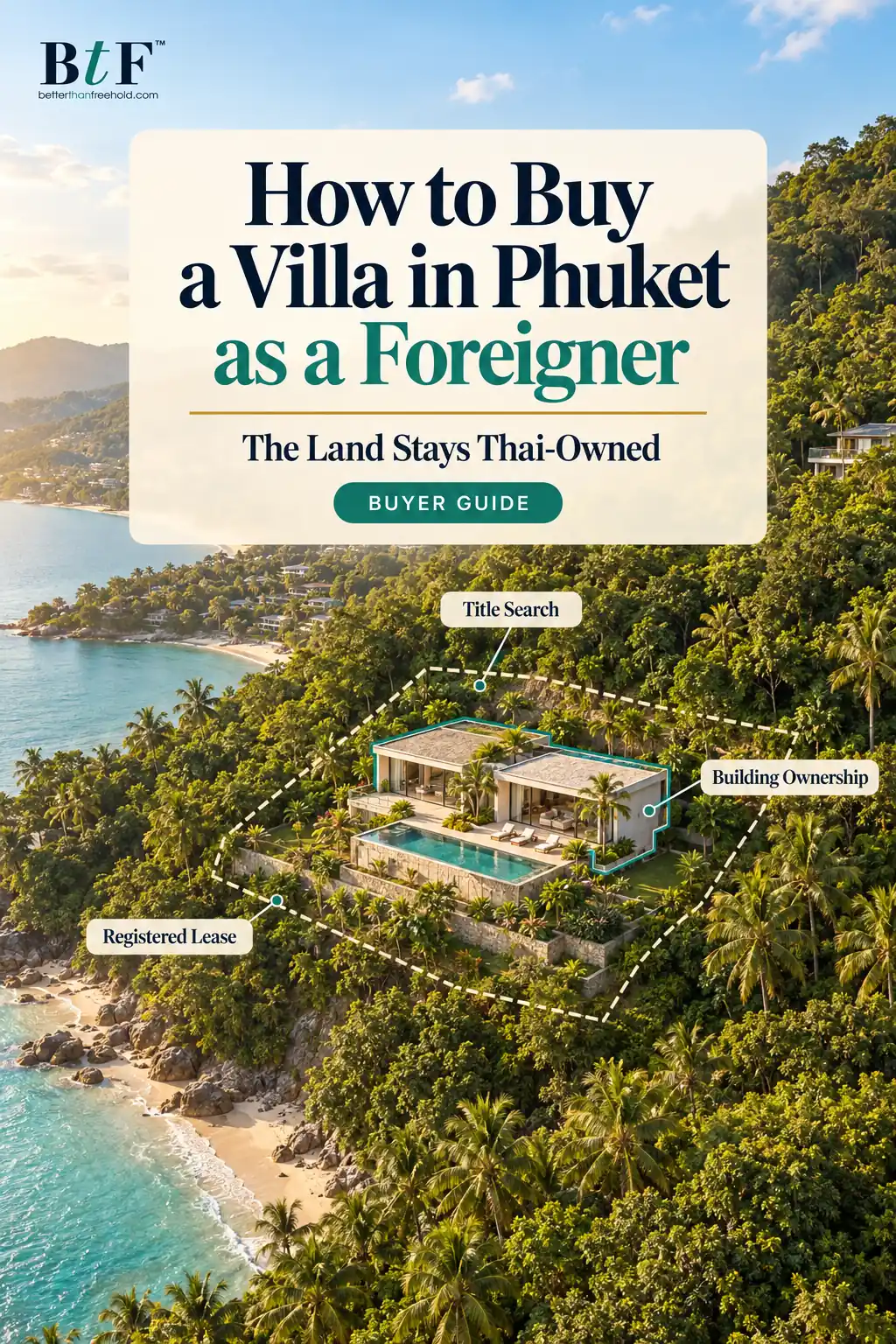
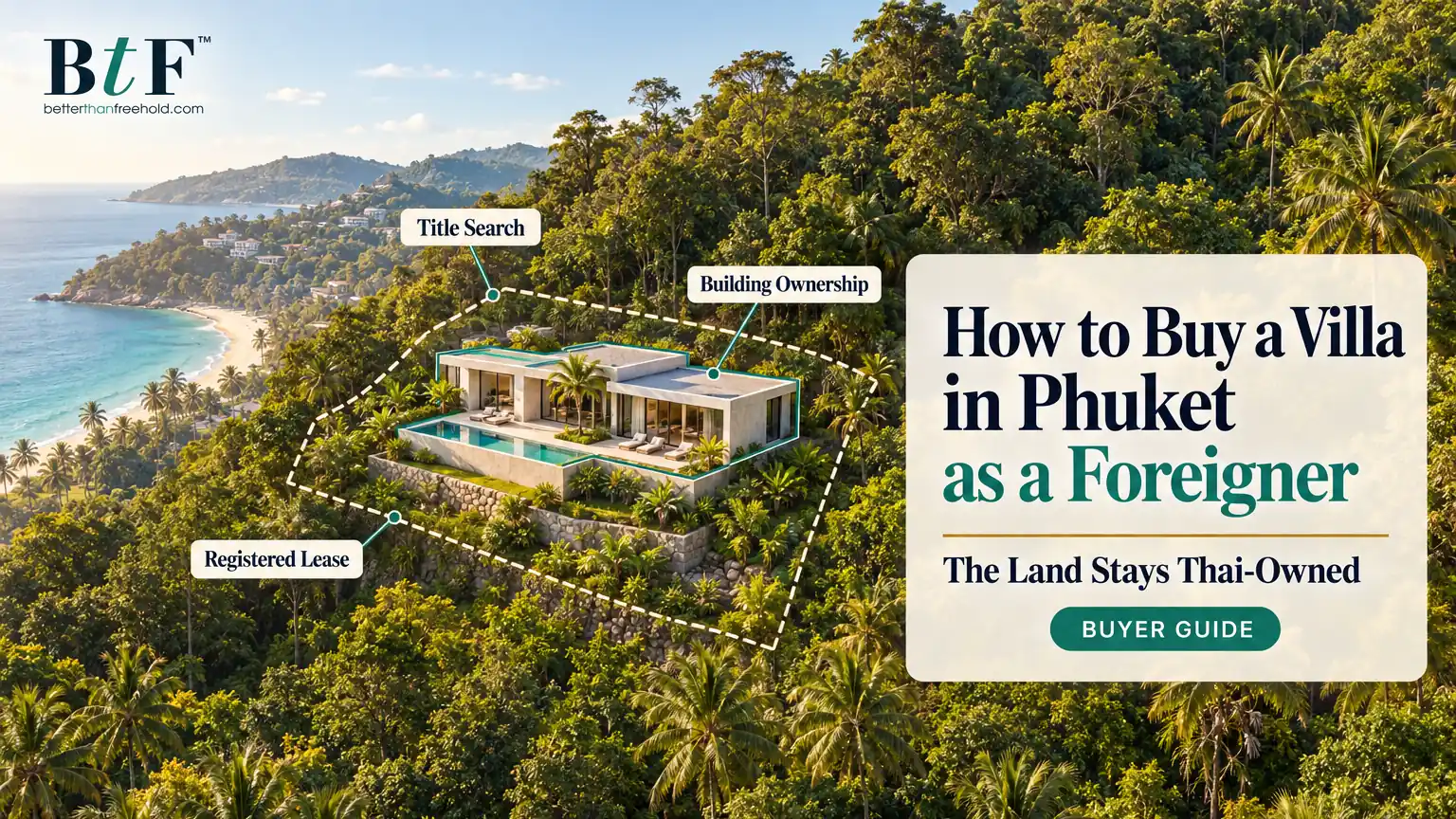
A foreigner cannot buy the land under a Phuket villa, so the lawful route is to buy registered rights while the land stays Thai-owned: a registered 30-year land lease, ownership of the building through a superficies, or a compliant leasehold structure.
Key takeaways
- Freehold land is closed, with narrow exceptions: Section 96 bis needs more than 40 million baht of qualifying investment and the Minister's approval, for one rai at most.
- The building can be separated from the land: a registered superficies gives a foreigner ownership of the building.
- A chanote is the starting point, not the finish. Section 61 allows the Director-General to annul a title deed issued illegally, and Phuket's hillside property and land titles are under review.
- The company route is under investigation, with Phuket inspections widened in July 2026 to more than 361 potentially high-risk businesses.
How to buy a Villa in Phuket as a Foreigner (2026) #
Foreigners cannot buy freehold land in Thailand, with narrow exceptions. The one route people cite is Section 96 bis of the Land Code: more than 40 million baht of qualifying investment, up to one rai for a residence, and the Minister's approval. Almost no villa buyer uses it.
What Can a Foreigner Lawfully Hold a Villa in Phuket Without a Nominee? #
A foreign buyer or investor in Phuket can lawfully hold a registered lease of the land for up to 30 years, ownership of the villa building itself through a registered superficies, a usufruct for life use, or a leasehold structure built without a nominee shareholder. None of these is land ownership, and each depends on registration at the Land Office.
A building put up by someone exercising a right over another's land is not a part of that land (Civil and Commercial Code, Section 146), and Section 1410 allows a landowner to grant a superficies: the right to own buildings on the land. A fixed-term superficies runs for up to 30 years and passes to heirs unless the granted right says otherwise.
The registered lease does most of the work. A land lease of more than three years must be registered at the relevant Land Office, or it is enforceable for three years only (Section 538); no term may exceed 30 years (Section 540), and a registered lease binds a later transferee of the land (Section 569). Renewal promises are contractual, not registered rights, as our guide to lease renewal clauses in Thailand explains.
A usufruct always ends when the holder dies (Section 1418). It suits a home for life, not capital appreciation or inheritance for heirs.
Condominium freehold, within a building's 49% foreign quota, does not extend to a standalone villa; a seller who claims otherwise should show a condominium title deed and the juristic person's quota letter. Couples should first read what a foreigner can own through a Thai spouse.
Why Is the Legacy Thai Company Route Under Investigation in Phuket? #
Investors and buyers who hold a Phuket villa plot through a Thai company with nominee shareholders are inside a structure that Phuket and nationwide enforcement now targets. In a nominee company, Thai shareholders hold shares for the benefit of a foreigner who funds or controls the company, and both sides face penalties under the Foreign Business Act.
Section 36 of that Act carries up to three years' imprisonment and/or a fine of THB 100,000 to 1,000,000 for both, plus court-ordered cessation of the shareholding. Under Sections 94 and 96 of the Land Code, land held in place or on behalf of a foreigner must be disposed of within the period the Director-General sets, of not less than 180 days and not more than one year; otherwise, the Director-General can sell it and pay the price to the person entitled. Any lease over that plot ceases on the day the owners are notified of that disposal (Section 53), so a lease from a nominee-held landowner might end early.
In July 2026, the Interior Ministry widened inspections to more than 361 potentially high-risk businesses on the island. Police raids followed in August, covered in our report on the Phuket nominee network Phase 4 operation.
The Department of Special Investigation has also opened a fact-finding inquiry into a Phuket MP alleged to hold shares or directorships in more than 30 companies, most of them reported to hold land or condominium property with foreigners. As of late September 2026, he was a witness and nobody had been charged; our Phuket MP nominee investigation timeline tracks it.
Savills has linked slower resale-oriented foreign investment in Phuket to that enforcement, as our report on the Phuket villa market in 2026 sets out.
Owners already holding a villa through an at-risk property-owning company face a different decision: when to plan a divestment that typically takes eight to sixteen weeks.
Which Title Deeds Should a Phuket Villa Buyer Accept? #
A Phuket villa buyer or investor should expect a title deed, the chanote, which the Land Code defines as the document showing ownership of land. A certificate of use only certifies that land has been put to use. On Phuket's hillsides, even a chanote needs its issuing history checked, because forest-land reviews are testing whether titles were lawfully issued to begin with.
On 30 July 2026, the government said its "Phuket Model" drive would examine unlawfully issued title deeds, with the Royal Forest Department reviewing land-title documents retrospectively. Within days, a sweep covered eight sites, including Kamala, Rawai and Patong, as our report on the Phuket land crackdown describes.
Section 61 of the Land Code allows the Director-General to annul or amend a title deed issued inaccurately or illegally, after a committee of enquiry. A lease or superficies registered against that deed depends on it being valid.
The August sweep focused on mountainous, deforested plots, so a hillside villa title needs a clear title check.
What Should Due Diligence Cover Before a Deposit Is Paid? #
Due diligence on a Phuket villa should confirm five things before any deposit leaves a buyer's or investor's account: the title type and its issuing history, legal road access, a building permit, who will own the building, and who the seller really is. Each is checked at the Land Office, the local authority or the company registry.
- Title. Ask the Phuket Land Office for a title search covering registered mortgages, leases and servitudes, and check the plot against forest-reserve boundaries.
- Access. A villa reached by way of a neighbour's land needs a registered right of way, not a verbal assurance.
- The building permit should come from the local authority and match what stands on the plot.
- Building ownership. On leased land, the documents must say who owns the building, during the term and after it.
- Off-plan payments need to be paid in stages tied to construction, ideally held in escrow (or a lawyer's client account) until transfer.
- The seller and the landowner. A company seller's or lessor's directors and filings sit with the Department of Business Development.
What Are the Steps to Buy a Villa in Phuket, From Reservation to the Land Office? #
Buying a villa in Phuket as a foreigner runs in six steps: appoint an independent lawyer, reserve, complete due diligence, sign the lease or sale agreement, remit the funds, and register at the Land Office. Investors and buyers should treat registration as the moment the rights begin; an unregistered lease over three years is enforceable for three years only.
- Appoint an independent Thai lawyer.
- Reserve, with a deposit refundable if due diligence fails.
- Complete the checks above, in writing.
- Sign the lease, any superficies, and any sale agreement for the building.
- Remit the funds from abroad, keeping the bank records.
- Register at the Land Office, where officials may question the parties under Section 74 of the Land Code.
Where ownership of a building or condominium unit transfers, the Land Department charges a transfer fee of 2% of the appraised value. The reduced 0.01% fee, extended to 30 June 2027, applies to Thai nationals only. A registered lease attracts stamp duty of 1 baht per 1,000 baht of total rent under the Revenue Department schedule, plus a registration fee.
How Does Better-than-Freehold™ Work for a Phuket Villa? #
Better-than-Freehold™ is a leasehold and security structure designed to comply with Thai law, giving a foreign buyer or investor the benefit of registered rights over a Phuket villa without a nominee shareholder. A new buyer uses it where the seller's or developer's property is already Better-than-Freehold™ enabled; only property held through a Thai company can move into it.
Compliance comes first. Thailand Investor Network, a 100% Thai-owned property holding and management company with its own Thai-funded paid-up share capital, and no foreign funding or control, holds legal title. An existing lease cannot be converted into the structure.
Security follows. Four principal instruments sit behind it: a registered 30-year lease and a registered first-priority mortgage, a Year-30 Option Agreement appended to the mortgage, and a share pledge. Those rights are held by a trust for the client through SPH Trustees Ltd. Clear Blue Security Agents (CBSA) mediate and enforce as the first point of dispute settlement, with Thailand Arbitration Centre (THAC) arbitration as the backstop; mortgage enforcement still requires a Thai court.
The benefits are resale of your rights by assignment of the trust interest, and succession without Thai probate.
Free to start · No obligation · Your decision at every stage
FAQ Section #
Related Terms #
- How to Buy Property in Thailand as a Foreigner
- Buying Property Through a Thai Company
- Lease Renewal in Thailand
- Buying a Villa in Koh Samui as a Foreigner
Expert Guidance #
Check the title history first, then the seller, then the structure, and only then the price; a view and a figure agreed early make every later question harder to ask. If the only route on offer is a company with Thai shareholders, look for a property that does not need one.
Free to start · No obligation · Your decision at every stage
Conclusion #
A foreigner can buy a villa in Phuket without a nominee, but not the land under it. The workable routes are a registered lease, a superficies over the building, or a leasehold structure with no nominee. Phuket's title reviews and company inspections in 2026 have made the checks harder to skip.
This article is provided for general information only and does not constitute legal, tax, or investment advice. Laws and enforcement practices change; obtain advice tailored to your situation before acting.
About the Author: Andrew Moore FPFS, CDir
Chairman, Better-than-Freehold™

Andrew Moore has been an active investor in Thai property since 2004. He is a Chartered Director and a Fellow of the Personal Finance Society. He has invested in and built properties in several countries since the late 1990s and first invested in Thailand in 2004. Having owned homes in Bangkok, Samui, Phangan and Phuket he can offer a unique perspective on Thailand's property markets together with past and future trends in both ownership and investor opportunities.