
Phuket Land Crackdown Widens: Officials to Verify Whether Title Deeds Were Lawfully Issued
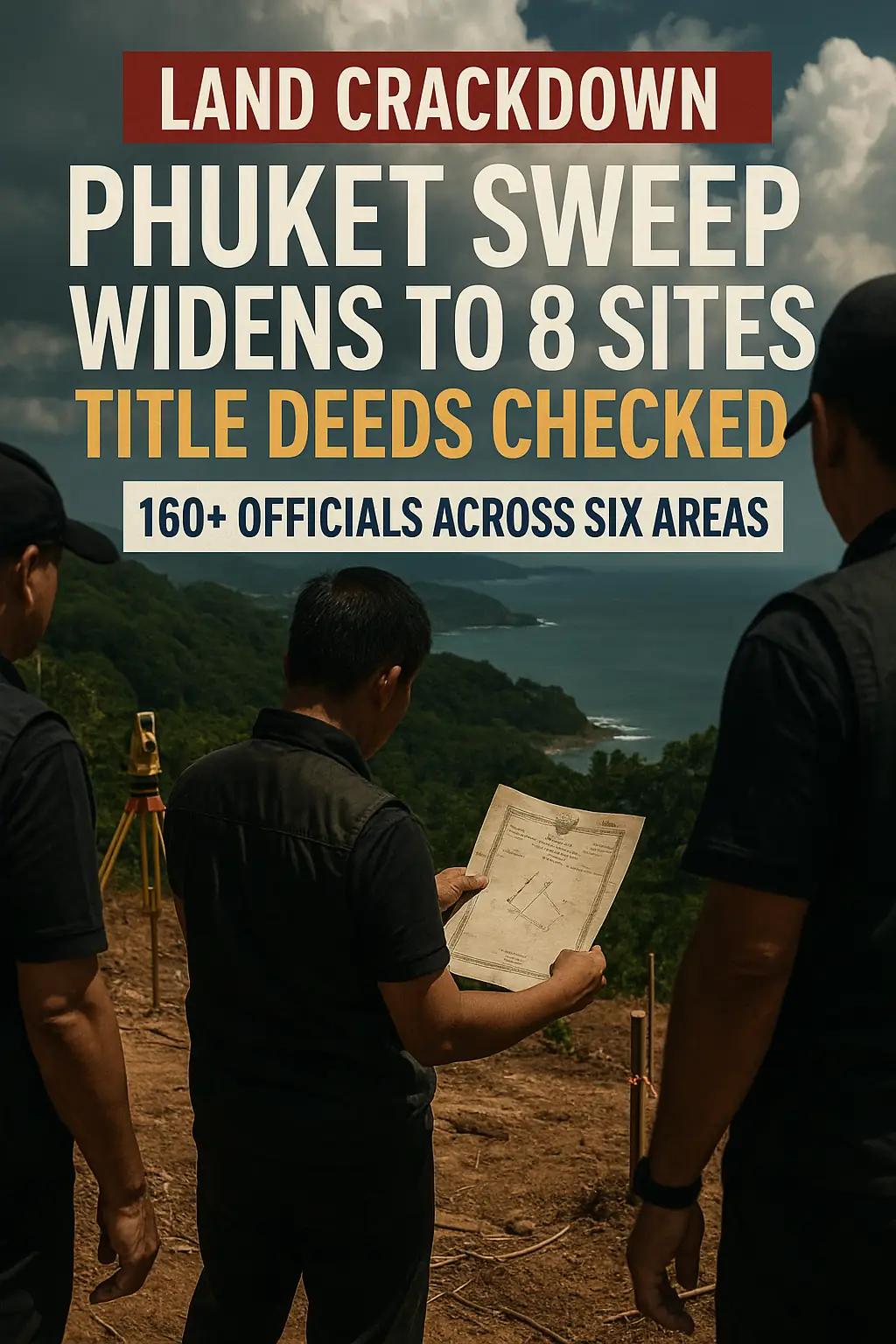
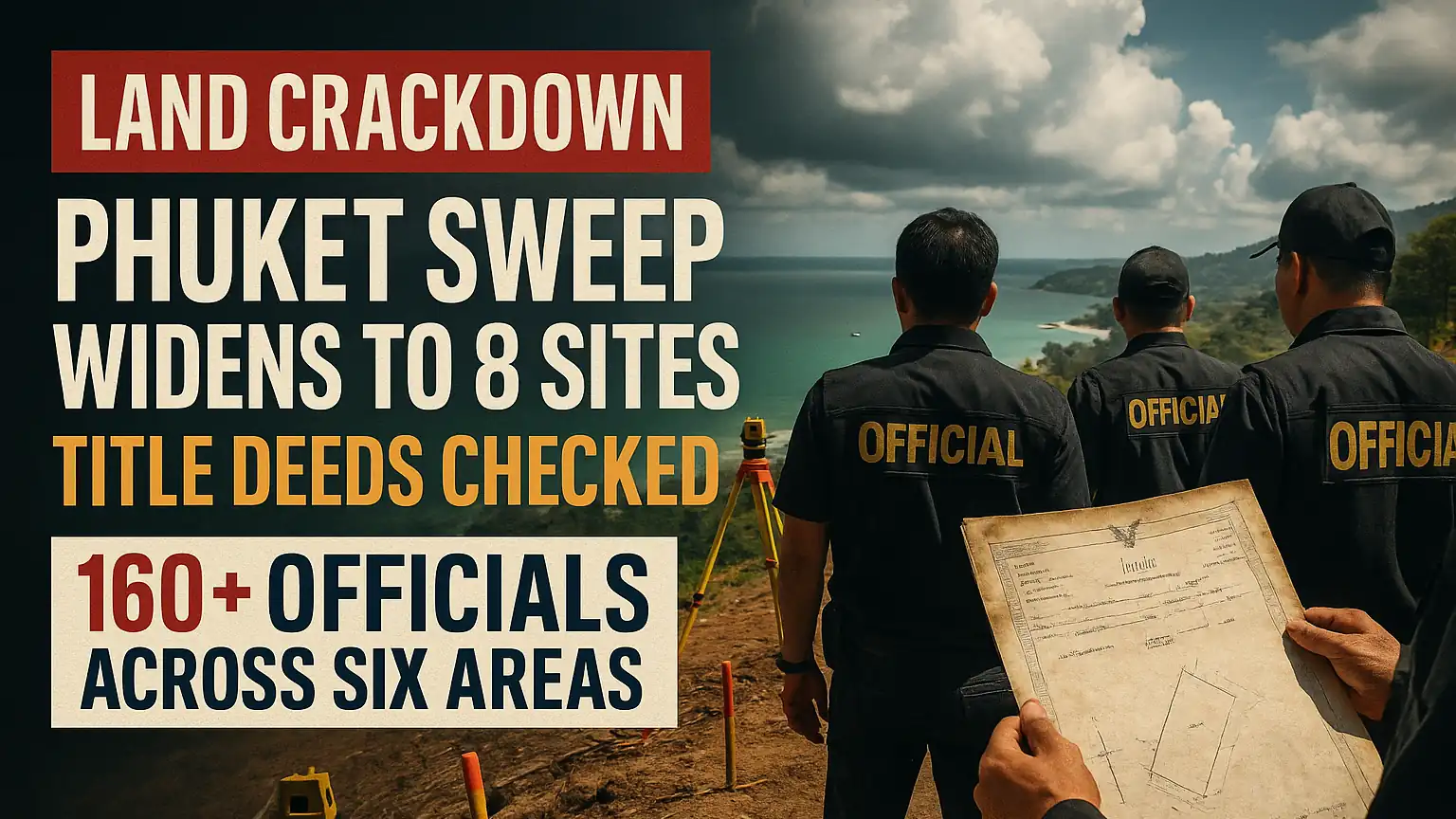
The Royal Forestry Department expanded its Phuket sweep to eight locations from 3 to 5 August 2026, checking whether title deeds held over deforested hillside plots were ever lawfully issued.
Officials Widen the Phuket Sweep to Test Whether Existing Land Titles Hold Up #
Key takeaways
- Eight-site sweep: 160+ officials covered six areas from Thep Krasattri to Patong, 3 to 5 August.1
- Title deeds under review: officials will check whether documents held over deforested hillside plots were lawfully issued.12
- Nui Beach precedent: roughly 500 structures removed last month under a court order, closing a decade-long dispute.3
- Better-than-Freehold™ takeaway: no registered instrument can cure a title never validly issued; provenance comes before structure.
What Happened in Phuket This Week? #
- What Triggered the Expanded Sweep
- Why a Title Deed Is Not the End of the Story
- What This Means for Existing At-Risk Property-Owning Companies
- Impact on Foreign Property Buyers
- The Better-than-Freehold™ Solution
- FAQ Section
- Related Terms
- Expert Guidance
What Triggered the Expanded Sweep #
Deputy director-general Phatpong Samittipat said the sweep followed Internal Security Operations Command intelligence on suspected encroachment at eight sites, covering Thep Krasattri, Choeng Thale, Sri Sunthorn, Rawai, Kamala and Patong.1
Six areas, not one hotspot. Enforcement has moved from last month's single Nui Beach dispute, where roughly 500 structures were removed under a court order, to a province-wide review backed by AMLO asset tracing.123 One target, a Patong restaurant, is reported linked to an influential figure; officials named no individual.1
Why a Title Deed Is Not the End of the Story #
Some plots are held by private parties with title documents, and officials will verify whether those documents were lawfully issued. A Chanote in hand is evidence of registration, not proof the underlying grant was valid, particularly near a forest-reserve boundary.12
A title survives a paperwork review far more easily than a review of how it was granted. Flat-land Chanote issued decades ago rarely draws scrutiny; hillside and near-boundary plots do, and the same question is being asked, more quietly, on Koh Samui.
What This Means for Existing At-Risk Property-Owning Companies #
An owner holding Phuket land through an at-risk property-owning company faces two exposures on one asset: the corporate structure and the land title. Divestment addresses only the first.
Planned divestment, typically eight to sixteen weeks, removes the Department of Business Development risk that shareholding never reflected genuine Thai control. A bad title is untouched by that fix; its remedy runs against the land itself, through the Land Department and the courts. Fixing the company first is the costlier mistake.
Impact on Foreign Property Buyers #
A buyer weighing an alternative to a Thai company should treat land-office provenance and forest-reserve overlay as non-negotiable, not a final-survey formality. A clean Chanote is no longer assumed clean.
No registered instrument sits above a defective title, Better-than-Freehold™ included. The four security instruments (the lease and mortgage registered at the Land Office, the Option Agreement appended to the mortgage, and a share pledge) go only over land whose provenance is already verified.
The Better-than-Freehold™ Solution #
Compliance comes first. Better-than-Freehold™ places legal title with Thailand Investor Network, a 100% Thai-owned property holding and management company with its own Thai-funded paid-up share capital, taking on land only once its title history is checked.
Security follows. Four principal instruments, a registered lease and mortgage, an Option Agreement appended to the mortgage and a share pledge, are enforced by Clear Blue Security Agents, with mortgage enforcement through the Thai courts as a last resort.
Benefits follow: financing to 50% LTV as a future workstream (expected H1 2027, not yet live), resale by assignment, and succession without Thai probate.
Free to start · No obligation · Your decision at every stage
FAQ Section #
Related Terms #
- Nominee Company Risks in Thailand - how nominee structures are identified
- Thailand Property Market Analysis - enforcement's effect on growth-province demand
- Foreign Business Act Thailand - the statute defining nominee offences
- Anti-Money Laundering Act Thailand - the asset-tracing powers behind the Phuket sweep
Expert Guidance #
Immediate Action Required #
Owners near a forest-reserve boundary should request the title's issuance history before relying on the asset's value. Treat that check as separate from, not a substitute for, planned divestment. Contact the Better-than-Freehold™ advisory team for a confidential compliance assessment.
Long-term Security Strategy #
Verifying title history and forest-reserve overlay at the start of due diligence, not the end, avoids inheriting a risk no structure can absorb later.
Free to start · No obligation · Your decision at every stage
Conclusion #
A title deed is a starting point, not a guarantee. The state's remedy for a defective one runs against the land, regardless of who holds the structure above it. Owners already inside an at-risk property-owning company should treat provenance and structural exposure as separate problems. Better-than-Freehold™ starts from land already verified, the only order that works.
References #
This article is provided for general information only and does not constitute legal, tax, or investment advice. Laws and enforcement practices change; obtain advice tailored to your situation before acting.
Footnotes #
-
Bangkok Post. (2026, August 4). "Royal Forestry Department widens Phuket land crackdown." https://www.bangkokpost.com/thailand/general/3296024/royal-forestry-department-widens-phuket-land-crackdown ↩ ↩2 ↩3 ↩4 ↩5 ↩6 ↩7
-
Nation Thailand. (2026, July 30). "Thailand expands Phuket Model drive against land encroachment." https://www.nationthailand.com/news/policy/40069214 ↩ ↩2 ↩3
-
Bangkok Post. (2026, July). "Buildings encroaching on Phuket's Hat Nui being demolished." https://www.bangkokpost.com/thailand/general/3288857/buildings-encroaching-on-phukets-hat-nui-being-demolished ↩ ↩2
About the Author: Andrew Moore FPFS, CDir
Chairman, Better-than-Freehold™

Andrew Moore has been an active investor in Thai property since 2004. He is a Chartered Director and a Fellow of the Personal Finance Society. He has invested in and built properties in several countries since the late 1990s and first invested in Thailand in 2004. Having owned homes in Bangkok, Samui, Phangan and Phuket he can offer a unique perspective on Thailand's property markets together with past and future trends in both ownership and investor opportunities.