
Is Thailand Seizing Foreign-Held Property? Forced Sale, Not Confiscation

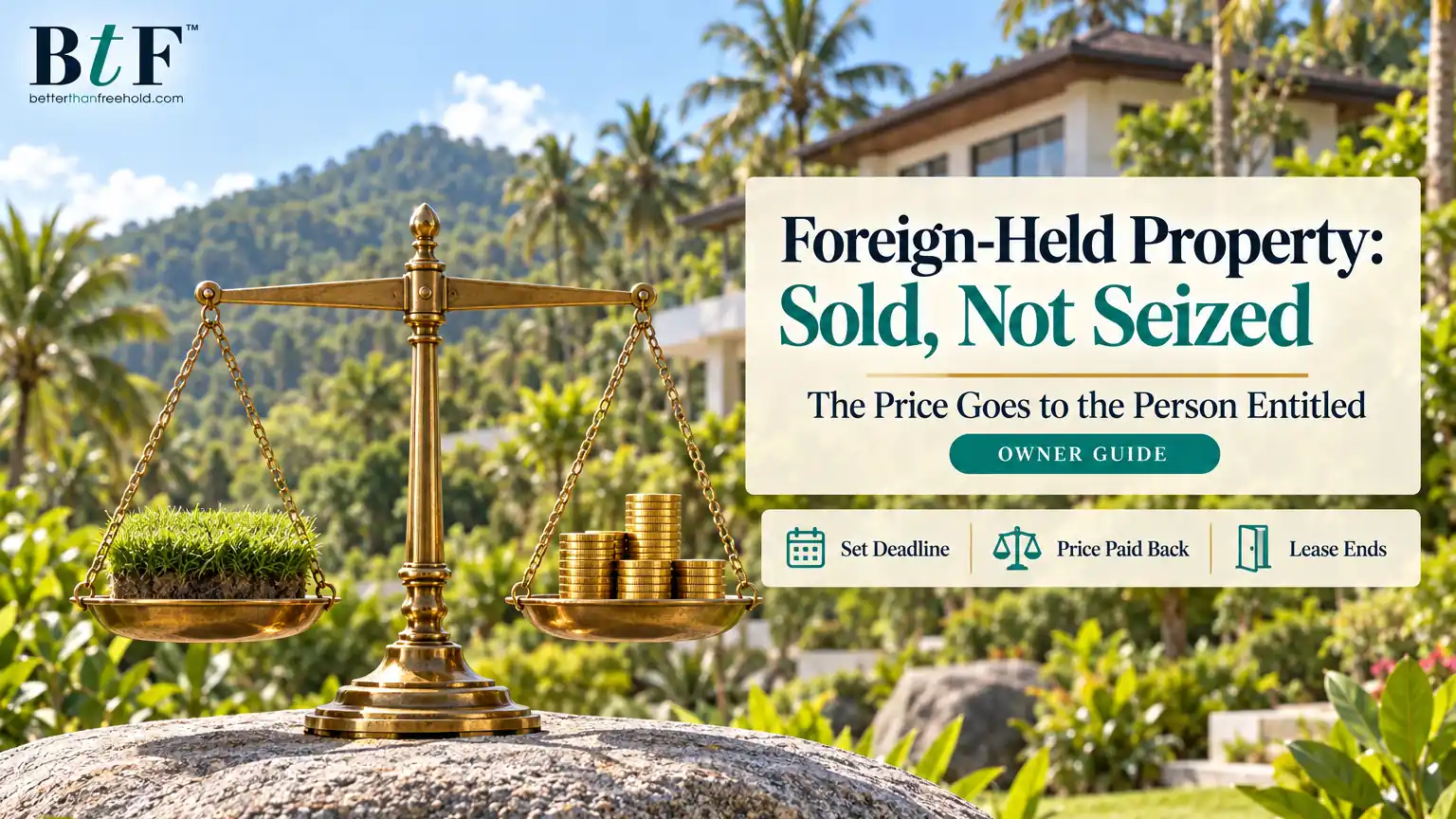
Thailand is not confiscating foreign-held property under the Land Code: land held unlawfully, including through a nominee, is sold on a Director-General deadline of 180 days to one year and the price is paid to the person entitled, while AMLO seizures need a separate money-laundering predicate offence.
Is Thailand Seizing Foreign-Held Property? Forced Sale, Not Confiscation #
Foreigners cannot buy freehold land in Thailand, with narrow exceptions.
Is Thailand confiscating villas from foreigners? #
No. The Land Code does not take unlawfully held land without payment. Where a foreigner holds land unlawfully, directly or through a Thai nominee, the Code orders a sale: the holder receives a Director-General deadline of between 180 days and one year to dispose of it, and the Director-General sells it if that deadline passes.
That is section 94. Section 96 applies the same procedure to land acquired by someone "in place of" a foreigner, which is how the Code describes a nominee holding. The narrow exception is section 96 bis: up to 1 rai for residence, for a foreigner bringing in a qualifying investment above 40 million baht, with the Minister's approval.
None of that is harmless, because the state sets the clock.
What happens to property in a nominee company in Thailand? #
When officials find that land was acquired on behalf of a foreigner, the Land Code directs it into a forced sale. The holder must sell within the deadline the Director-General sets; if no sale happens within the mandated timeframe, the Director-General can sell it under the Code's own disposal rules, on a timetable the owner does not control.
The process is no longer theoretical. On Koh Pha Ngan, officials examined all 1,832 land-holding companies in 2026 and found 112 over the foreign shareholding limit. By August 2026, the provincial governor had issued disposal orders against eight companies covering nine plots, as our report on the Koh Pha Ngan disposal orders sets out.
In Krabi, headlines called 126 rai "seized"; the next step officials described was compulsory disposal, covered in our Krabi cross-shareholding report. A freeze, then a sale.
Who receives the money when the Director-General sells the land? #
The person entitled to the land does. Section 54 of the Land Code requires the Director-General to pay the purchase price to the person entitled to it, and where land is sold in instalments, those payments can stretch up to ten years. The money comes back; the choice of buyer, final price, costs of disposal and control over timing does not.
The three provisions in the Code's disposal chapter matter most to an owner:
- Notice and price (section 52). At least 30 days' notice to everyone with rights in the land, then a price agreed with the holder or fixed by arbitration, reflecting the market price on the day of notice.
- Possession and leases (section 53). From that notice, the Director-General has the right of possession; occupants must leave within one year, and any lease over the plot ends that day.
- The fee (section 50). The Director-General may levy up to 5% of the sale price.
A villa let to tenants loses the lease on the notice date, not at completion. And the Code pays "the person entitled"; in a structure dependent on side agreements, who that person is might be the last thing a non-declared beneficial owner wants decided under pressure.
What criminal penalties come with a forced sale? #
A nominee holding adds criminal exposure. Under section 36 of the Foreign Business Act, acting as a nominee carries up to three years' imprisonment and/or a fine of THB 100,000 to 1,000,000, and the foreigner who uses one faces the same. The court also orders the shareholding to cease, with daily fines of THB 10,000 to 50,000 for non-compliance.
The full consequence is two-fold: forced disposal of the land under the Land Code, and court-ordered cessation of the shareholding under the Foreign Business Act. The exposure is personal, which is why the risks of nominee companies are measured in court dates as well as land values.
When can AMLO actually seize property in Thailand? #
The Anti-Money Laundering Office can seize property today, but only where the asset is connected with a predicate offence under the Anti-Money Laundering Act, such as narcotics, public fraud, large-scale illegal gambling or customs smuggling. Holding land through a nominee is not, by itself, on that list. Most seizure videos circulating at present blur that line.
The mechanism is civil. Under section 48, the AMLO Transaction Committee may order a provisional seizure or attachment for up to 90 days where a connected asset might be moved or hidden. Under section 49, the case goes to the public prosecutor, who asks the court to vest the asset in the State.
Section 50 lets a claimant show they are the real owner and the asset is unconnected with the offence; if the court finds the asset is connected and the claim untenable, section 51 vests it in the State. In August 2026, AMLO referred thirteen cases to prosecutors for forfeiture after owners' objections failed, as our analysis of AMLO's forfeiture burden of proof records.
That is a real seizure, but is tied to a separate criminal act.
Will nominee land be forfeited to the State in future? #
Possibly, but nothing has been enacted. Two proposals point that way. A Land Code section 94 amendment under study would replace the forced sale with forfeiture to the State and no receipt of proceeds, and a proposal before the House ad hoc committee reviewing the AMLA bill would make nominee conduct a money-laundering predicate offence.
The AMLA bill lapsed in December 2025 and was revived by Parliament on 15 May 2026. It still needs second and third readings, the Senate, royal assent and Royal Gazette publication; our guide to the Anti-Money Laundering Act tracks it.
Direction, not deadline, but both proposals would make waiting higher risk and ultimately more expensive.
Why do so many videos say foreigners are losing their homes? #
Because "seized" is the word in the headlines: it compresses three different events into one: a freeze whilst officials verify a structure, a forced sale under the Land Code, and AMLO forfeiture for a separate crime. Only the last of those ends with assets vested in the State, and it requires a predicate offence that the nominee holding alone does not satisfy.
These videos point towards where things are likely heading, but they get the mechanism wrong, and they misrepresent the timetable for legislative changes. An owner facing a disposal order has, at worst, the Director-General's deadline, a price process they do not run and, where a nominee is involved, possible criminal proceedings in parallel.
What should an owner of an at-risk property-owning company do now? #
Act before an order arrives. A planned divestment typically runs from eight to sixteen weeks, which is expected to reduce to under four weeks as Better-than-Freehold™ grows, whereas a disposal order runs on the Director-General's clock and price process, which makes it a sale on the state's timetable.
Start to take action, three steps, in this order: Undertake an independent legal review of how the company was capitalised and who controls it. Assemble the relevant documents that would prove a lawful interest. Then choose a pathway out; our explainer on the divestment process covers why a share transfer now draws Department of Business Development scrutiny.
Only property held through a Thai company can move into Better-than-Freehold™; an existing lease cannot be converted. Whether a particular property qualifies depends on its title, the company's documents and its valuation.
How does Better-than-Freehold™ de-risk the forced-sale risk? #
It does not trigger the red flags that section 96 looks for, because it is designed to meet the law, not circumvent it. Better-than-Freehold™ places legal title with a genuinely Thai-owned company and secures the investor through registered rights held by a trust, not hidden control, so there is no land acquired "in place of" a foreigner and no foreign shareholding ratio for a Land Office to test.
Compliance comes first. Thailand Investor Network, a 100% Thai-owned property holding and management company with no foreign funding or control, holds legal title and grants a 30-year lease registered at the Land Department.
Security follows. The structure uses four principal instruments: a registered lease and a registered first-priority mortgage, a year-30 Option Agreement appended to the mortgage, and a share pledge. These rights are held by a trust for you through SPH Trustees Ltd, and Clear Blue Security Agents (CBSA) mediate and enforce independently of the parties.
The benefits complete the picture: resale by assignment of the trust interest, and succession without Thai probate.
Free to start · No obligation · Your decision at every stage
Key takeaways
- The Land Code orders a sale: sections 94 and 96 give a Director-General deadline of 180 days to one year, after which the Director-General sells.
- The price goes back: section 54 pays the person entitled, possibly in instalments over up to ten years, whilst section 53 ends leases on the plot from the notice date.
- Real seizure runs through AMLO: AMLA sections 48 to 51 allow a 90-day provisional seizure and court-ordered forfeiture, but only for assets tied to a predicate offence.
- Forfeiture of nominee land is a proposal: both the Land Code change and the AMLA nominee predicate remain unenacted; direction, not deadline.
FAQ Section #
Related Terms #
- Nominee Company Risks in Thailand
- Anti-Money Laundering Act Thailand
- Foreign Business Act Thailand
- AMLO Land Seizures and the Burden of Proof
Expert Guidance #
The worst position is the commonest: aware of the crackdown, unsure where the company sits, and waiting. The Land Code is on FAOLEX in English, and the Office of the Council of State publishes Thai legislation, but reading a statute is not testing a structure against it. Contact the Better-than-Freehold™ advisory team to open a confidential case and see your choices before an official sets the timetable.
Free to start · No obligation · Your decision at every stage
Conclusion #
The Land Code forces sales on a deadline of 180 days to one year and pays the price to the person entitled, with FBA penalties and court-ordered cessation of the shareholding alongside for nominee holdings. AMLO seizes only where a separate crime is involved. The proposals that would turn the sale into forfeiture are not law. For an owner of an at-risk property-owning company, that gap is the window to divest on their own terms.
Sources: Land Department, Anti-Money Laundering Office, Office of the Council of State, Department of Business Development
This article is provided for general information only and does not constitute legal, tax, or investment advice. Laws and enforcement practices change; obtain advice tailored to your situation before acting.
About the Author: Andrew Moore FPFS, CDir
Chairman, Better-than-Freehold™

Andrew Moore has been an active investor in Thai property since 2004. He is a Chartered Director and a Fellow of the Personal Finance Society. He has invested in and built properties in several countries since the late 1990s and first invested in Thailand in 2004. Having owned homes in Bangkok, Samui, Phangan and Phuket he can offer a unique perspective on Thailand's property markets together with past and future trends in both ownership and investor opportunities.