
THB 2.1 Billion in Krabi Land Seized as Cross-Shareholding Nominee Scheme Unravels
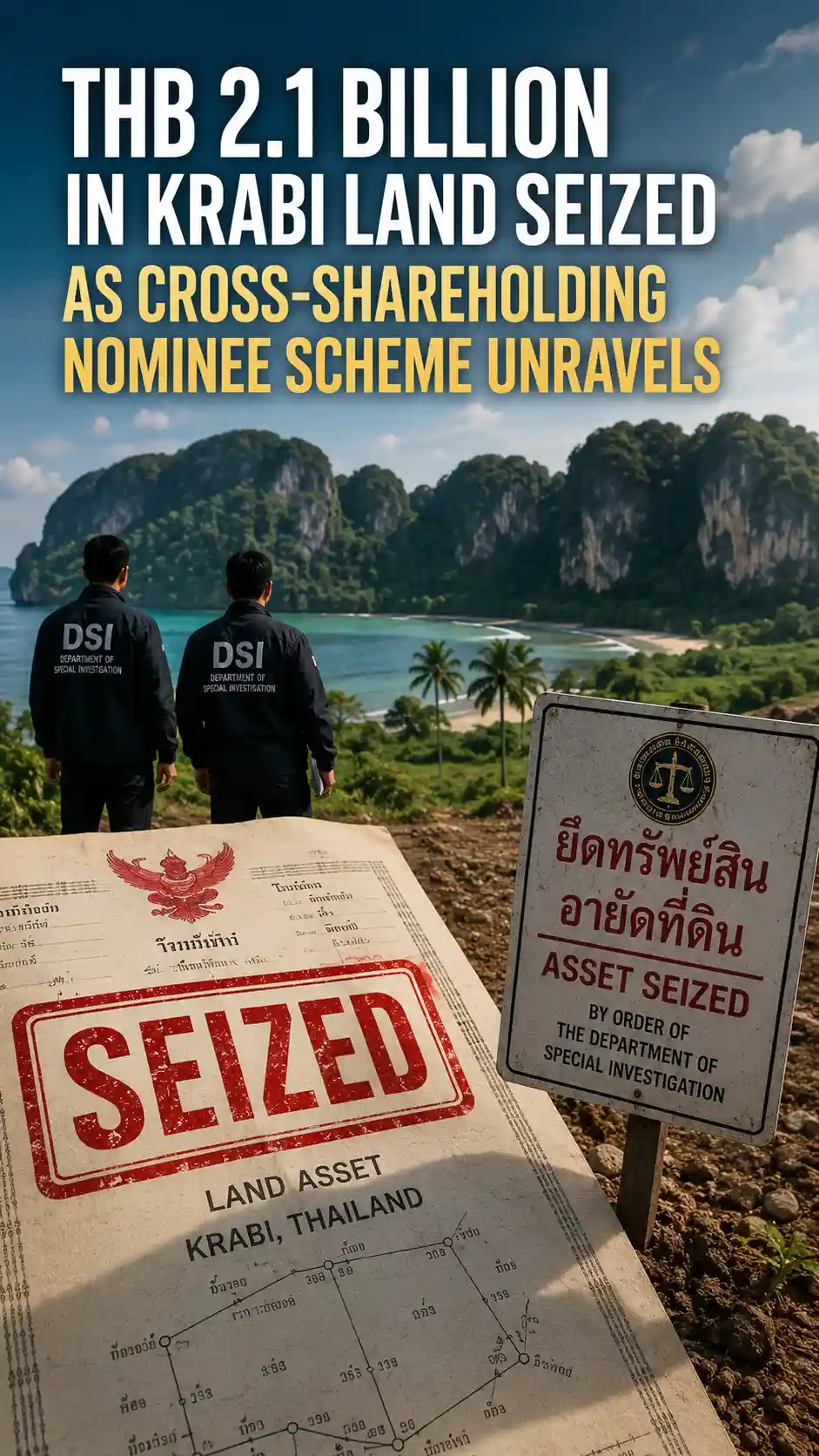
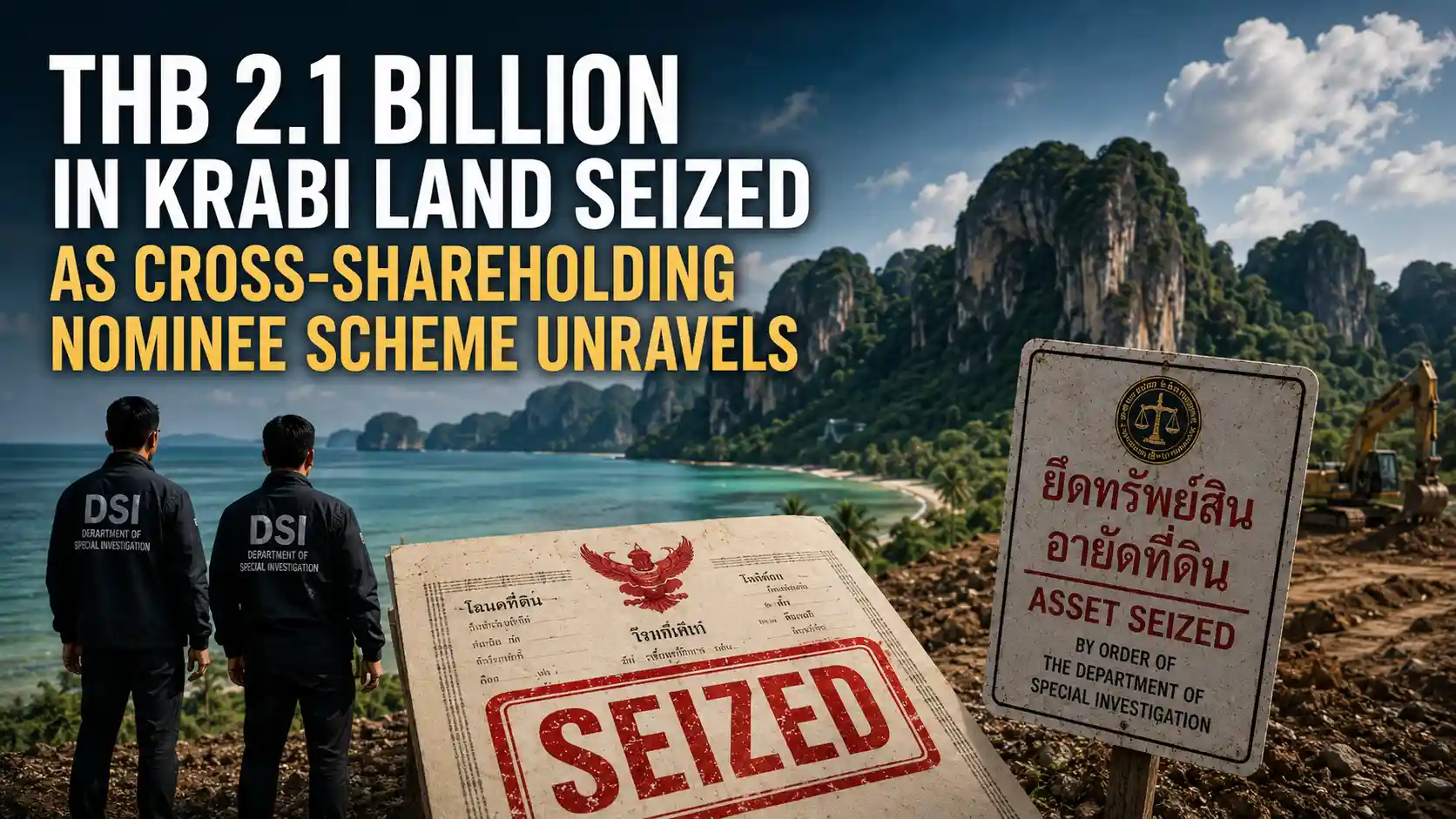
Thailand's Interior Ministry has frozen 126 rai of Koh Lanta land worth THB 2.146 billion after uncovering an alleged nominee scheme built on circular cross-shareholdings, with compulsory disposal now under way.
Thailand's Interior Ministry seized 126 rai of land valued at THB 2.146 billion in Krabi's Koh Lanta district on Friday 24 July 2026, after an investigation found a British national allegedly controlled three Thai-registered companies through circular cross-shareholdings, in one of the largest single-network nominee seizures of the current nationwide crackdown #
Key takeaways
- THB 2.146 billion frozen: 22 plots spanning more than 126 rai on Koh Por, Koh Lanta district, were seized on Friday and cannot be sold or transferred pending legal proceedings.1
- Cross-shareholdings defeated the paperwork: three companies each appeared to respect the 49% foreign shareholding limit, yet circular holdings between them gave one foreign national 99.87% effective control of the landholding company.1
- Compulsory disposal is coming: the Department of Lands will verify the ownership documents before Krabi province orders forced disposal of the land, a process officials expect to take six months to one year.1
- The financial trail is next: police will examine whether foreign funds financed the purchases, and anyone who acted as a nominee or facilitated the structure faces legal action; even the possible involvement of state employees is under review.1
- Better-than-Freehold™ exists for precisely this moment: a securitised lease with registered Land Office instruments provides the security nominee structures pretend to, without hidden control or criminal exposure.
What happened in Koh Lanta? #
- How the Cross-Shareholding Structure Worked
- What Happens to the Seized Land Now
- Why This Seizure Signals a Deeper Enforcement Shift
- What This Means for Existing Nominee Holders
- The Better-than-Freehold™ Solution
- FAQ Section
- Related Terms
- Expert Guidance
How the Cross-Shareholding Structure Worked #
Investigators found that three companies, each individually appearing to comply with Thai shareholding limits, were bound together by circular cross-shareholdings that concentrated 99.87% effective control of the landholding company in the hands of one British national. According to Deputy Interior Minister Polapee Suwunchwee, the network used these structures to acquire 22 plots covering more than 126 rai on Koh Por in Koh Lanta district, then offered the land for sale online.1
The mechanics matter. Cross-shareholding schemes place companies as shareholders in one another so that each entity's register shows a Thai majority, whilst the ownership loop quietly routes control back to a foreign principal.2 The Land Code and the Foreign Business Act look through this arrangement: what counts is effective control, not the appearance of the shareholder list. Formal compliance with the 49% ceiling offered no protection once investigators mapped the loop.
What Happens to the Seized Land Now #
The Interior Ministry has frozen all 22 plots pending legal proceedings. The Department of Lands will first verify the ownership documents; the case then passes to Krabi province for compulsory disposal of the land, a process officials estimate at six months to one year.1 In parallel, police will widen the investigation to trace whether foreign money financed the acquisitions, and Mr Polapee confirmed the probe will also examine whether any state employees were involved.1
Every participant is exposed. Those found to have acted as nominees, and those who facilitated the structure, face legal action.1 During the same operation, officials inspected two Krabi hotels suspected of operating without licences: one stood on land with questionable title documents, the other had been approved as a residential building but converted into hotel use.1
Why This Seizure Signals a Deeper Enforcement Shift #
This is the clearest demonstration yet that Thai authorities are auditing substance, not paperwork. The seized network was not a crude nominee arrangement with obvious proxy shareholders; it was engineered to pass a surface-level shareholding check. It failed anyway, because enforcement now traces effective control through corporate layers.
The Koh Lanta seizure sits within a sustained national campaign. In June, more than 500 officers raided suspected nominee landholdings across Phuket, Phangnga and Krabi, freezing land and buildings worth around THB 1.05 billion and securing dozens of arrest warrants.3 Since January 2026, DBD Order No. 2/2568 has required Thai shareholders in foreign-linked companies at registration to prove the source of their funds, and DBD Order No. 1/2569 added, from April 2026, a written investment confirmation letter from the signing director when a change brought in a foreign director or a foreign minority partner; it never required a sworn statement, a six-month bank-statement audit or an interview. A proposal now under discussion would treat concealed foreign ownership as a money-laundering predicate, opening the door to AMLO asset tracing and retrospective checks.4
What This Means for Existing Nominee Holders #
Anyone currently holding Thai land through a nominee or cross-shareholding structure should treat this seizure as a direct warning: the exposure is the structure itself, not the quality of its disguise. Forced disposal means the land is sold out from under the beneficial owner on the state's timetable, and criminal liability extends to the Thai shareholders and professional facilitators who signed the papers.
The traditional exit, selling the company through a share transfer, has become a legal dead end; the buyer inherits the company's funding history and nominee exposure, and few buyers will accept it. A compliant conversion pathway exists instead: the property asset is acquired directly at the Land Office by a genuinely Thai-owned entity, the empty company is wound up, and the foreign owner's economic interest is secured through registered instruments. For those not yet invested, the lesson is simpler still: choose a structure whose form and substance align from the outset.
The Better-than-Freehold™ Solution #
Better-than-Freehold™ is a securitised lease designed to deliver long-term security without any concealed control. Compliance comes first: Thailand Investor Network (TIN), a 100% Thai-owned property holding and management company with the institutional substance to satisfy 2026 DBD audits, holds legal title as Lessor. The structure is designed to avoid nominee arrangements: there are no shareholding loops to unwind, and no Thai shareholder funding for a registrar to test.
Security follows through four instruments: a 30-year registered lease, a first-priority registered mortgage with the Option Agreement appended to it, and a share pledge over 100% of TIN's holding company, held for the investor by SPH Trustees Ltd, an offshore trustee whose Labuan FSA licence is in progress, acting as Lessee through a bare trust. Clear Blue Security Agents (CBSA), an independent Thai lawyer-led security agency appointed by both parties, holds enforcement and step-in rights, with THAC Arbitration as the backstop. The benefits flow from that foundation: succession without probate, assignable beneficial interest, and optional financing through Siam Venture Capital, expected from H1 2027 and not yet live. Where nominee owners in Krabi now face forced disposal, Better-than-Freehold™ investors hold registered rights the Land Office itself recognises.
Free to start · No obligation · Your decision at every stage
FAQ Section #
Related Terms #
- Nominee Company Risks Thailand - why proxy Thai shareholding is illegal and how enforcement detects it
- Krabi Ghost Office Nominee Raid - earlier Krabi enforcement against nominee networks
- Land Department Nominee Landholding Crackdown - nationwide landholding enforcement
- Foreign Business Act Thailand - how Thai law defines foreign control of companies
- Nominee Structure Conversion - exit pathways that avoid the share-transfer dead end
- Better-than-Freehold™ Structure Explained - how registered instruments create security beyond a bare lease
Expert Guidance #
Immediate Action Required #
If you hold Thai property through a company with layered or reciprocal shareholdings, obtain an independent legal review now. The Krabi case shows that structures designed to pass shareholding checks are being unwound through effective-control analysis, and forced disposal proceeds on the state's timetable, not yours.
Long-term Security Strategy #
Long-term security in Thai property comes from registered rights, not concealed control. A structure whose legal form matches its economic substance, secured by Land Office-registered instruments and independent enforcement, is designed to remove the audit risk and preserves succession and exit value for your heirs.
For comprehensive assessment and implementation of compliant structures, contact our expert team today.
Free to start · No obligation · Your decision at every stage
Conclusion #
The Koh Lanta seizure demonstrates how far Thai enforcement has evolved: a THB 2.146 billion landholding, engineered for paper compliance, dismantled through effective-control analysis and now headed for compulsory disposal. With funding trails, facilitators and even officials under investigation, and inspections continuing nationwide, the era of surviving on disguise is over. Foreign investors seeking durable security in Thai property should hold it the way Better-than-Freehold™ does: openly, contractually, and registered at the Land Office.
References #
This article is provided for general information only and does not constitute legal, tax, or investment advice. Laws and enforcement practices change; obtain advice tailored to your situation before acting.
Footnotes #
-
Bangkok Post. (2026, July 26). "B2.1bn in land seized in nominee bust." https://www.bangkokpost.com/thailand/general/3291810/b21bn-in-land-seized-in-nominee-bust ↩ ↩2 ↩3 ↩4 ↩5 ↩6 ↩7 ↩8 ↩9 ↩10
-
Chiang Rai Times. (2026, July 26). "Krabi Authorities Seize: $62 Million Nominee Estate Held By British National." https://www.chiangraitimes.com/news/krabi-land-seizure-foreign-nominee-bust/ ↩
-
The Nation Thailand. (2026, June 21). "Thailand targets Bt1bn suspected foreign nominee land network in Andaman provinces." https://www.nationthailand.com/news/general/40067693 ↩
-
Thai Examiner. (2026, July 24). "Crackdown turned nightmare for foreign owners with plan to treat nominee schemes as money laundering." https://www.thaiexaminer.com/thai-news-foreigners/2026/07/24/crackdown-turned-nightmare-for-foreign-owners-plan-to-treat-nominee-schemes-as-money-laundering/ ↩
About the Author: Andrew Moore FPFS, CDir
Chairman, Better-than-Freehold™

Andrew Moore has been an active investor in Thai property since 2004. He is a Chartered Director and a Fellow of the Personal Finance Society. He has invested in and built properties in several countries since the late 1990s and first invested in Thailand in 2004. Having owned homes in Bangkok, Samui, Phangan and Phuket he can offer a unique perspective on Thailand's property markets together with past and future trends in both ownership and investor opportunities.