
DBD Orders Bank-Statement Checks in 16 Risk Provinces from 1 August 2026
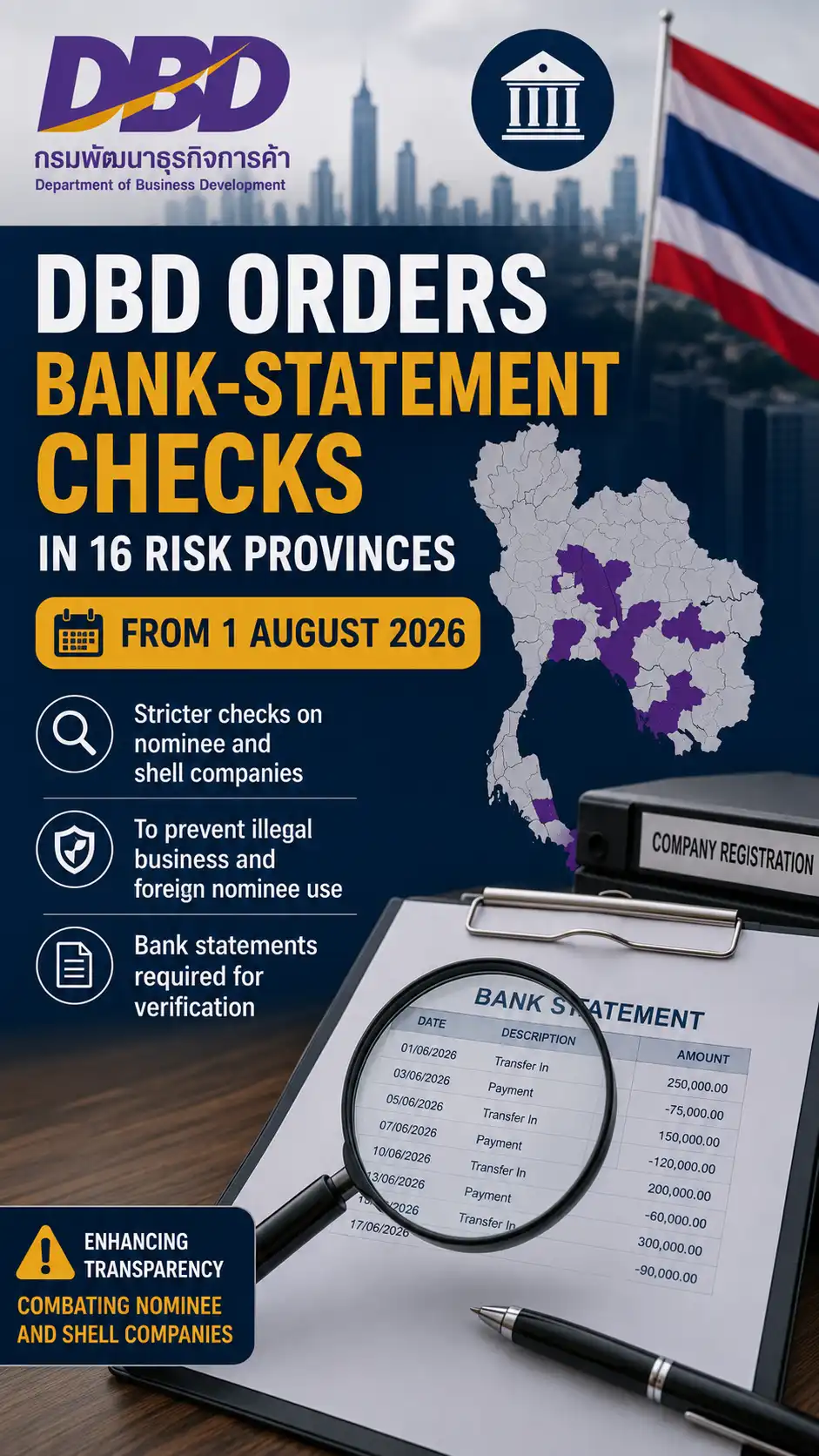
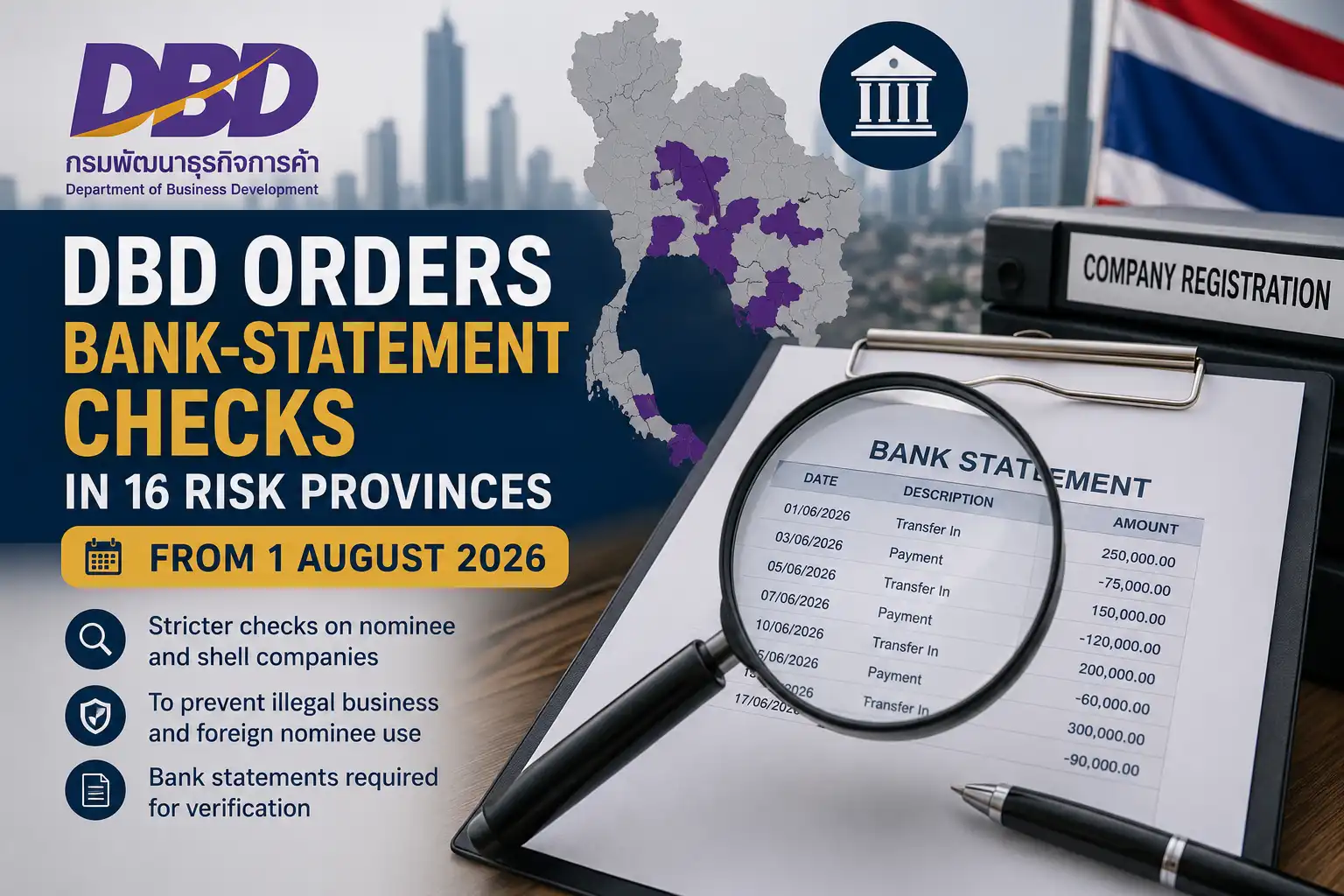
Thailand's DBD will demand bank statements from Thai shareholders and directors in nearly 120,000 flagged companies from 1 August 2026, with registrations rejected on any mismatch. What the new financial-trail order means for foreign property buyers and owners.
The Department of Business Development will require bank statements from Thai shareholders and company directors in high-risk firms from 1 August 2026, after flagging nearly 120,000 companies with minority foreign shareholdings across 16 provinces, in the most direct financial-trail scrutiny Thai company registration has ever faced #
Key takeaways
- New DBD order effective 1 August 2026; Thai shareholders investing alongside foreigners, and the directors who receive investment funds, must submit personal bank statements at registration.1
- Nearly 120,000 companies flagged; the DBD's analysis of registration data, shareholder records, and accounting-office information identified companies with foreign shareholdings between 0.01% and 49.99% requiring inspection, with the sharpest focus on holdings of 40% to 49.99%.1
- 16 named risk provinces; Chonburi, Surat Thani, Phuket, Krabi, Phang Nga, Prachuap Khiri Khan, Chiang Mai, Chiang Rai, Mae Hong Son, Rayong, Bangkok, Samut Prakan, Samut Sakhon, Nakhon Pathom, Nonthaburi and Pathum Thani; the first ten alone contain 18,720 very high-risk companies.1
- Instant rejection on mismatch; registrars will cross-check declared investment against actual transfers in the correct proportion and period; any inconsistency means immediate refusal.1
- Better-than-Freehold™ requires none of this; a securitised lease registered at the Land Office involves no Thai nominee shareholders, no bank-statement audits, and nothing for a registrar to reject.
What is the DBD's new financial-trail order? #
- What the New Order Requires
- Which Provinces and Companies Are Targeted
- Legal and Compliance Context
- Impact on Foreign Property Buyers and Owners
- The Better-than-Freehold™ Solution
- FAQ Section
- Related Terms
- Expert Guidance
What the New Order Requires #
The order introduces three connected measures that take effect on 1 August 2026, each aimed at the financial reality behind a company's shareholder register rather than the paperwork on its face.1
First, bank statements become mandatory. According to Poonpong Naiyanapakorn, director-general of the Department of Business Development under the Commerce Ministry, the DBD will request statements from Thai nationals who invest jointly with foreigners, and from the company directors responsible for receiving investment funds.1
Second, registrars will run consistency checks. Officials will examine whether the declared investment matches actual financial transfers, in the correct proportion and within the correct period. Where the numbers do not reconcile, the registrar rejects the registration immediately; there is no cure period and no negotiation at the counter.1
Third, ownership changes come under continuous watch. The order explicitly covers companies that begin life as 100% Thai-owned and later shift directors or shareholders to foreign nationals. The DBD reports this staged conversion has become a favoured evasion route precisely because earlier orders concentrated on companies that were foreign-linked from day one.1
The director-general also issued a pointed warning to the professions that make these structures possible: more than 80,000 accountants and over 90,000 lawyers and legal consultants were told to stop supporting or advising on nominee registration, since foreign nationals cannot complete Thai-language filings without local professional help.1
Which Provinces and Companies Are Targeted #
The DBD's data analysis flagged nearly 120,000 companies in which foreign nationals hold between 0.01% and 49.99% of shares, with particular attention on holdings between 40% and 49.99%, the band sitting just beneath the legal ceiling.1
Sixteen provinces are named. Ten are tourism and coastal economies: Chonburi, Surat Thani, Phuket, Krabi, Phang Nga, Prachuap Khiri Khan, Chiang Mai, Chiang Rai, Mae Hong Son and Rayong. Within these ten, the DBD identified 18,720 very high-risk and 14,118 high-risk companies. The remaining six cover Bangkok and its metropolitan ring: Bangkok, Samut Prakan, Samut Sakhon, Nakhon Pathom, Nonthaburi and Pathum Thani, contributing a further 7,579 very high-risk and 1,752 high-risk companies.1 By late August one of the sixteen had gone province-wide: Surat Thani's nominee screen covered its whole company register.
The registration pipeline itself shows why the DBD is moving. Of more than 18,246 new companies established in the past six months, 3,270 were assessed as at risk of being structured to support nominee shareholding, involving nationals of China, Britain, India, France, Singapore, Russia, Japan and South Korea among others.1
Legal and Compliance Context #
The August order is the third tightening in eight months, and each has narrowed the same gap: the distance between what a shareholder register declares and what the money actually did. DBD Order No. 2/2568, effective 1 January 2026, first required Thai shareholders to evidence their source of funds at registration and reportedly cut nominee registration attempts by roughly 60% in the first quarter.2 DBD Order No. 1/2569, effective 1 April 2026, added a written investment confirmation letter from the signing director when a change brought in a foreign director or a foreign minority partner; it never required a sworn statement, a six-month bank-statement audit or an interview.
Nominee arrangements are illegal under the Foreign Business Act B.E. 2542 (1999), and the Commerce Ministry has framed the campaign as a matter of protecting fair competition, noting that companies considered at risk of nominee structures rose from 523 in 1998 to 11,746 in 2025.3 Enforcement is no longer a single-agency affair: the Revenue Department, Department of Lands, Royal Thai Police and Department of Special Investigation are now integrating their data with the DBD to pursue prosecutions.1
The direction of travel is unambiguous. Each order pushes verification earlier in the company's life, deeper into personal finances, and wider across the professional ecosystem that once facilitated these structures.
Impact on Foreign Property Buyers and Owners #
For anyone holding Thai property through a company with Thai nominee shareholders, the order changes the risk calculus in two ways. Adding a foreign authorised director to an all-Thai board now needs a written investment letter, and a company incorporated on or after 1 August 2026 that changes directors within one year must show its registered capital was received, scrutiny that most nominee arrangements cannot survive, because the Thai shareholders never genuinely funded their shares. And the traditional exit, selling the company itself, becomes harder with every tightening: the buyer inherits the company's funding history, so the pool of willing and viable purchasers shrinks. Owners in this position should be examining conversion pathways out of the company structure before an audit or a rejected filing forces the issue, and structured routes exist that transfer the property asset directly at the Land Office rather than the company's shares.
For prospective buyers still being offered a "49/51 company" by an agent or developer, the message is simpler: from 1 August, the structure might fail at the registrar's counter before the ink dries. A rejected registration is the good outcome; the bad one is a completed purchase inside a company that later fails an inspection, with a forced sale of the land and court-ordered cessation of the shareholding among the available consequences.4
The Better-than-Freehold™ Solution #
The Better-than-Freehold™ answer to this order is structural: it is designed to avoid nominee arrangements. The structure is a securitised lease built on four security instruments (the lease and mortgage registered at the Land Office, the Option Agreement appended to the mortgage, and a share pledge). A 100% Thai-owned property holding and management company, Thailand Investor Network (TIN), holds legal title as Lessor with its own Thai-funded paid-up share capital exceeding THB 100 million, precisely the financial substance the DBD's audits are designed to find. SPH Trustees Ltd, an offshore trustee whose Labuan FSA licence is in progress, acts as Lessee for the investor through a bare trust. The 30-year lease and the first-priority mortgage are registered at the Land Office, with the Option Agreement appended to the mortgage and a 100% share pledge alongside, giving security that runs beyond the lease term without asking any Thai national to pretend to own anything.
Because every party's role matches its paperwork, there is no declared investment to reconcile against bank transfers, no shareholder to interview, and no registration for a registrar to reject. The structure was designed for exactly the regulatory environment that arrives on 1 August. For owners currently in nominee companies, conversion routes into the structure exist. Financing or deferred payment is being developed as a future workstream, with first loan products due to come online in H1 2027.
Free to start · No obligation · Your decision at every stage
FAQ Section #
Related Terms #
- Nominee Company Risks Thailand - why paper shareholders fail substance audits
- DBD Order 1/2569 Compliance Guide - the April 2026 rules on share transfers
- DBD Order 2/2568 Company Registration - the January 2026 source-of-funds order
- Nominee Structure Conversion - exit pathways that avoid the share-transfer dead end
- Better-than-Freehold™ Structure Explained - how the securitised lease works
Expert Guidance #
Immediate Action Required #
If you hold Thai property through a company with Thai shareholders, establish now whether those shareholders can evidence their own funds with bank statements. If they cannot, do not initiate any share transfer, director change, or capital amendment after 1 August without professional advice, since any of these can trigger the new checks. Buyers currently being offered company structures should pause and seek an independent legal review before committing funds.
Long-term Security Strategy #
The regulatory trajectory since January 2026 points one way: structures that depend on a gap between legal form and financial substance are being systematically closed. A durable holding strategy needs every registered position to match economic reality. A securitised lease achieves this by design, giving registered security at the Land Office, succession through an offshore trust, and enforcement rights independent of any Thai shareholder's cooperation. Owners in legacy structures should treat conversion as a planned project, not an emergency response to an inspection letter.
For comprehensive assessment and implementation of compliant structures, contact our expert team today.
Free to start · No obligation · Your decision at every stage
Conclusion #
The 1 August order completes a shift that began in January: Thai company registration now runs on verified money, not declared money. With nearly 120,000 companies flagged, 16 provinces named, and registrars empowered to reject filings on any financial mismatch, the space for nominee arrangements is closing at the counter itself. For foreign buyers and owners, the strongest position is the one with nothing to hide and nothing to reconcile, and that is a question of structure, chosen before the registrar asks.
References #
This article is provided for general information only and does not constitute legal, tax, or investment advice. Laws and enforcement practices change; obtain advice tailored to your situation before acting.
Footnotes #
-
The Nation. (2026, July 16). "DBD tightens nominee crackdown, orders financial-trail checks in 16 risk provinces." https://www.nationthailand.com/news/general/40068701 ↩ ↩2 ↩3 ↩4 ↩5 ↩6 ↩7 ↩8 ↩9 ↩10 ↩11 ↩12 ↩13 ↩14
-
Bangkok Post. (2026, April 26). "Thailand ramps up crackdown on nominee businesses." https://www.bangkokpost.com/thailand/general/3244294/thailand-ramps-up-crackdown-on-nominee-businesses ↩
-
Bangkok Post. (2026, July 5). "Nominee crackdown steps up." https://www.bangkokpost.com/business/general/3281069/nominee-crackdown-steps-up ↩
-
Siam Legal International. (2026, May 28). "Thailand Expands Crackdown on Nominee Shareholders." https://www.siam-legal.com/thailand-law/thailand-expands-crackdown-on-nominee-shareholders/ ↩
About the Author: Andrew Moore FPFS, CDir
Chairman, Better-than-Freehold™

Andrew Moore has been an active investor in Thai property since 2004. He is a Chartered Director and a Fellow of the Personal Finance Society. He has invested in and built properties in several countries since the late 1990s and first invested in Thailand in 2004. Having owned homes in Bangkok, Samui, Phangan and Phuket he can offer a unique perspective on Thailand's property markets together with past and future trends in both ownership and investor opportunities.