
Police Dismantle Alleged Chinese Nominee Network Behind 33 Bangkok Luxury Homes
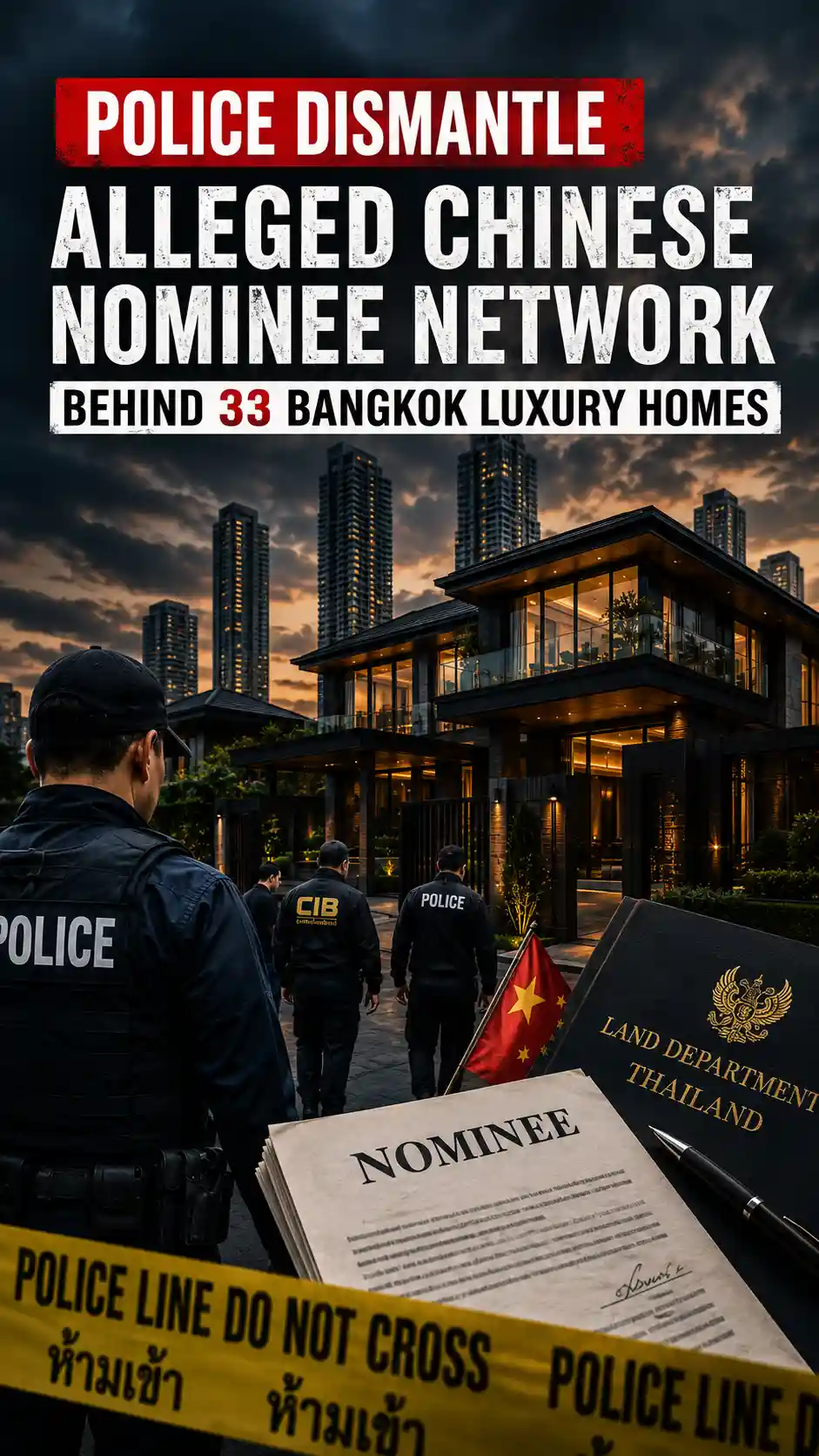

Thai economic crime police have moved against an alleged Chinese-backed nominee network accused of using 33 companies to acquire luxury Bangkok homes worth over THB 1.275 billion. What the case reveals for foreign property buyers and owners.
The Economic Crime Suppression Division announced on 22 July 2026 that it has launched legal action against an alleged Chinese-backed nominee network accused of using 33 Thai-registered companies to acquire luxury homes worth more than THB 1.275 billion along Bangkok's Pattanakarn and Krungthep Kreetha roads, with lawyers, accountants and property agents now under investigation alongside the shareholders #
Key takeaways
- 33 luxury homes, THB 1.275 billion plus; the alleged network used 33 companies with Thai nominee shareholders to acquire houses across three developments in eastern Bangkok, in an operation police dubbed "Dismantling the Chinese Nominee Capital Empire".1
- A single alleged funder; investigators say a Chinese national supplied the capital behind the companies, working with two Thai associates to register the network, while a law firm and an accounting company allegedly handled the paperwork.1
- Three acquisition methods identified; police categorised the arrangements into direct nominee-company purchases (28 homes), purchases or reservations funded by the alleged principal (2 homes), and shareholding structures altered to add Chinese nationals after sale agreements (3 homes).1
- 20 locations searched, extensive evidence seized; raids between 26 June and 7 July 2026 recovered three land-title deeds, 30 sets of sale and ownership documents, 15 passports, 13 electronic devices, 24 sets of rental agreements and company records, and six company seals.1
- Better-than-Freehold™ holds nothing this way; the securitised lease structure involves no nominee shareholders, no concealed funding, and no gap between registered ownership and financial reality for investigators to find.
What is the Bangkok Chinese nominee network case? #
- What the Investigation Found
- How the Alleged Network Operated
- Legal and Compliance Context
- Impact on Foreign Property Buyers and Owners
- The Better-than-Freehold™ Solution
- FAQ Section
- Related Terms
- Expert Guidance
What the Investigation Found #
According to the Central Investigation Bureau's Economic Crime Suppression Division, the case began with information from the Department of Business Development and complaints from residents of housing developments along Pattanakarn and Krungthep Kreetha roads, who reported disturbances involving Chinese nationals living in the estates. Officers examined properties across five residential projects and identified 33 luxury houses in three of them allegedly acquired through companies using Thai nationals as nominee shareholders.1
Police allege that a Chinese national directed the operation and supplied the money used to establish the companies and purchase the homes, working with a close Thai associate and her mother to register more than 33 companies. A law firm and an accounting company allegedly handled the registrations and related documentation. Investigators suspect the corporate layer existed to conceal the true source of funds and give foreign nationals control over residential property through Thai names on the shareholder register.1
Searches at 20 locations between 26 June and 7 July 2026 produced a substantial evidence haul: three land-title deeds, 30 sets of property sale agreements and ownership documents, 15 passports issued by several countries, 13 electronic devices, 24 sets of rental agreements, receipts, company records and financial statements, six company seals, and items resembling Thai and foreign banknotes valued at roughly THB 1.4 million. The devices and documents are now being examined to trace the movement of money and identify further connected parties.1
How the Alleged Network Operated #
After examining financial transactions and questioning witnesses, accounting representatives and property agents, investigators divided the alleged arrangements into three categories, and the breakdown is instructive for anyone assessing how these structures actually work.1
The bulk, 28 houses, were allegedly purchased through companies established with Thai nominee shareholders and funded by the alleged Chinese principal. A further two houses were purchased or reserved by nominee-shareholder companies using his money. The remaining three involved a different sequence: after Chinese customers agreed to buy the houses, the companies' shareholding or directorship structures were changed to include Chinese nationals. A Chinese-operated property agency was then allegedly used to find customers to rent or purchase the homes.1
The common thread across all three methods is the one investigators say will decide the case: whether the Thai shareholders exercised genuine control over the companies, or were listed only to satisfy legal ownership requirements while the registered capital and purchase money came from elsewhere.1
Legal and Compliance Context #
Nominee arrangements, where Thai nationals hold shares on behalf of foreigners to circumvent ownership limits, are illegal under the Foreign Business Act B.E. 2542 (1999), and land acquired through them is exposed under the Land Code B.E. 2497 (1954), with penalties spanning prosecution, forced disposal of the land and court-ordered cessation of the shareholding. This case sits squarely inside the enforcement pattern that has defined 2026: the Commerce Ministry has vowed to intensify its campaign against nominee shareholding, which it says distorts market competition, and the number of companies considered at risk rose from 523 in 1998 to 11,746 in 2025.2
Two features of the Bangkok case mark the current phase of enforcement. First, the referral chain: the investigation started with Department of Business Development data before the Economic Crime Suppression Division took over, showing the inter-agency data integration between the DBD, police, the Department of Special Investigation and other bodies operating in practice, not just on paper.1 Second, the professional net: police explicitly listed the lawyers, accountants and property agents connected to the network as subjects of investigation. That lands within days of the DBD's warning to more than 80,000 accountants and over 90,000 lawyers and legal consultants to stop supporting nominee registrations, and just before the DBD's new financial-trail checks take effect on 1 August 2026.13
Impact on Foreign Property Buyers and Owners #
For foreign owners currently holding Thai property through company structures, the case demonstrates that exposure does not require a DBD audit letter. This investigation began with neighbours' complaints and routine registration data; the trigger can be that ordinary. Once investigators start tracing funds, the question of whether Thai shareholders genuinely invested is answered by bank records, not by the company affidavit, and every professional who touched the structure has an incentive to cooperate. Owners in this position should be assessing conversion pathways out of the company structure while it remains a choice; routes exist that transfer the property asset directly at the Land Office rather than relying on a company share sale that no compliant buyer will now touch.
For prospective buyers, particularly in the luxury segment where agents still quietly offer company structures, the case is a preview of the downside. The properties involved here have been seized as evidence, the paperwork is in police hands, and any purchaser or tenant who dealt with the network's agency faces disruption at best. A structure that depends on concealment fails precisely when scrutiny arrives, and scrutiny is now the operating environment. On 10 October 2026, police searched four eastern Bangkok housing estates and said 94 houses were held through companies using Thai nominee shareholders.
The Better-than-Freehold™ Solution #
Everything the investigators are hunting for in this case, hidden funders, paper shareholders, capital that does not match the register, is absent by design from a Better-than-Freehold™ holding. The structure is a securitised lease, not a concealed purchase. Thailand Investor Network (TIN), a 100% Thai-owned property holding and management company with its own Thai-funded paid-up share capital exceeding THB 100 million, holds legal title openly and acts as Lessor. SPH Trustees Ltd, an offshore trustee whose Labuan FSA licence is in progress, acts as Lessee for the investor through a bare trust. Four principal instruments, a 30-year registered lease, a first-priority registered mortgage, a year-30 Option Agreement appended to the mortgage and a 100% share pledge, secure the investor's position beyond the lease term.
There is no gap between form and substance for a financial trail to expose: the Thai owner genuinely owns and is genuinely capitalised, and the foreign investor has a beneficial interest in leasehold, contractual and security rights that Thai law permits foreigners to hold. Better-than-Freehold™ delivers the security the buyers in this case were presumably seeking, without the criminal exposure their structure created. For owners in legacy nominee companies, conversion routes into the structure exist. Financing or deferred payment is being developed as a future workstream, with first loan products due to come online in H1 2027.
Free to start · No obligation · Your decision at every stage
FAQ Section #
Related Terms #
- Nominee Company Risks Thailand - why paper shareholders fail financial-trail analysis
- DBD Financial-Trail Checks from 1 August 2026 - the new bank-statement rules across 16 risk provinces
- Gatekeeper Liability - professional exposure for lawyers, accountants and agents
- Nominee Structure Conversion - exit pathways that avoid the share-transfer dead end
- Better-than-Freehold™ Structure Explained - how the securitised lease works
Expert Guidance #
Immediate Action Required #
If you hold Bangkok or resort property through a company whose Thai shareholders did not genuinely fund their shares, treat this case as the template for what an investigation looks like: it can start with a neighbour's complaint, and it reaches the lawyers and accountants who built the structure. Do not wait for contact from authorities; obtain an independent review of your structure now, and avoid any share transfer or company amendment that could trigger the DBD's new checks arriving on 1 August.
Long-term Security Strategy #
Durable foreign property holding in Thailand now requires structures where every registered position matches financial reality. A securitised lease achieves this openly: registered security at the Land Office, succession through an offshore trust, and enforcement rights that do not depend on any Thai shareholder's cooperation or silence. Owners in legacy structures should plan conversion as a managed project on their own timetable, rather than a forced response after an investigation begins.
For comprehensive assessment and implementation of compliant structures, contact our expert team today.
Free to start · No obligation · Your decision at every stage
Conclusion #
The "Chinese Nominee Capital Empire" case shows Thai enforcement operating at full reach: DBD data feeding police investigations, financial trails overriding shareholder registers, and professional enablers treated as suspects rather than bystanders. Thirty-three luxury homes are now evidence in a criminal case because the structure holding them depended on concealment. For foreign buyers and owners, the lesson is structural, not geographic: what fails is the gap between paper and money, and the only reliable protection is a holding with no such gap to find.
References #
This article is provided for general information only and does not constitute legal, tax, or investment advice. Laws and enforcement practices change; obtain advice tailored to your situation before acting.
Footnotes #
-
The Nation. (2026, July 22). "Police expose alleged Chinese nominee network behind 33 luxury homes." https://www.nationthailand.com/news/general/40068930 ↩ ↩2 ↩3 ↩4 ↩5 ↩6 ↩7 ↩8 ↩9 ↩10 ↩11 ↩12 ↩13
-
Bangkok Post. (2026, July 5). "Nominee crackdown steps up." https://www.bangkokpost.com/business/general/3281069/nominee-crackdown-steps-up ↩
-
The Nation. (2026, July 16). "DBD tightens nominee crackdown, orders financial-trail checks in 16 risk provinces." https://www.nationthailand.com/news/general/40068701 ↩
About the Author: Andrew Moore FPFS, CDir
Chairman, Better-than-Freehold™

Andrew Moore has been an active investor in Thai property since 2004. He is a Chartered Director and a Fellow of the Personal Finance Society. He has invested in and built properties in several countries since the late 1990s and first invested in Thailand in 2004. Having owned homes in Bangkok, Samui, Phangan and Phuket he can offer a unique perspective on Thailand's property markets together with past and future trends in both ownership and investor opportunities.