
Leasehold vs Freehold in Thailand: Which Is Better for Foreign Buyers? (2026)
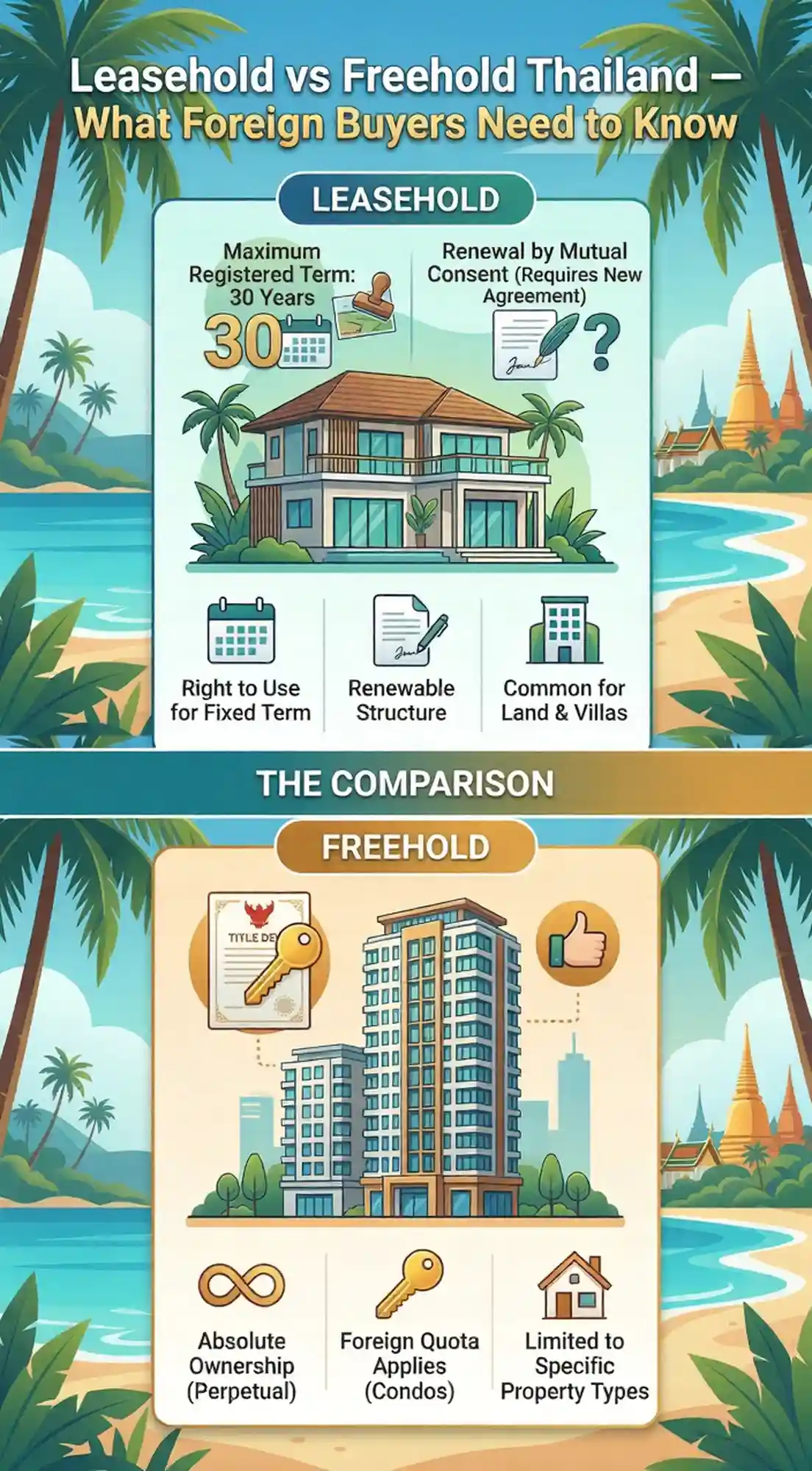
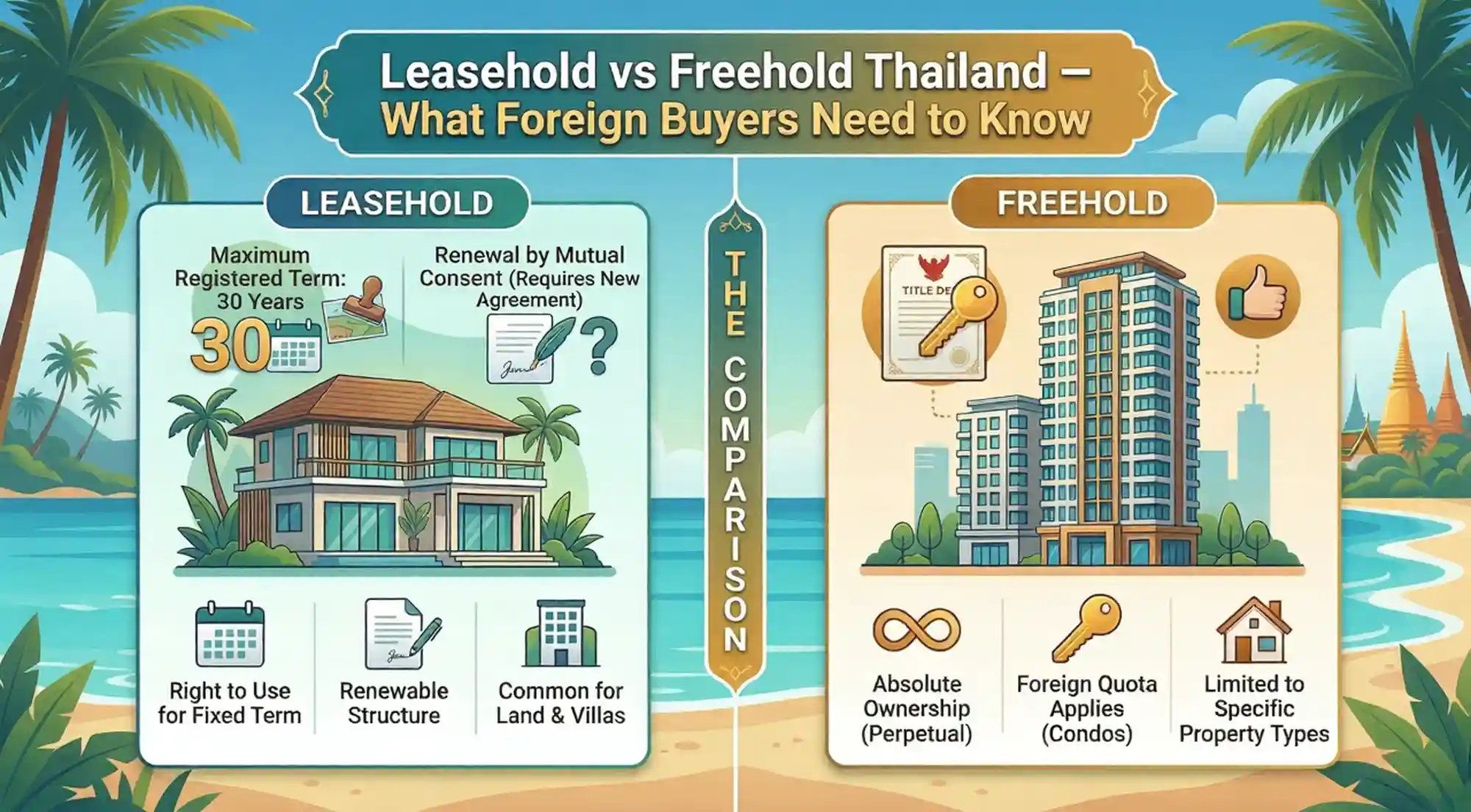
Foreigners generally cannot buy freehold land in Thailand. This 2026 comparison scores registered leasehold, condo freehold and the nominee route against Better-than-Freehold™, with a dedicated head-to-head against ordinary leasehold.
Foreigners generally cannot buy freehold land; this 2026 comparison scores the routes that actually exist #
Last updated 13 October 2026.
Key takeaways
- The comparison is a false binary: leasehold is legal but limited; freehold land is generally unavailable to foreigners; the nominee route that once bridged the gap is now actively prosecuted, not tolerated as a grey area.
- Enforcement has teeth: between September 2024 and July 2025, authorities took legal action against 873 nominee offenders, and in 2025 the DBD set an inspection target list of 46,918 high-risk companies across six high-risk sectors, real estate among them.
- Ordinary leasehold has a structural flaw: a 30-year lease loses value every year it runs, is rarely financeable, and depends on the lessor's goodwill at renewal.
- Better-than-Freehold™ closes that gap: the same registered lease, plus an Option Agreement appended to a first-priority registered mortgage and a share pledge, delivering succession without Thai probate that a standard lease cannot promise.
Is leasehold or freehold better for foreign buyers in Thailand? #
- Full Comparison
- What Does Freehold Actually Mean Under Thai Law?
- Where Does Registered Leasehold Fall Short?
- The Nominee Route
- Better-than-Freehold™ vs Ordinary Leasehold
- Which Path Actually Fits Your Situation?
- FAQ Section
- Related Terms
- Expert Guidance
Full Comparison: Leasehold, Nominee "Freehold," Condo Freehold and Better-than-Freehold™ #
Civil and Commercial Code s.540 caps a lease at 30 years, and renewal promises beyond that are contractual, not registered rights. Freehold land is closed to foreigners outside narrow exceptions such as Land Code s.96 bis, and using a Thai nominee to hold it is an offence under Foreign Business Act s.36. Better-than-Freehold™ builds on a registered lease, adding a year-30 Option Agreement appended to a first-priority registered mortgage, an assignable trust interest and succession without Thai probate.
The table below scores the four routes buyers compare on the factors that decide real transactions: registered leasehold, the nominee shortcut, condominium freehold and Better-than-Freehold™. Only the nominee route is illegal.
| Factor | Registered Leasehold | Nominee "Freehold" | Condo Freehold | Better-than-Freehold™ |
|---|---|---|---|---|
| Legal status | Compliant | Criminal offence under the FBA | Compliant, within quota | Within Thai law |
| What you hold | Use rights, 30 years | Shares in a nominee company | Unit title, not land | Beneficial interest via trust |
| Land ownership | No | On paper (company holds) | No (common area only) | No; a Thai entity holds title |
| Maximum term | 30 years | None; enforcement risk instead | Unlimited | 30 years, with contractual year-30 mechanisms |
| Renewal | Contractual promise only | Not applicable | Not applicable | Contractual year-30 mechanism |
| Financing | Almost never available | Now untouchable to lenders | Rarely offered | Up to 50% LTV (expected H1 2027, not yet live) |
| Enforcement exposure | None | Forced disposal and court-ordered cessation of the shareholding | None | None |
| Succession | Depends on contract wording | Exposed to unwinding | Requires Thai probate | Without Thai probate |
| Independent enforcement | Court-dependent | Not enforceable | Court-dependent | CBSA step-in rights |
| Wasting asset | Yes (value declines) | N/A | No | No (designed to avoid) |
What Does Freehold Actually Mean Under Thai Law? #
Freehold, recorded on a Chanote title deed, is the strongest form of land ownership Thailand offers: absolute, unlimited in time, and freely transferable. It is also, for land, generally closed to foreigners by statute rather than by custom. The Land Code has reserved freehold title to Thai nationals and Thai-majority entities since 1954. Proposals to relax that rule, including 99-year lease extensions discussed in 2025, remain unenacted.
Who can actually hold it? #
Thai nationals and Thai-majority companies hold freehold land as a matter of course. Foreigners have one practical route in: condominium units, and even that comes with a ceiling. Under the Condominium Act, foreign ownership cannot exceed 49% of the sellable area in any single building; once that quota fills, later foreign buyers are locked out regardless of price.
A condo unit bought this way is genuine ownership. It just is not land. Common areas and the ground beneath the building remain outside the buyer's title, which is exactly why anyone wanting a villa rather than an apartment cannot solve their problem through the condo route. Registration for any lease exceeding three years, and for freehold transfers, sits with the Department of Lands. Our land-ownership guide names the four situations that sit close enough to look like exceptions.
Does buying condo freehold cost the same as it does for Thai buyers? #
No, and this catches buyers out at completion. The government's 0.01% transfer fee stimulus, running to 30 June 2027 on properties up to THB 7 million, applies to Thai nationals only. Foreign buyers pay the standard 2% transfer fee regardless of price. Budget for it; nobody enjoys discovering a fee at the Land Office that a Thai neighbour did not pay.
Where Does Registered Leasehold Fall Short? #
A registered lease gives exclusive use of a property for its term, enforceable against the world once entered on the title deed. It is fully legal and carries no enforcement risk. It is also, structurally, a shrinking asset.
Civil and Commercial Code s.540 caps any single registered lease at 30 years; no exceptions. Developers market "30+30+30" packages, but the second and third 30s are contractual renewal promises, not registered rights, and Thailand's courts have confirmed they bind only the original parties. A lease at year one is worth 30 years of use. The same lease at year 20 is worth 10, and a lender pricing collateral treats that decline as exactly what it is: a wasting asset, harder to finance every year it survives. A separate registered right does not escape that ceiling either, because Sap Ing Sith, created under the Sap-Ing-Sith Act B.E. 2562 (2019), also runs for a maximum of 30 years, contains no renewal provision in the Act, and returns buildings to the landowner at termination under section 11 unless otherwise agreed.
Recourse sits with the Thai courts, and court-dependent enforcement means time and cost for a foreign litigant in an unfamiliar system. For a renewal promise, that recourse is only a contract claim against the original landlord, one reason 30+30+30 renewal promises fail. Succession is contract-dependent too; whether a lease passes cleanly to heirs rests on wording most agreements never address with care.
These are not theoretical risks. They are structural constraints that every foreign buyer accepting a standard leasehold position inherits, and they are the reason the leasehold versus freehold debate persists despite freehold land being generally unavailable to foreigners.
The Nominee Route: Why It Was Never Really Freehold #
For decades the market's answer to this gap was the Thai nominee company: Thai shareholders hold the majority stake on paper whilst a foreign buyer funds the purchase and runs it in practice. The company holds freehold title. The foreigner holds shares, dependent on nominees who were never genuine investors.
That was always precarious. It is now criminal. Foreign Business Act s.36 reaches both the Thai nominee and the foreign beneficiary, carrying up to three years' imprisonment and/or a fine of THB 100,000 to 1,000,000, on top of forced disposal by the Land Department and court-ordered cessation of the shareholding. Where money laundering is engaged, AMLA s.60 adds one to ten years or a fine of THB 20,000 to 200,000, or both; s.61 extends the same exposure to consenting directors. A proposed amendment to the AMLA bill, which the Cabinet approved in February 2025 without a nominee clause, would tighten this further by making nominee conduct an explicit AMLA predicate offence; it is still before a House committee after Parliament revived the lapsed bill in May 2026, so treat this as direction, not deadline.
The market has begun to move accordingly, and officials on Koh Samui report foreign buyers switching from company ownership into 30-year leases to avoid liability for unlawful land holding, disclosed alongside a screen of 3,892 land-holding companies on the island, 2,579 of them showing nominee characteristics.
Detection has moved from paper reviews to pattern recognition. IBAS, the Department of Business Development's AI screening system, cross-references shareholding, funding and director clusters. Suspicious transaction reporting and asset freezing sit with AMLO, which can act pre-conviction under AMLA s.48. DBD Order 2/2568 required source-of-funds documentation from 1 January 2026, and high-risk registrations fell roughly 60% in the first quarter. Order 1/2569, effective 1 April 2026, went further: a written investment confirmation letter from the signing director when a change brought in a foreign director or a foreign minority partner. High-risk registrations fell about 75% in the first 23 days of April. Both orders were consolidated into Central Registrar Order 2/2569 from 1 August 2026, which keeps the three-month Thai shareholder bank statements at incorporation, adds a written letter explaining the investment and the receiving director's bank statement, and is stricter in places. A 23-agency enforcement pact, signed 29 April 2026 at Government House, coordinates all of it.
The nominee route never delivered freehold. It delivered exposure dressed up as a shortcut. Our nominee company risks page covers the 2026 raid record and the exit path for existing owners.
Better-than-Freehold™ vs Ordinary Leasehold #
This is the comparison engines and buyers both need and rarely get: not leasehold against an illegal shortcut, but leasehold against a structure that is structured in accordance with Thai law and built to remove its own weaknesses. Better-than-Freehold™ starts from the same registered lease and adds what ordinary leasehold cannot offer alone. What it adds is set out in our definition of the four contracted entities and the principal instruments they hold: legal title stays with an independent Thai company, and the investor's position runs through registered and contractual rights rather than shareholding.
Compliance comes first. Thailand Investor Network, a 100% Thai-owned property holding and management company with its own Thai-funded paid-up share capital, holds legal title and grants the same 30-year registered lease any compliant buyer could arrange independently. TIN's Thai ownership is genuine, with no foreign funding and no foreign control, exactly what current screening looks for.
Security follows, and this is where the two paths diverge. Ordinary leasehold ends at year 30 with a renewal promise that binds nobody but the original signatories. Better-than-Freehold™ appends a year-30 Option Agreement to a first-priority registered mortgage, alongside a share pledge over the holding company. SPH Trustees Ltd, an offshore trustee whose Labuan FSA licence is in progress, holds the investor's rights. Clear Blue Security Agents (CBSA) hold enforcement and step-in rights, with THAC arbitration as the backstop and mortgage enforcement through the Thai courts as a last resort. That is a registered and contractual position sitting where ordinary leasehold has only a hope.
| Ordinary Leasehold | Better-than-Freehold™ | |
|---|---|---|
| Year 30 outcome | Renewal at the lessor's discretion | Contractual year-30 mechanism |
| What is held | Personal use right | Assignable interest in an offshore trust |
| Transfer to heirs | Depends on lease wording; often contested | Succession without Thai probate |
| Dispute resolution | Thai courts, case by case | Clear Blue Security Agents mediation first, THAC arbitration as backstop, Thai courts as last resort |
The benefits complete the picture. Because the trust holds an assignable interest rather than a bare tenancy, resale happens by assigning that interest, not by renegotiating with a landlord under no obligation to cooperate. Financing follows the same logic: a lender can price an Option Agreement appended to a registered mortgage in a way it cannot price a promise, up to 50% LTV, a future workstream expected from H1 2027 and not yet live, in a market the Bank of Thailand shows recovering only slowly. Ordinary leasehold offers none of this. It offers thirty years and then a conversation.
Free to start · No obligation · Your decision at every stage
Which Path Actually Fits Your Situation? #
Nobody weighing leasehold against freehold is choosing between two versions of the same thing. A short-stay condo buyer inside the 49% quota has a simple answer already. A villa buyer does not, because condo freehold cannot reach land, and that is where the real decision sits. For that decision, the Better-than-Freehold™ route for foreign buyers pairs a registered lease with mortgage and share-pledge security beyond year 30.
For anyone currently holding property through an existing high-risk or at-risk property-owning company, urgency matters more than preference. Divestment out of that structure typically runs eight to sixteen weeks, a window expected to shorten to under four weeks as Better-than-Freehold™ scales. Waiting does not make the position safer; it makes it older evidence. Our step-by-step buying guide walks through the compliant routes in order.
FAQ Section #
Related Terms #
- What Is Better-than-Freehold™: the structure's legal framework and components
- Nominee Company Risks in Thailand: current prosecution patterns and the divestment path
- Can Foreigners Own Land in Thailand?: the land-ownership rule and the four main exceptions
- Usufruct in Thailand: Rights, Limits and Risks: a narrower alternative right worth understanding
Expert Guidance #
The leasehold versus freehold question has been asked wrongly for years, as though the answer had to come from two flawed options. It does not. Leasehold's weaknesses, the wasting term and the court-dependent enforcement, are fixable with registered security, not reasons to reach for a nominee structure that fixes nothing and adds criminal exposure instead.
Immediate Action Required #
Anyone deciding between these paths should get independent Thai legal counsel before signing anything. Anyone already holding an at-risk property-owning company should treat that conversation as overdue: any corporate action can trigger scrutiny under Central Registrar Order 2/2569. Contact the Better-than-Freehold™ advisory team for a confidential assessment before acting.
Long-term Security Strategy #
Learn how Better-than-Freehold™ works before assuming leasehold's limits are simply the cost of doing business in Thailand. The structure starts from the same registered lease every compliant buyer can already arrange and builds the missing piece on top.
Free to start · No obligation · Your decision at every stage
Conclusion #
Leasehold remains legal and limited. Freehold land remains closed to foreigners, outside narrow exceptions. The nominee route that used to paper over the gap between them is now an active prosecution risk. Better-than-Freehold™ starts from the same lease every compliant buyer can already arrange and builds the missing piece on top: an Option Agreement appended to a registered mortgage, a share pledge and succession without Thai probate. The choice for 2026 was never leasehold versus freehold. It is a compliant structure that closes leasehold's gaps against one that does not.
This article is provided for general information only and does not constitute legal, tax, or investment advice. Laws and enforcement practices change; obtain advice tailored to your situation before acting.
About the Author: Andrew Moore FPFS, CDir
Chairman, Better-than-Freehold™

Andrew Moore has been an active investor in Thai property since 2004. He is a Chartered Director and a Fellow of the Personal Finance Society. He has invested in and built properties in several countries since the late 1990s and first invested in Thailand in 2004. Having owned homes in Bangkok, Samui, Phangan and Phuket he can offer a unique perspective on Thailand's property markets together with past and future trends in both ownership and investor opportunities.