
Better-than-Freehold™ vs Freehold vs Leasehold: How Foreign Buyers Hold Thai Property

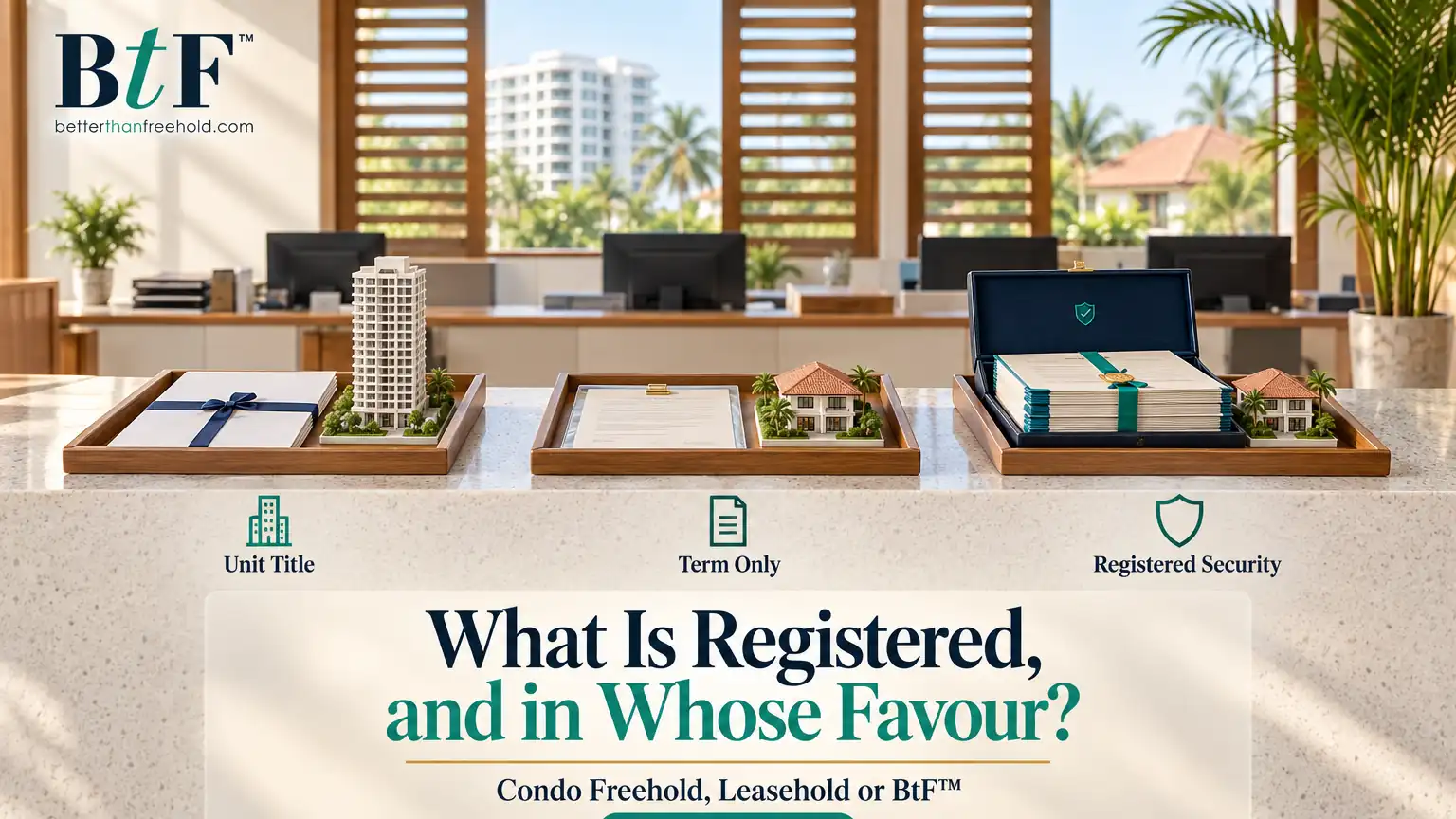
A three-way comparison of condominium freehold, a conventional 30-year registered lease, and Better-than-Freehold™: what is registered, what happens at year 30, and which route suits which buyer.
Three lawful routes: what each registers, and what each is worth at year 30 #
Key takeaways
- Only one of the three is title: condominium freehold puts a foreigner's name on the unit title, within the 49% foreign quota set by the Condominium Act.
- A bare lease registers the 30-year term only: the Civil and Commercial Code sets that cap, and any renewal promise attached to it is the weakest part of the document.
- Better-than-Freehold™ uses four principal instruments: a registered 30-year lease, a registered first-priority mortgage with the Option Agreement appended, and a 100% share pledge, all held by a Labuan FSA-regulated trustee.
- None of the three gives a foreigner land title: Thai law does not permit it, so the comparison is between registered rights of different depth.
What Is the Difference Between Freehold, Leasehold and Better-than-Freehold™ in Thailand? #
| Feature | Condominium freehold | Conventional 30-year registered leasehold | Better-than-Freehold™ |
|---|---|---|---|
| Registered at the Land Office | Unit title in the buyer's own name | The lease alone, under Civil and Commercial Code section 538 | Lease and first-priority mortgage, with the Option Agreement appended to the mortgage; the share pledge sits at company level |
| Term and year 30 | Perpetual; no expiry | Term ends; continuation depends on the landowner agreeing fresh terms | Option Agreement sets out the agreed year-30 terms: negotiation of a new lease on known terms, sale to a legally qualified purchaser, or refund of the option premium |
| Legal title held by | The foreign buyer | The Thai landowner throughout | Thailand Investor Network, a 100% Thai-owned property holding and management company |
| Eligibility constraints | Capped at 49% of a building's saleable area; funds remitted from abroad | Open to foreigners; leasing is permitted where acquisition is not | Open to foreigners; available on land and villas, not only condominium units |
| Security for the buyer | None needed; title is the security | None; the tenant holds a term only | Registered first-priority mortgage, plus a pledge of 100% of the holding property holding company's shares |
| Enforcement route | Ordinary title remedies in the Thai courts | Contract claim against the landowner, damages the usual outcome | Clear Blue Security Agents mediate and enforce, holding step-in rights; expert panel with arbitration as backstop, security enforced through the Thai courts |
| Inheritance | Thai probate, subject to the quota | Unexpired term passes only if the contract allows assignment | Corporate trustee does not die; interest passes without Thai probate |
| Financeability | Thai bank lending to foreigners is limited but exists | Rarely accepted as security | To 50% loan-to-value (expected H1 2027) |
| Resale mechanics | Sale of the unit, if a foreign quota slot is free | Assignment of the lease, with the landowner's consent | Assignment of the beneficial interest; registered lease and mortgage unchanged |
| Typical use case | A city apartment buyer who values simplicity | A short-horizon buyer, or a villa buyer offered nothing else | A land or villa buyer wanting security, succession and a defined year-30 outcome |
- What Does Condominium Freehold Actually Give a Foreigner?
- Why Is a Conventional 30-Year Lease Weaker Than It Looks?
- What Is Better-than-Freehold™, and What Is It Not?
- Which Route Fits Which Buyer?
- FAQs
- Related Terms
- Expert Guidance
- Conclusion
What Does Condominium Freehold Actually Give a Foreigner? #
Condominium freehold gives a foreign buyer registered title to a specific unit, in their own name, with no expiry date. The Condominium Act permits foreign ownership of up to 49% of the saleable area of any registered condominium building, and purchase funds must be remitted into Thailand from abroad in foreign currency.
It is the cleanest route Thai law offers a foreigner, and for many buyers, the right answer. Anyone who wants a city apartment and has no interest in land should look here and stop. The title is entered on the public record maintained by the Department of Lands.
The quota is the main constraint. It applies building by building, so a unit resells to another foreigner only while a slot remains free, and nothing outside the building qualifies: no villa, no plot, no house on land. Rental income is assessable under rules administered by the Revenue Department, and the buyer's own tax residency affects what is ultimately owed.
Why Is a Conventional 30-Year Lease Weaker Than It Looks? #
A registered lease gives a foreigner the right to occupy land or a house for a term capped at 30 years by the Civil and Commercial Code and registered at the Land Office once it runs beyond three years. It is lawful, common, and what most villa buyers receive. Its weakness is year 31, when continuation rests on a promise.
Marketing copy advertises "30+30+30", presenting a 90-year horizon. That horizon depends on the renewal promise, and Supreme Court jurisprudence has treated prepaid renewals on terms frozen at signing as ineffective, since a renewal of that kind is not a genuine future agreement. Where the promise fails, the tenant holds a damages claim against a landowner who might no longer exist.
Lenders rarely accept a lease term as security, so a tenant seldom has a financing route. Assignment on resale needs the landowner's consent, a negotiation rather than a right. Our leasehold versus freehold guide scores four routes side by side, including the nominee company.
What Is Better-than-Freehold™, and What Is It Not? #
Better-than-Freehold™ is a securitised lease. The 30-year registered lease stays in place, and three further contractual rights and safeguards sit alongside it: an Option Agreement governing year 30, a first-priority mortgage over the property, and a pledge of 100% of the Lessor's holding-company shares. SPH Trustees Ltd, regulated by the Labuan Financial Services Authority, holds all four in a bare trust.
Compliance comes first. The Lessor, Thailand Investor Network, is a 100% Thai-owned property holding and management company with institutional capital, built to meet the capital-verification checks the Department of Business Development, under the Ministry of Commerce, applies at registration. Security follows. The mortgage and pledge give the trust registered claims at the property and corporate level. Clear Blue Security Agents hold the step-in rights, and they mediate and enforce independently. The benefits complete it: succession without Thai probate, resale by assignment of the trust interest, and financing to 50% loan-to-value (expected H1 2027).
It does not give a foreigner freehold land ownership; no structure in Thailand delivers that. Nor is it a nominee company, where a Thai shareholder holds shares for the benefit of a foreigner, and both sides face Foreign Business Act penalties, forced disposal of the land under the Land Department and court-ordered cessation of the shareholding. Under proposed amendments now before a House committee, which Parliament has not passed, the Anti-Money Laundering Office would also be able to reach the proceeds. And the year-30 pathway is a separate Option Agreement, appended to the registered mortgage, with three defined outcomes, rather than a 30+30+30 renewal clause repeating today's terms.
Which Route Fits Which Buyer? #
The decision turns on what is being bought, and on how long the holding must last, including beyond the buyer's lifetime. Condominium freehold suits the buyer who wants an apartment, values a title deed in their own name and accepts the quota. Adding structure to a condominium purchase wastes money.
A conventional registered lease suits a short horizon: ten or fifteen years, no succession concern, no need to borrow. It fits badly where the property is meant to reach the buyer's children, because the value sits in a shrinking term and a renewal promise that might not hold.
Better-than-Freehold™ is built for the third case: land or a villa, a long horizon, and a buyer who wants the year-30 question answered in writing today, not negotiated by their heirs. It also suits owners in a high-risk property-owning company, where divestment closes the exposure set out in our guide to nominee company risks. Buyers new to the subject should start with our guide to buying property in Thailand legally.
FAQ Section #
Related Terms #
- Leasehold vs Freehold in Thailand
- What Is Better-than-Freehold™?
- Nominee Company Risks in Thailand
- How to Buy Property in Thailand as a Foreigner
Expert Guidance #
Buyers arrive asking which route is "best", and the answer depends on the property. For an apartment, condominium freehold wins on simplicity. For land, there is no freehold answer for a foreigner, so the choice is between a term with a promise attached and a term with registered security attached. Ask one question of any document put in front of you: what is registered, and in whose favour? See how BtF™ works, or discuss your choices with the advisory team.
Free to start · No obligation · Your decision at every stage
Conclusion #
Thailand offers foreign buyers three lawful ways to hold residential property, and each registers something different. Condominium freehold is title, bounded by a quota. A conventional 30-year lease is a term, bounded by a renewal promise that might not survive scrutiny. Better-than-Freehold™ is that lease with three further positions around it, anchored by a registered mortgage, so the buyer holds ownership rights supported by security rather than goodwill. Match the route to the property and the horizon.
This article is provided for general information only and does not constitute legal, tax, or investment advice. Laws and enforcement practices change; obtain advice tailored to your situation before acting.
About the Author: Andrew Moore FPFS, CDir
Chairman, Better-than-Freehold™

Andrew Moore has been an active investor in Thai property since 2004. He is a Chartered Director and a Fellow of the Personal Finance Society. He has invested in and built properties in several countries since the late 1990s and first invested in Thailand in 2004. Having owned homes in Bangkok, Samui, Phangan and Phuket he can offer a unique perspective on Thailand's property markets together with past and future trends in both ownership and investor opportunities.