Thailand Signs 23-Agency MOU Against Nominee Firms and Grey Capital
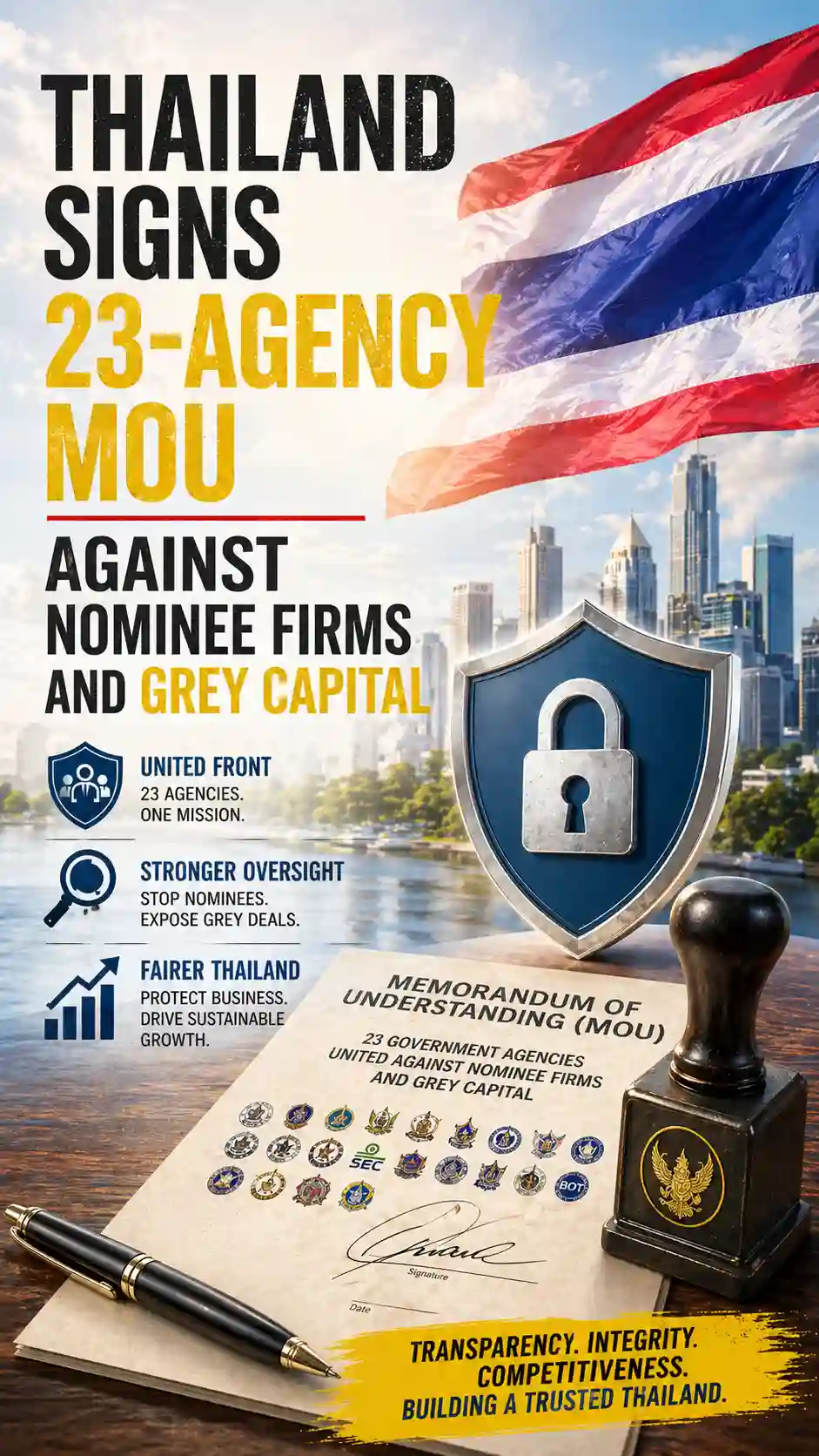
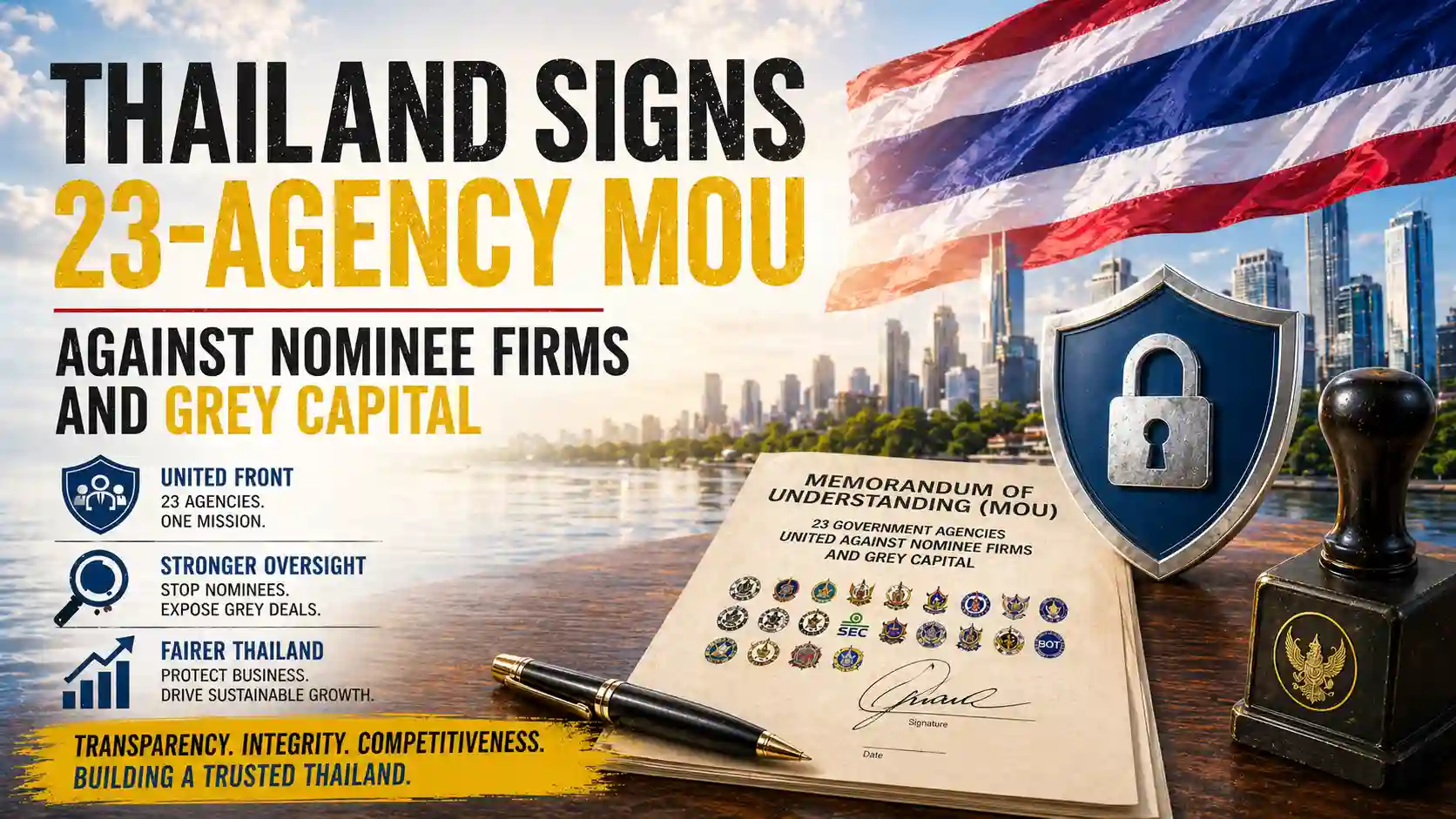
Thailand has signed a 23-agency MOU at Government House to integrate data, monitor suspicious businesses and dismantle nominee structures. Effective immediately.
Thailand Signs 23-Agency MOU Against Nominee Firms and Grey Capital #
Government House signing on 29 April 2026 binds 23 state agencies and private-sector bodies into a single coordinated framework to detect concealed foreign control #
The Thai government has formally elevated nominee enforcement from a fragmented regulatory issue into a coordinated national law-enforcement priority. On 29 April 2026, Deputy Prime Minister and Commerce Minister Suphajee Suthumpun presided over the signing of a memorandum of understanding at Government House under the theme "Closing economic cracks, joining forces to defeat nominees", binding 23 state agencies and private-sector bodies into a shared enforcement framework targeting nominee structures and grey capital.1
Key Takeaways
- Twenty-three agencies signed an MOU at Government House on 29 April 2026, integrating enforcement across business registration, banking, taxation, anti-money-laundering, securities, land, labour and tourism.[1]
- The DBD's database of 980,000+ juristic entities is being linked with the Ministry of Digital Economy and Society and the Royal Thai Police to detect connections between registered businesses, mule accounts and crime networks.1
- Deputy PM Suphajee confirmed nominee structures are no longer a fragmented regulatory problem but a serious law-enforcement priority, with operations under way since October 2025.1
- Better-than-Freehold™ provides a fully compliant ownership structure that eliminates nominee exposure entirely whilst maintaining secure registered property rights and access to offshore financing.
What Did Thailand's 23-Agency MOU Establish? #
Quick Answer
Quick Answer: A Government House signing on 29 April 2026 bound 23 agencies including the Bank of Thailand, AMLO, DSI, Revenue Department, Department of Lands, Royal Thai Police, BoI, SEC and the DBD into a coordinated framework for data integration, business monitoring and enforcement against nominee structures and grey capital.1 The MOU is structured around three pillars: cross-agency data integration, a forward-looking monitoring mechanism to identify nominee activity before it causes wider damage, and a public confidence pillar protecting compliant operators.1 The arrangement is operational immediately.
- What Happened
- Why the MOU Matters
- Who Is Affected
- Legal and Compliance Context
- What Happens Next
- How Better-than-Freehold Addresses This Enforcement Environment
- FAQ Section
- Related Terms
- Expert Guidance
What Happened #
Deputy PM Suphajee Suthumpun was joined at the signing by the Minister of Digital Economy and Society and the Minister of Tourism and Sports.1 She stated that the issue would no longer be treated as a fragmented regulatory problem, but as a serious law-enforcement priority requiring effective coordination between agencies responsible for business registration, banking, taxation, law enforcement, investment, securities and anti-money-laundering.1 She confirmed that operations had already been under way since October 2025, including arrests, crackdowns and stricter proactive prevention measures.1
The 23 signatories include the Bank of Thailand, AMLO, DSI, Revenue Department, Customs Department, Department of Lands, Royal Thai Police, BoI, SEC, Stock Exchange of Thailand, the DBD, and 12 other agencies covering the Ministry of Digital Economy and Society, Interior, employment, tourism, industry, agriculture, national parks, internal security, trade competition, food and drug, and industrial standards.1
Why the MOU Matters #
Earlier enforcement waves operated through individual ministries, with each agency holding its own dataset. Nominee structures historically exploited the gap between these silos: a Thai company with foreign minority shareholding might pass DBD scrutiny whilst its banking patterns, land holdings, tax declarations and beneficial ownership disclosures sat in separate institutions, never cross-referenced.
The MOU closes those silos. The DBD's 980,000+ juristic entity records, integrated with the Ministry of Digital Economy and Society and the Royal Thai Police, allow authorities to detect links between registered businesses, mule accounts and crime networks at the database level.1 Detection no longer depends on a triggering event; the integrated database itself surfaces anomalies.
Who Is Affected #
Foreign property holders sit at the centre of the exposure. The Department of Lands is one of the 23 signatories, which means property registrations, lease filings and ownership transfers are now part of the integrated dataset.1 Combined with the DBD's beneficial ownership data and the Bank of Thailand's transaction records, the trail of any nominee-held property is visible in ways it was not before. Professional facilitators face pattern-based detection rather than complaint-based investigation, and Thai nominees face identical penalties to the foreign principals they front for under Section 36 of the Foreign Business Act.
Legal and Compliance Context #
Under Section 36 of the Foreign Business Act, foreigners using Thai nominees face imprisonment up to three years and fines of THB 100,000 to 1,000,000. Thai nominees face identical penalties. Where nominee conduct is treated as a predicate offence under the Anti-Money Laundering Act, penalties escalate to imprisonment up to 10 years, fines reaching 10 million baht, and asset forfeiture under AMLO authority. The 23-agency MOU formalises the data flow that allows AMLO to investigate in parallel with the DBD, Revenue Department and Department of Lands rather than waiting for a referral.
What Happens Next #
The MOU shifts enforcement from reactive to systemic. Any corporate action - a director change, share transfer, lease registration, capital amendment or annual filing - now passes through cross-checks comparing DBD records against banking activity and beneficial ownership disclosures. For holders considering exit, voluntary restructuring undertaken before a trigger event is materially different in cost and consequence from restructuring under investigation.
How Better-than-Freehold™ Addresses This Enforcement Environment #
The structure operates entirely outside the structural risk that the 23-agency MOU is built to detect. Because it does not rely on foreign equity in a Thai operating company, it does not engage the FBA constraints that nominee structures are designed to circumvent, and it does not depend on Thai shareholders, concealed beneficial ownership or shared registration addresses.
Thailand Investor Network (TIN) holds legal title as a genuinely independent Thai entity. SPH Trustees, a Labuan FSA-regulated trust company, holds the registered lease, option to renew, mortgage and pledge rights. Clear Blue Security Agents (CBSA) registers all contracts with Thai authorities and provides independent enforcement without court dependency. Because there is no nominee shareholder to declare and no concealed beneficial ownership to surface, the structural triggers the MOU framework relies on simply do not exist.
FAQ Section #
When did the 23-agency MOU take effect?˅
The MOU was signed at Government House on 29 April 2026 and is operational immediately, building on enforcement work already under way since October 2025.
Which agencies are involved?˅
Signatories include the Bank of Thailand, AMLO, DSI, Revenue Department, Department of Lands, Royal Thai Police, BoI, SEC, Stock Exchange of Thailand, and the DBD, plus additional agencies across digital economy, employment, tourism, industry, agriculture, and standards.
Does the MOU affect property already held through a nominee company?˅
Yes. With the Department of Lands included in the MOU, property registrations, lease filings, and transfer records can now be cross-referenced with company, tax, and banking data.
What does grey capital mean in this context?˅
Grey capital refers to funds operating outside formal regulated channels, often through concealed ownership structures or undeclared transactions.
What penalties apply under the FBA and AMLA?˅
Section 36 of the Foreign Business Act provides imprisonment up to three years and fines of THB 100,000 to 1,000,000. AMLA exposure can escalate to imprisonment up to 10 years, fines up to 10 million baht, and asset forfeiture.
How quickly should existing nominee holders act?˅
Promptly. The MOU shifts enforcement from reactive investigations to systemic detection, making early voluntary restructuring materially safer than waiting for an enforcement trigger.
Related Terms #
- Thailand's "Quick Big Win" Cuts At-Risk Nominee Company Registrations by 60% in Q1 2026 - Q1 2026 enforcement results and the operational template for the MOU
- DBD Registration Order Nominee Crackdown Thailand 2026 - Director certification under DBD Order No. 1/2026 effective 1 April 2026
- Nominee Company Investigation Thailand 2026 - Inter-agency enforcement framework and AMLA exposure
- Nominee Structure Conversion: Legal Process in Thailand - Step-by-step pathway from nominee company to compliant ownership
Expert Guidance #
Foreign property investors using nominee structures now face enforcement that is integrated by design, not reactive by exception. Once agency data is linked, patterns that previously remained hidden between separate departments become searchable and actionable in a single workflow.
Immediate Action Required #
If your structure depends on Thai nominee shareholders or opaque beneficial ownership, the practical risk profile has changed immediately. Early restructuring before a registration trigger, tax event, or land transfer inquiry remains the most controllable pathway.
Long-term Security Strategy #
Better-than-Freehold™ offers a compliant framework that does not rely on nominee mechanics the MOU is meant to detect. A structure that is transparent, registrable, and enforceable across jurisdictions gives materially better long-term stability for foreign investors.
For tailored support on conversion pathways, contact the Better-than-Freehold team.
Conclusion #
The 23-agency MOU represents the most significant structural change in Thailand's nominee enforcement architecture to date. It is no longer a question of whether one ministry might investigate; it is a single integrated framework where banking, tax, land, securities, corporate and law-enforcement data are cross-checked against each other. For foreign property holders, the practical question has shifted from "will enforcement reach my structure?" to "how much time remains to restructure voluntarily before it does?".
If you're considering Thai property investment - or already hold property through a nominee structure - register to watch our free video to see how Better-than-Freehold™ addresses these risks: https://app.betterthanfreehold.com/register
References #
Legal Disclaimer
This article is for informational purposes only and does not constitute legal advice. Nominee structure enforcement and Thai property law are complex and subject to change. For specific guidance regarding individual circumstances, consult qualified legal professionals familiar with Thai property law and Better-than-Freehold™ compliance solutions.
Footnotes #
About the Author: Andrew Moore

Andrew Moore has been an active investor in Thai property since 2004. He is a Chartered Director and a Fellow of the Personal Finance Society. He has invested in and built properties in several countries since the late 90's and first invested in Thailand 20 years ago. Having owned residencies in Bangkok, Samui, Phangan and Phuket he can offer a unique perspective on the island's property markets together with past and future trends in both ownership and investor opportunities.