
Usufruct in Thailand: Rights, Limits and Risks
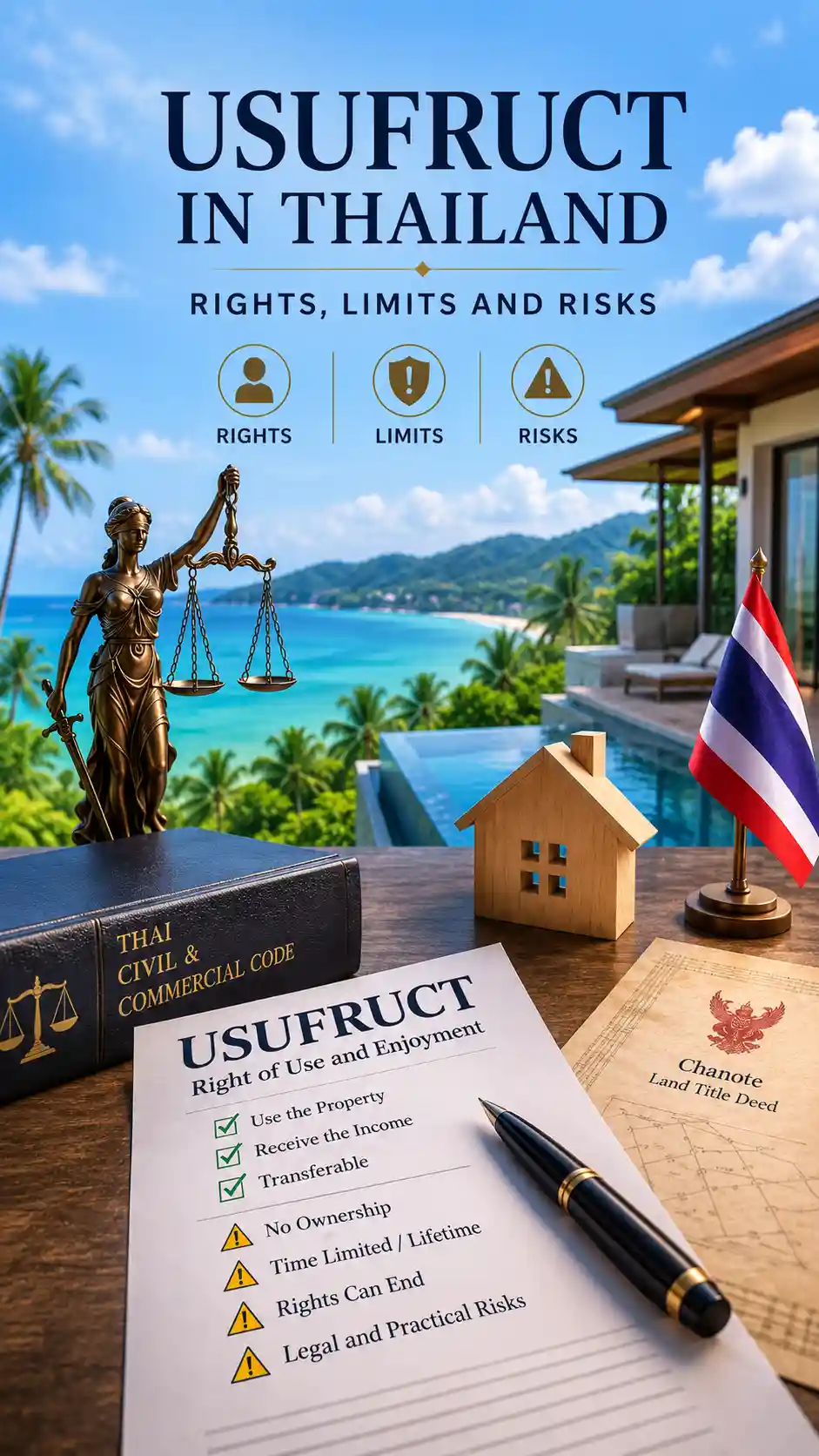
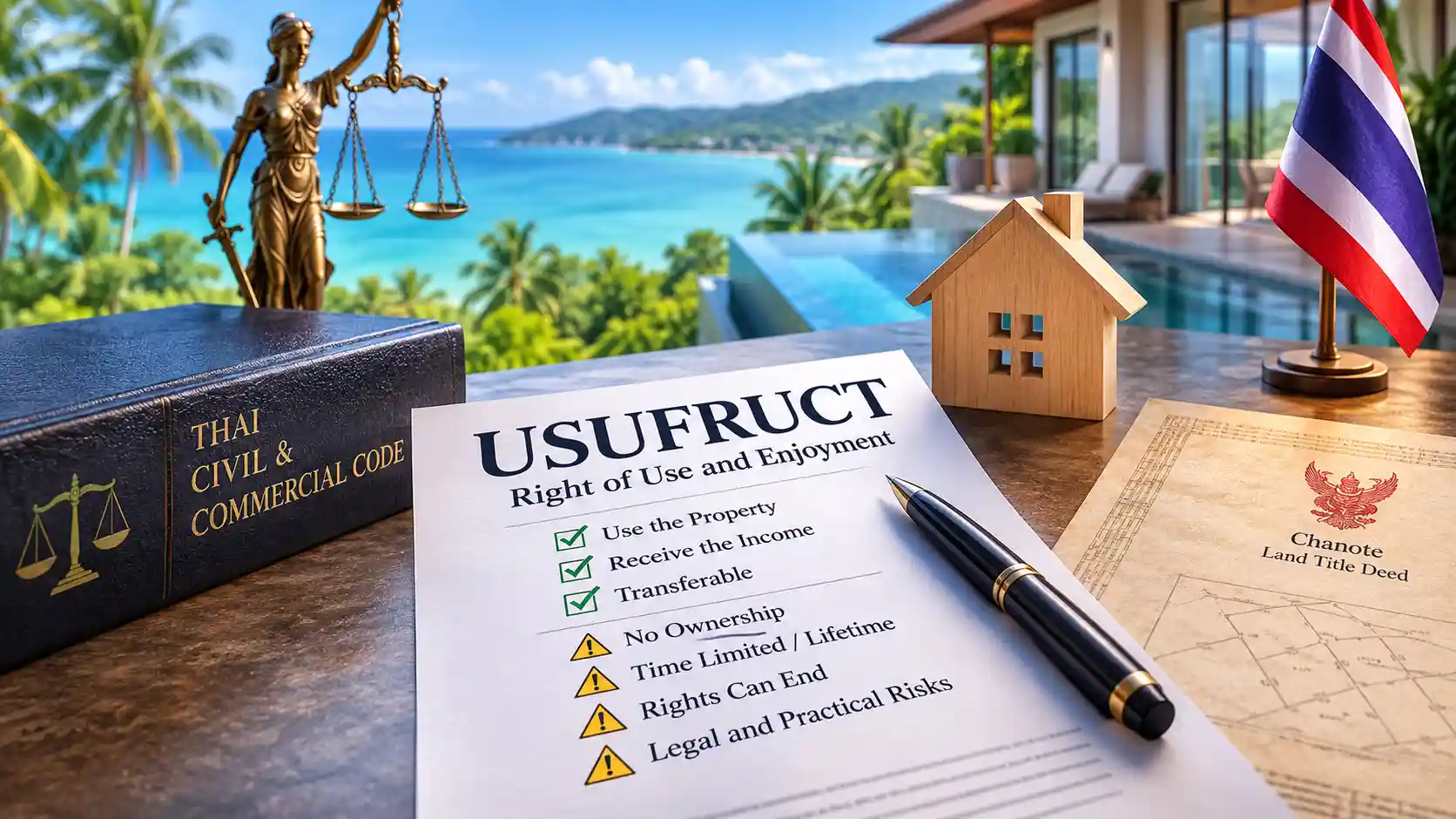
What a usufruct in Thailand grants a foreigner: lifetime use and benefit under Civil and Commercial Code ss.1417 to 1428, and the limits on equity, financing, and inheritance.
A registrable lifetime use right that is genuinely legal, but narrow on equity, finance, and inheritance #
Key takeaways
- A usufruct is legal but narrow: it grants use and income rights under Civil and Commercial Code ss.1417-1428, never equity, financing, or resale value.
- It always ends with the holder: under s.1418 a usufruct, lifetime or fixed-term, terminates on the holder's death and does not pass to heirs.
- It is not a nominee substitute in scope: it avoids FBA s.36 exposure but delivers far less than a nominee structure ever promised.
- Better-than-Freehold™ layers four instruments: a 30-year registered lease, a first-priority registered mortgage with the year-30 Option Agreement appended, and a share pledge, giving security a usufruct cannot match.
What is a usufruct under Thai law? #
- What Is a Usufruct Under Thai Law?
- What Rights Does a Usufruct Actually Grant?
- Why Foreigners Opt for a Usufruct
- Usufruct, Lease, Superficies or Better-than-Freehold™: A Comparison
- Where Better-than-Freehold™ Differs
- FAQ Section
- Related Terms
- Expert Guidance
What Is a Usufruct Under Thai Law? #
A usufruct (sitthi kep kin) is a real right under Civil and Commercial Code sections 1417 to 1428: the holder may possess, use and collect income from another person's property while the owner, often a Thai spouse or partner, keeps title. Section 1418 allows a lifetime grant or a fixed term of up to 30 years, and always ends the right at the holder's death. Once registered at the Land Department, it binds a later buyer of the land.
Foreigners generally cannot own land in Thailand under the Land Code, so a usufruct is often presented as an alternative: a Thai spouse or partner can hold the title, and the foreigner registers a usufruct over the property. The right is enforceable against third parties once endorsed on the title deed (chanote) at the Land Department, unlike an unregistered private agreement a court might disregard entirely.
The maximum term is 30 years or the usufructuary's lifetime, if the parties choose a lifetime grant. Most foreign buyers opt for lifetime grants precisely because a fixed 30-year term expires on a calendar date regardless of how long the holder lives.
What Rights Does a Usufruct Actually Grant? #
A usufruct grants use, occupation, and the right to derive income from the property; it does not grant ownership, equity, or a transferable interest. The holder can live in the house and collect rent from it, but cannot sell the land, mortgage it, or pass it to heirs by testament (will).
The rights are personal. Section 1418 of the Civil and Commercial Code provides that the usufruct terminates on the usufructuary's death; it does not descend to the estate. A foreign retiree who has lived in a property for twenty years leaves nothing transferable to a spouse or children. Other assets fare differently, as the table in how foreign heirs inherit Thai property shows asset by asset.
The landowner can sell the underlying title, but the usufruct survives the sale, binding the new owner.
Why Foreigners Opt for a Usufruct #
Foreigners typically consider a usufruct after learning that nominee company structures are prosecutable under the Foreign Business Act and the Anti-Money Laundering Act, enforced respectively by the Ministry of Commerce and AMLO, and that leaseholds expire without guaranteed renewal. A usufruct looks attractive by comparison: it is lawful, registrable, and needs no Thai company.
That comparison holds. A usufruct genuinely avoids the FBA s.36 exposure a nominee structure carries (up to three years imprisonment and/or a THB 100,000 to 1,000,000 fine, reaching both the Thai nominee and the foreign beneficiary, plus forced disposal by the Land Department and court-ordered cessation of the shareholding). It is a real, if narrow, right, not an illegal workaround.
The trade-off is depth, not legality. A usufruct trades away everything that makes property an investment: no equity growth, no finance against the right, and near-impossible resale, since a buyer would acquire a personal right that could end on the seller's death rather than their own. Most usufructs sit over property already owned by a Thai family member, so the position depends on that relationship holding. Our guide to land bought through a Thai spouse follows that relationship through a divorce and a death.
Usufruct, Lease, Superficies or Better-than-Freehold™: A Comparison #
The lawful routes foreigners can consider include a usufruct, a registered lease, a superficies, or a Better-than-Freehold™ structure, with each differentiated mainly by what rights they grant and withhold rather than in legality; nominee companies are the illegal outlier and are therefore not listed here. Where the choice narrows to two, usufruct vs leasehold in Thailand compares them feature by feature.
| Structure | Duration | Equity | Financeable | Inheritable |
|---|---|---|---|---|
| Usufruct | Life or up to 30 years | None | No | No (terminates on death) |
| Registered lease | Up to 30 years, renewal not guaranteed | None | Rarely | Ends on the tenant's death unless its terms show it was not personal to the tenant, for example by allowing assignment or subletting |
| Superficies | Up to 30 years, or the landowner's or holder's life (s.1412) | Ownership of structures only | Rarely | Yes, unless the grant provides otherwise (s.1411) |
| Better-than-Freehold™ | 30-year lease plus year-30 option | Assignable trust interest | To 50% LTV (expected H1 2027, not yet live) | Passes without Thai probate |
A superficies right, also under the Civil and Commercial Code, lets the holder own buildings on someone else's land; it matters mainly to those constructing rather than buying a property. Unlike a usufruct, it passes to heirs unless the grant provides otherwise (section 1411), although a superficies granted for the holder's life ends when the holder dies. A superficies suits a house on a Thai partner's land, and our superficies, usufruct and leasehold comparison sets out where the other two fit.
Where Better-than-Freehold™ Differs #
Compliance comes first. Thailand Investor Network, a 100% Thai-owned property holding and management company with its own Thai-funded paid-up share capital, holds legal title, so the Better-than-Freehold™ framework never depends on a foreigner's personal relationship with a Thai landowner and creates nothing for enforcement agencies to flag.
Security follows. Four instruments, a 30-year registered lease, a first-priority registered mortgage with the year-30 Option Agreement appended, and a share pledge, give the investor layered protection and right to legal claims that Clear Blue Security Agents (CBSA) can enforce, with mortgage enforcement through the Thai courts as a last resort, rather than a single personal right that expires on death.
The benefits complete the picture. The investor's position, held through SPH Trustees Ltd as an assignable trust interest, can be assigned to third parties, passed to heirs without Thai probate, and eventually financed at 50% LTV (expected H1 2027, not yet live), within Bank of Thailand macroprudential norms. None of this exists under a usufruct, which more typically suits someone wanting lifetime occupation of a property already in family hands.
Free to start · No obligation · Your decision at every stage
FAQ Section #
Related Terms #
- Nominee Company Risks in Thailand
- Leasehold vs Freehold in Thailand
- Foreign Business Act in Thailand
- Foreign Property Ownership in Thailand: Legal Framework
Expert Guidance #
Usufructs and leases have a genuine, lawful place in Thai property planning, but each trades away equity and succession for simplicity. Anyone weighing these against a compliant structure such as Better-than-Freehold™ should decide what they need first: occupation only, or a financeable investment with succession rights.
Immediate Action Required #
Before registering a usufruct, confirm the underlying title, the grantor's capacity, and whether the right is intended for occupation only or for investment. If financing, resale, or succession matter, a usufruct alone is unlikely to meet the requirement.
Long-term Security Strategy #
For investors who need more than lifetime occupation, compare the registered rights each lawful structure actually delivers. Better-than-Freehold™ is designed for scrutiny, succession, and enforceable security rather than dependence on a personal relationship with a Thai landowner.
For comprehensive assessment and implementation of compliant structures, contact our expert team today.
Free to start · No obligation · Your decision at every stage
Conclusion #
A usufruct is one of the few genuinely legal routes available to foreigners seeking long-term use of Thai property, and it deserves recognition as such rather than dismissal alongside nominee structures. But legality is not adequacy: a right offering no equity, no financing, and no inheritance suits lifetime occupation within a trusted family setting, not anyone treating Thai property as an investment.
This article is provided for general information only and does not constitute legal, tax, or investment advice. Laws and enforcement practices change; obtain advice tailored to your situation before acting.
About the Author: Andrew Moore FPFS, CDir
Chairman, Better-than-Freehold™

Andrew Moore has been an active investor in Thai property since 2004. He is a Chartered Director and a Fellow of the Personal Finance Society. He has invested in and built properties in several countries since the late 1990s and first invested in Thailand in 2004. Having owned homes in Bangkok, Samui, Phangan and Phuket he can offer a unique perspective on Thailand's property markets together with past and future trends in both ownership and investor opportunities.