
What Is the Best Structure for Foreign Property Ownership in Thailand? (2026)
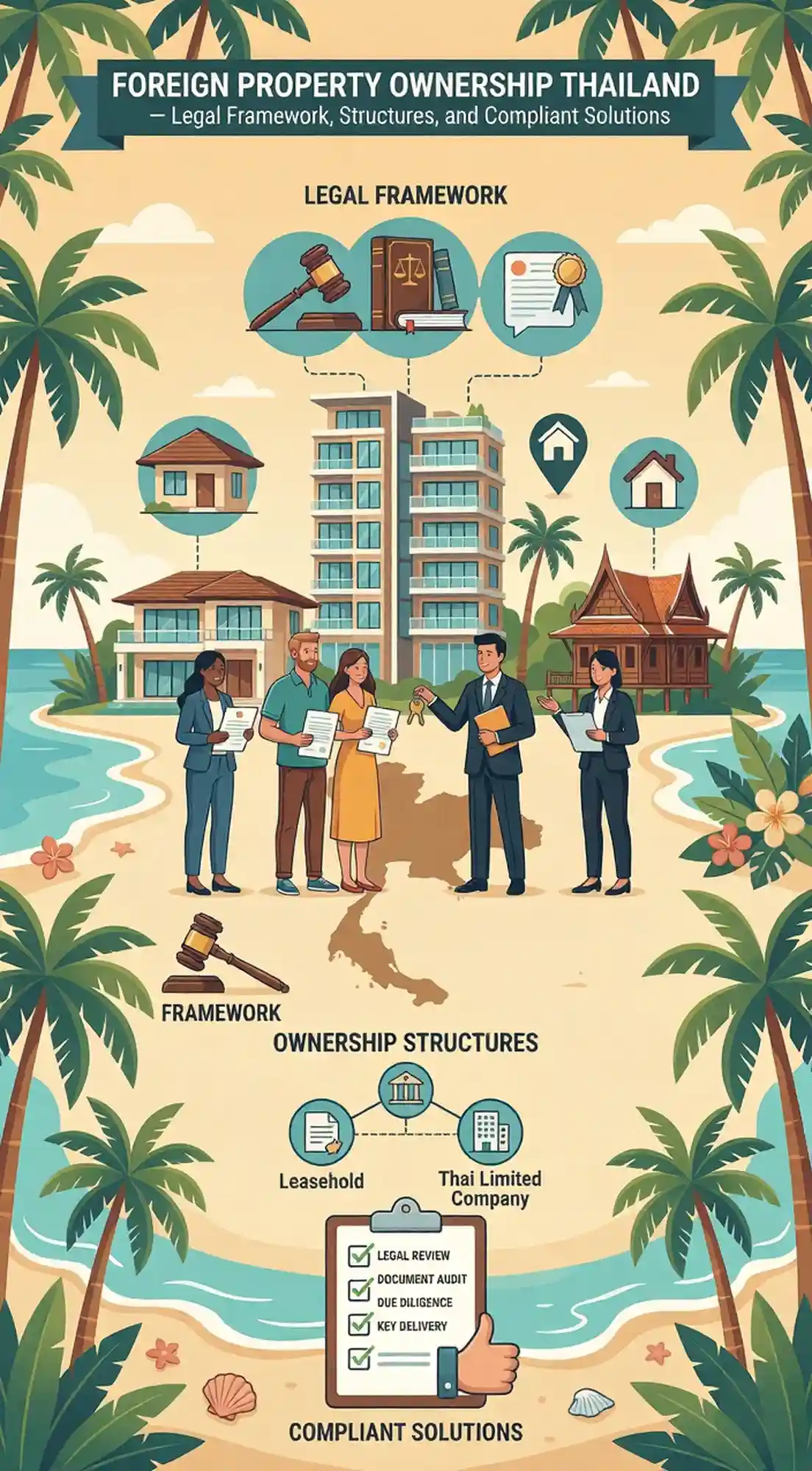
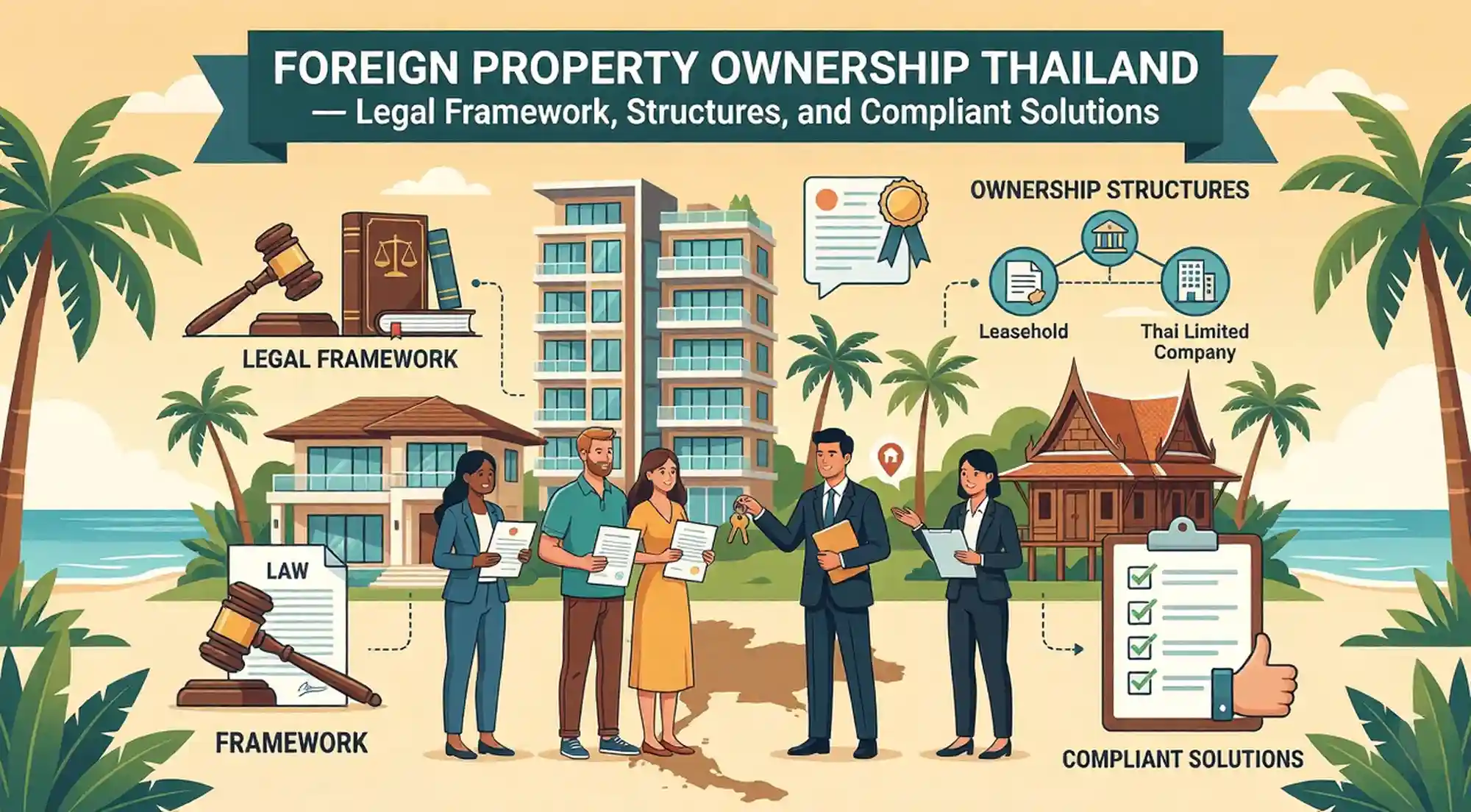
For a condominium within the 49% foreign quota, freehold is best; for villas and land, foreigners generally cannot own the land, so the lawful choice is a registered lease, usufruct, superficies or Better-than-Freehold™ over Thai-held title, never a nominee company.
Last updated 13 October 2026.
What Is the Best Structure for Foreign Property Ownership in Thailand? #
Key takeaways
- Condominium freehold is the best structure for apartments: foreigners may own units outright within the 49% foreign quota with funds sent from abroad.
- Foreigners generally cannot own land under the Land Code: landed property therefore needs a registered lease, usufruct, superficies, Sap Ing Sith right or Better-than-Freehold™.
- The nominee company route fails the enforcement test: FBA section 36 carries up to three years' imprisonment for nominee and foreigner alike.
- Better-than-Freehold™ adds what a bare lease lacks: a registered lease and mortgage held in trust, a year-30 Option Agreement, and succession without Thai probate.
Land Code section 86 bars foreigners from owning land outside narrow exceptions, so most landed routes trade title for a registered right. Civil and Commercial Code section 540 caps a lease at 30 years, and renewal promises beyond that are contractual. A usufruct always ends at the holder's death. Better-than-Freehold™ builds on a registered lease, adding a first-priority mortgage with a year-30 Option Agreement appended, all held in trust for the client, but its year-30 terms remain contractual.
Why Can't Foreigners Own Land in Thailand? #
Foreigners generally cannot own land in Thailand because the Land Code reserves land ownership for Thai nationals and Thai juristic persons that are genuinely Thai-owned. Section 86 bars foreign acquisition unless a treaty or specific law permits it, and no general exception exists for individuals buying a home. Every lawful structure works around that constraint rather than through it.
The constraint is old and deliberate. It is also narrower than people assume: it bars acquisition of land, not the leasing of it, and not the ownership of a building or a condominium unit. That distinction is the whole map. Title to land is recorded on the chanote at the Department of Lands, and a foreign name will not appear there as owner.
One statutory route exists on paper. The Land Code allows a foreigner investing at least THB 40 million to seek ministerial permission for up to one rai of residential land; approval is discretionary, so it is not a plan for most buyers.
Which Structures Are Lawful for Foreigners? #
Five structures are lawful for foreigners: condominium freehold within the foreign quota, a registered lease of up to 30 years, a usufruct, a superficies, and the Sap Ing Sith right introduced in 2019. Each grants rights registered at the Land Office. None grants ownership of land, and each carries its own limit on duration or transfer. The same five appear, with the main alternatives, in a scored comparison of legal routes that rates each on six criteria.
Condominium freehold. Foreigners may own units outright, provided foreign ownership in the building stays within 49% of total unit area and the purchase funds arrive from abroad. For an apartment, this is the strongest position available. A proposal to raise the quota to 75% remains a proposal.
Registered lease. Civil and Commercial Code section 540 caps a registered lease at 30 years. The lease binds successors in title, which is its great strength. Its weakness is year 30: renewal clauses are personal promises, and renewal promises beyond the registered term are contractual, not registered rights.
Usufruct and superficies. A usufruct gives the right to use and take income from land for up to 30 years or for life, but it always ends on the holder's death and cannot be transferred. A superficies separates ownership of a building from the land beneath it; the foreigner owns the house, the Thai owner keeps the land.
Sap Ing Sith. The 2019 Sap-Ing-Sith Act also caps at 30 years, with no renewal mechanism and, unless the parties agree otherwise, reversion of buildings to the owner at term end.
BOI and the Treaty of Amity. Neither helps a home buyer. BOI promotion can permit land ownership for the promoted business activity, not a residence. The US Treaty of Amity allows American-owned companies to operate most businesses, but it expressly excludes land.
Why Does the Thai Company Route Fail? #
The Thai company route fails because it depends on nominee shareholders: Thais who hold majority shares on paper whilst a foreigner provides the money or exercises control. That is unlawful under the Foreign Business Act and the Land Code. Enforcement agencies now test real funding, real control and real benefit, and paperwork alone no longer survives the test.
The scale has changed. In July 2026, the Ministry of Commerce reported that police economic crime investigators had taken legal action against 2,257 suspected nominee entities referred by the Department of Business Development, and that the DSI had accepted 2,236 as special cases. The ministry did not give the period covered. A 23-agency enforcement memorandum was signed at Government House on 29 April 2026. And registration scrutiny tightened again when Central Registrar Order 2/2569 came into force on 1 August 2026, replacing Orders 2/2568 and 1/2569 with one consolidated, in places stricter, instrument administered by the Department of Business Development.
The consequences come in pairs. The Land Department can order forced disposal of the land; the foreigner receives the sale proceeds, so this is a forced sale, not confiscation. A court can also order cessation of the shareholding under Foreign Business Act section 36, which carries up to three years' imprisonment and/or fines of THB 100,000 to 1,000,000 for the Thai nominee and the foreign beneficiary alike, plus daily fines of THB 10,000 to 50,000.
Proposed amendments to the Anti-Money Laundering Act would treat nominee conduct as a money-laundering predicate offence. They are not law. As of September 2026 the proposal is before a House committee reviewing the AMLA bill that Parliament revived in May, after the December 2025 dissolution. Treat it as direction, not deadline. Existing law, overseen by the Anti-Money Laundering Office, is already severe enough.
What Is Better-than-Freehold™ and How Does It Work? #
Better-than-Freehold™ is a structure in which a 100% Thai-owned company holds legal title and grants a 30-year registered lease and a first-priority registered mortgage to an offshore trustee, which holds those rights for the foreign client. The client acquires ownership rights, never the land itself, and no nominee is involved at any level.
Compliance comes first. Thailand Investor Network, a 100% Thai-owned property holding and management company with its own Thai-funded paid-up share capital and no foreign funding or control, holds legal title. SPH Trustees Ltd, an offshore trustee whose Labuan FSA licence is in progress, verifies source of funds at onboarding and holds the rights for the client. The structure was reviewed by leading tier-one regional and Thai counsel and a leading global tax advisory firm.
Security follows. The structure uses four principal instruments, including a registered lease and mortgage, with a separate Option Agreement appended to the mortgage, plus a share pledge over the Thai company's shares. The registered lease binds successors in title. The mortgage gives a priority claim over the asset. Clear Blue Security Agents (CBSA) mediate and enforce on the client's behalf, independently of the parties.
The benefits complete the picture:
- Resale by assignment of the trust interest, without a new Land Office transfer.
- A year-30 pathway set out in the Option Agreement, rather than a bare renewal promise.
- Financing to 50% LTV (expected H1 2027).
- Succession without Thai probate, because a corporate trustee does not die.
How Do the Structures Compare? #
The structures differ on three things that matter: what you actually hold, how long it lasts, and what happens on death or resale. Condominium freehold wins for apartments. For landed property, a trust-backed structure such as Better-than-Freehold™ is designed to combine registered security, a planned year-30 pathway and probate-free succession; the nominee company offers none of that, only risk.
| Structure | What the foreigner holds | Duration | On death or resale | Legal status |
|---|---|---|---|---|
| Condominium freehold | Title to the unit | Indefinite | Probate; heir must qualify | Lawful within 49% quota |
| Registered lease | Registered right to use | Up to 30 years | Depends on drafting | Lawful |
| Usufruct | Use and income rights | 30 years or life | Ends on death; not transferable | Lawful |
| Superficies | The building, not the land | 30 years or life | Building rights end at term | Lawful |
| Sap Ing Sith | Real right of use | 30 years, no renewal | Buildings revert unless agreed otherwise | Lawful |
| Better-than-Freehold™ | Ownership rights in trust | 30-year lease plus Option Agreement | Assignment; no Thai probate | Lawful, no nominee |
| Nominee company | Nothing enforceable | Until detected | Forced sale; prosecution | Unlawful |
Read the bottom row twice. It is still the structure most commonly sold to foreign villa buyers.
What Should Owners of an At-Risk Company Do Now? #
Owners holding property through a high-risk or at-risk property-owning company should take independent advice now and plan a divestment into a compliant structure. A divestment through Better-than-Freehold™ is expected to take eight to sixteen weeks, reducing to under four weeks as Better-than-Freehold™ grows. Every corporate filing now attracts scrutiny.
The trigger is often mundane. An annual filing, a change of director or an address update now invites questions about who funded the Thai shareholders. Company records sit on registers maintained under the Ministry of Commerce, and those records are being cross-checked.
So don't wait for a letter. The order of work is simple: establish what you hold, confirm how the Thai shares were funded, and choose the exit before anyone else chooses it for you.
Free to start · No obligation · Your decision at every stage
FAQ Section #
Related Terms #
- Is Better-than-Freehold™ Legal in Thailand?
- Leasehold vs Freehold in Thailand
- Nominee Company Risks in Thailand
- Buying Property Through a Thai Company
Expert Guidance #
Start with the asset, not the structure. If it's a condominium unit within quota, buy it freehold and keep the foreign exchange transaction form. If it's a villa, ignore any agent who says "everyone uses a company"; that sentence has aged badly. Engage independent Thai counsel before signing, and ask one question of any structure offered: who genuinely funded the Thai side? How Better-than-Freehold™ works explains the structure in full. Talk to the advisory team about your choices for a confidential compliance assessment.
Free to start · No obligation · Your decision at every stage
Conclusion #
The best structure for foreign property ownership in Thailand is the one the law actually supports for the asset in question. For apartments, that is condominium freehold within the quota. For landed property, foreigners generally cannot own the land, so the real contest is between registered rights of different strength and length. A registered lease protects 30 years and little beyond. Usufruct ends with a life. The nominee company protects nothing, and the enforcement campaign of 2026 has made that plain. Better-than-Freehold™ structures give foreign buyers registered, trust-held ownership rights without a nominee anywhere in the chain.
Legal Disclaimer #
This content is for educational purposes only and does not constitute legal advice. Thai property law is complex and subject to change. For specific guidance, consult qualified legal professionals familiar with Thai property law and Better-than-Freehold™ structures.
About the Author: Andrew Moore FPFS, CDir
Chairman, Better-than-Freehold™

Andrew Moore has been an active investor in Thai property since 2004. He is a Chartered Director and a Fellow of the Personal Finance Society. He has invested in and built properties in several countries since the late 1990s and first invested in Thailand in 2004. Having owned homes in Bangkok, Samui, Phangan and Phuket he can offer a unique perspective on Thailand's property markets together with past and future trends in both ownership and investor opportunities.