
Thailand Nominee Crackdown Statistics (2026)

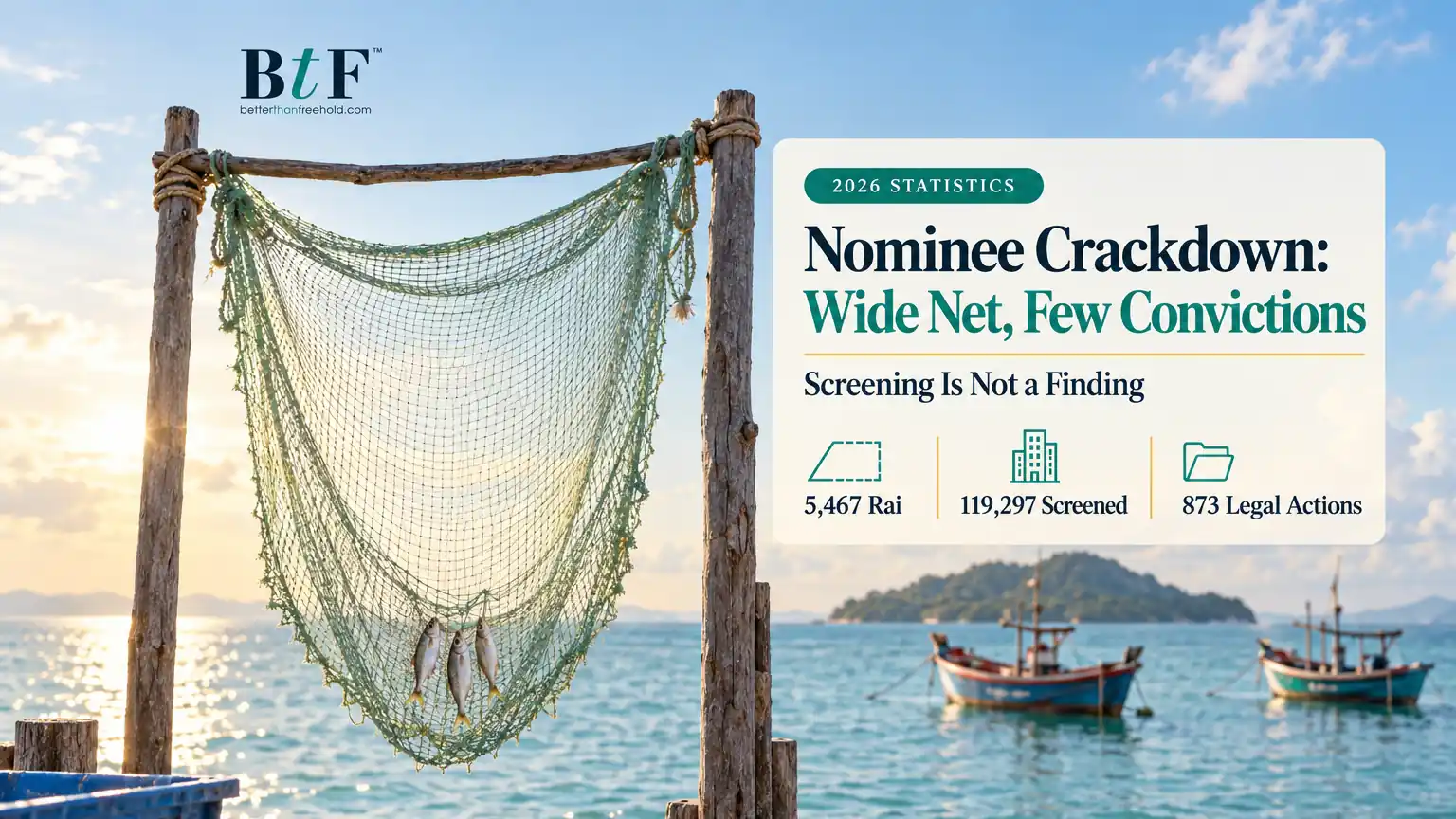
As of October 2026, Thailand's Department of Lands counted 5,467 rai held by 1,397 companies, worth about THB 14 billion, found or suspected to be nominee-held, and the Ministry of Commerce counted 119,297 at-risk companies; most figures are screening counts, not court findings.
The official figures on nominee screening, legal action and forced land sales, each dated and sourced #
Key takeaways
- Land under review: on 19 October 2026, the Department of Lands counted 5,467 rai held by 1,397 land-holding companies, worth about THB 14,010 million, with high-risk investigations ordered closed by December 2026.
- Companies screened: the Ministry of Commerce counted 119,297 at-risk companies with minority foreign shareholdings as of June 2026, out of 1,002,685 active juristic persons.
- Legal action: between September 2024 and July 2025, authorities took legal action against 873 nominee offenders; police later reported court convictions in 14 of 105 Koh Phangan cases.
- Screening is not a finding: most figures count companies or land flagged for checks, and each agency measures something different, so the totals cannot be added together.
How big is Thailand's nominee crackdown in numbers? #
| Figure | What it counts | As of |
|---|---|---|
| 5,467 rai, 1,397 companies, about THB 14,010 million | Land found or suspected to be nominee-held (Department of Lands) | 19 Oct 2026 |
| About 2,100 | Companies whose shareholding suggests nominee use (government) | 18 Sep 2026 |
| Over THB 80 billion | Land with nominee evidence held by suspect companies (government) | 18 Sep 2026 |
| 36,277 | Foreign-linked land-holding companies in a screening pool (DBD) | Sep 2026 |
| 119,297 | At-risk companies with 0.01% to 49.99% foreign shareholding (Ministry of Commerce) | 21 Jun 2026 |
| More than 100,000 | Foreign-linked companies whose data went to 43 embassies (DBD) | 30 Sep 2026 |
| 46,918 | Companies on the 2025 inspection target list (DBD) | 2025 |
| 2,257 and 2,236 | Entities facing police legal action, and DSI special cases (Ministry of Commerce) | Reported Jul 2026 |
| 873 | Nominee offenders facing legal action (DBD) | Sep 2024 to Jul 2025 |
| THB 15.6 billion | Damage to the Thai economy from those 873 cases (DBD) | Jul 2025 |
| 14 of 105 | Koh Phangan cases ending in court conviction (police) | 22 Jun 2026 |
| About 60% and 75% | Falls in new high-risk company registrations | Q1 and 1 to 23 April 2026 |
- How much land is under investigation for nominee holding?
- How many companies are being screened for nominee shareholders?
- How many nominee cases have reached legal action or conviction?
- What did October 2026's nominee enforcement actions find?
- What happened to new company registrations?
- What penalties apply to a nominee holding in Thailand?
- How should these nominee figures be cited?
- What do the figures mean for owners and buyers?
- How does Better-than-Freehold™ address nominee risk?
- FAQ Section
- Related Terms
- Expert Guidance
How much land is under investigation for nominee holding? #
On 19 October 2026, the Department of Lands counted 5,467 rai in 2,360 plots, held by 1,397 land-holding companies and worth about THB 14,010 million, that it had found or suspected to be held through nominees. None of that count is a court finding. The Prime Minister ordered the high-risk cases concluded by December 2026, as the Nation reported.
Our report on the December 2026 nominee land deadline covers the order in full. Two other land figures measure different things. As of September 2026, the Department of Business Development had placed 36,277 foreign-linked land-holding companies in a screening pool, and stressed that these are ownership figures, not findings.
On 18 September 2026, the government said companies with evidence of nominee landholding held land worth more than THB 80 billion. No agency has reconciled the two counts. THB 14 billion is not a revision of THB 80 billion.
On Koh Phangan, officials examined 1,832 land-holding entities, found 112 over the foreign shareholding limit, and by August 2026 had issued disposal orders against eight companies covering nine plots.
How many companies are being screened for nominee shareholders? #
As of late June 2026, the Ministry of Commerce counted 119,297 companies with foreign shareholdings between 0.01% and 49.99% in its at-risk pool, out of 1,002,685 active juristic persons. Shareholding shape alone defines the pool, so inclusion is not evidence of a nominee.
On 30 September 2026, the Department of Business Development said it had shared data on more than 100,000 foreign-linked companies with 43 embassies, and stressed that the companies are not nominee findings.
The narrower lists are older or regional. In 2025, the Department of Business Development set an inspection target list of 46,918 high-risk companies across six sectors, including tourism and real estate. On 18 September 2026, the government said a shareholding review had flagged about 2,100 companies, with more than 10,000 others flagged as suspicious, as Thairath also reported. The same day, a Chonburi provincial registry count briefed to a House committee gave 14,264 entities with foreign investors or shareholders.
How many nominee cases have reached legal action or conviction? #
Between September 2024 and July 2025, Thai authorities took legal action against 873 nominee offenders, according to the Department of Business Development, which put the damage to the Thai economy at THB 15.6 billion as of July 2025. Legal action covers cases still on their way to prosecution, so 873 is not a conviction count.
Real estate accounted for 252 of the 873, as InfoQuest reported. In July 2026, the Ministry of Commerce reported that police economic crime investigators had taken legal action against 2,257 suspected nominee entities, and that the DSI had accepted 2,236 as special cases. The ministry gave no period. Because the totals might overlap, they should not be added together, nor set against the 873 as a trend.
Convictions are rarer. Police reported on 22 June 2026 that 14 of 105 Koh Phangan nominee cases had ended in court convictions, a count of cases rather than people. Most 2026 cases are earlier in the stages of a nominee case.
What did October 2026's nominee enforcement actions find? #
In October 2026, police and officials searched suspected nominee holdings in Bangkok and Pattaya, and Prachin Buri's commerce office referred firms to law enforcement. Each figure below is an allegation reported at the time. Nobody had been convicted in any of these cases when the figures were published.
- Bangkok, 10 October: searches at 17 locations, with 94 homes worth over THB 6 billion said to be held through 95 companies (our report).
- Bang Lamung, Pattaya, 21 October: searches at 12 sites over holdings valued at more than THB 800 million, with 85 people under review.
- Prachin Buri, reported 22 October: after inspections, the provincial commerce office passed four waste companies to law enforcement, with site visits to 44 more flagged firms being prepared.
What happened to new company registrations? #
New registrations of high-risk companies fell sharply as the Department of Business Development tightened its rules. They fell about 60% in the first quarter of 2026, to 1,373 from 3,511 a year earlier, and about 75% year on year in the first 23 days of April. Both figures count new registrations only.
From 1 to 20 August 2026, new high-risk registrations fell to 141 from 561, again about 75%. The Commerce Minister stressed that this counts new registrations only. It says nothing about the 119,297 at-risk companies already on the register. Since 1 August 2026, Central Registrar Order 2/2569 has governed these checks.
What penalties apply to a nominee holding in Thailand? #
Under section 36 of the Foreign Business Act, a Thai nominee and the foreigner who uses one each face up to three years' imprisonment, a fine of THB 100,000 to 1,000,000, or both. A court can also order the shareholding to cease, with daily fines of THB 10,000 to 50,000 for non-compliance.
The land faces a separate process. Under sections 94 and 96 of the Land Code, land held unlawfully, including through a nominee, must be disposed of within a period the Director-General sets, of not less than 180 days and not more than one year, and section 54 requires the price to be paid to the person entitled. That is a forced sale, not confiscation.
A proposed amendment to the Anti-Money Laundering Act would add nominee conduct as a predicate offence; the bill is before a House committee and is not law. Direction, not deadline, is the correct reading.
How should these nominee figures be cited? #
Cite each figure with its date and the body that reported it, and say what it counts. Most of these numbers count companies or land flagged for checks, not wrongdoing proven in court, and the agencies measure different things, so the totals should never be added together or read as a single trend.
- Screening pools: 119,297, 100,000, 36,277 and 46,918 describe pools and target lists, not offences.
- Legal action: of the figures on this page, only the Koh Phangan count measures convictions.
- Plans: the 110,000 figure reported in February 2026 was a plan to investigate.
What do the figures mean for owners and buyers? #
For owners, investors and buyers connected to a high-risk property-owning company, the figures show screening across the whole company register, with land cases due to close by December 2026. Divestment from an at-risk structure typically takes eight to sixteen weeks, expected to reduce to under four weeks as Better-than-Freehold™ grows.
Reshuffling the Thai shareholders of a high-risk property-owning company now meets checks aimed at that pattern. The Department of Lands restated on 19 October 2026 that officials question buyers further on source of funds when land is paid for with THB 2 million or more in cash, or is assessed at THB 5 million or more. Our guide to nominee company risks in Thailand sets out the divestment choices.
How does Better-than-Freehold™ address nominee risk? #
Better-than-Freehold™ addresses nominee risk by leaving legal title with a genuinely Thai-owned company and securing the investor through registered rights rather than hidden control. It is designed to comply with Thai law, and every transaction remains subject to Land Office acceptance and the required checks.
Compliance comes first. Thailand Investor Network, a 100% Thai-owned property holding and management company with its own Thai-funded paid-up share capital, and no foreign funding or control, holds legal title and grants a 30-year lease registered at the Department of Lands.
Security follows. The structure uses four principal instruments, including a registered lease and mortgage, with a separate Option Agreement appended to the mortgage. SPH Trustees Ltd holds these rights for the client, and Clear Blue Security Agents (CBSA) mediate and enforce as the first point of dispute settlement, with Thailand Arbitration Center (THAC) arbitration as the backstop; mortgage enforcement still requires a Thai court.
The benefits are financing up to 50% LTV (expected H1 2027), resale of your rights by assignment, and succession without Thai probate.
Free to start · No obligation · Your decision at every stage
FAQ Section #
Related Terms #
- Nominee Company Risks in Thailand
- Foreign Business Act Thailand
- Anti-Money Laundering Act Thailand
- Thailand's Nominee Crackdown in 2026 So Far
Expert Guidance #
A screening figure says nothing about whether one particular company is at risk. The December 2026 deadline leaves little room to find out late. The Department of Business Development and the Anti-Money Laundering Office publish their rules. Testing a particular structure against them takes a review of its documents. Contact the Better-than-Freehold™ advisory team to open a confidential case and see your choices.
Free to start · No obligation · Your decision at every stage
Conclusion #
Thailand's nominee crackdown now spans more than 100,000 screened companies, thousands of rai under review and a December 2026 deadline for high-risk land cases. Convictions remain few, and most figures count screening rather than findings. An owner of a high-risk property-owning company can still plan divestment before a case opens.
Sources: Ministry of Commerce, Department of Lands, Department of Business Development, Anti-Money Laundering Office
This article is provided for general information only and does not constitute legal, tax, or investment advice. Laws and enforcement practices change; obtain advice tailored to your situation before acting.
About the Author: Andrew Moore FPFS, CDir
Chairman, Better-than-Freehold™

Andrew Moore has been an active investor in Thai property since 2004. He is a Chartered Director and a Fellow of the Personal Finance Society. He has invested in and built properties in several countries since the late 1990s and first invested in Thailand in 2004. Having owned homes in Bangkok, Samui, Phangan and Phuket he can offer a unique perspective on Thailand's property markets together with past and future trends in both ownership and investor opportunities.