
Is Better-than-Freehold™ Legal Under Thai Law?
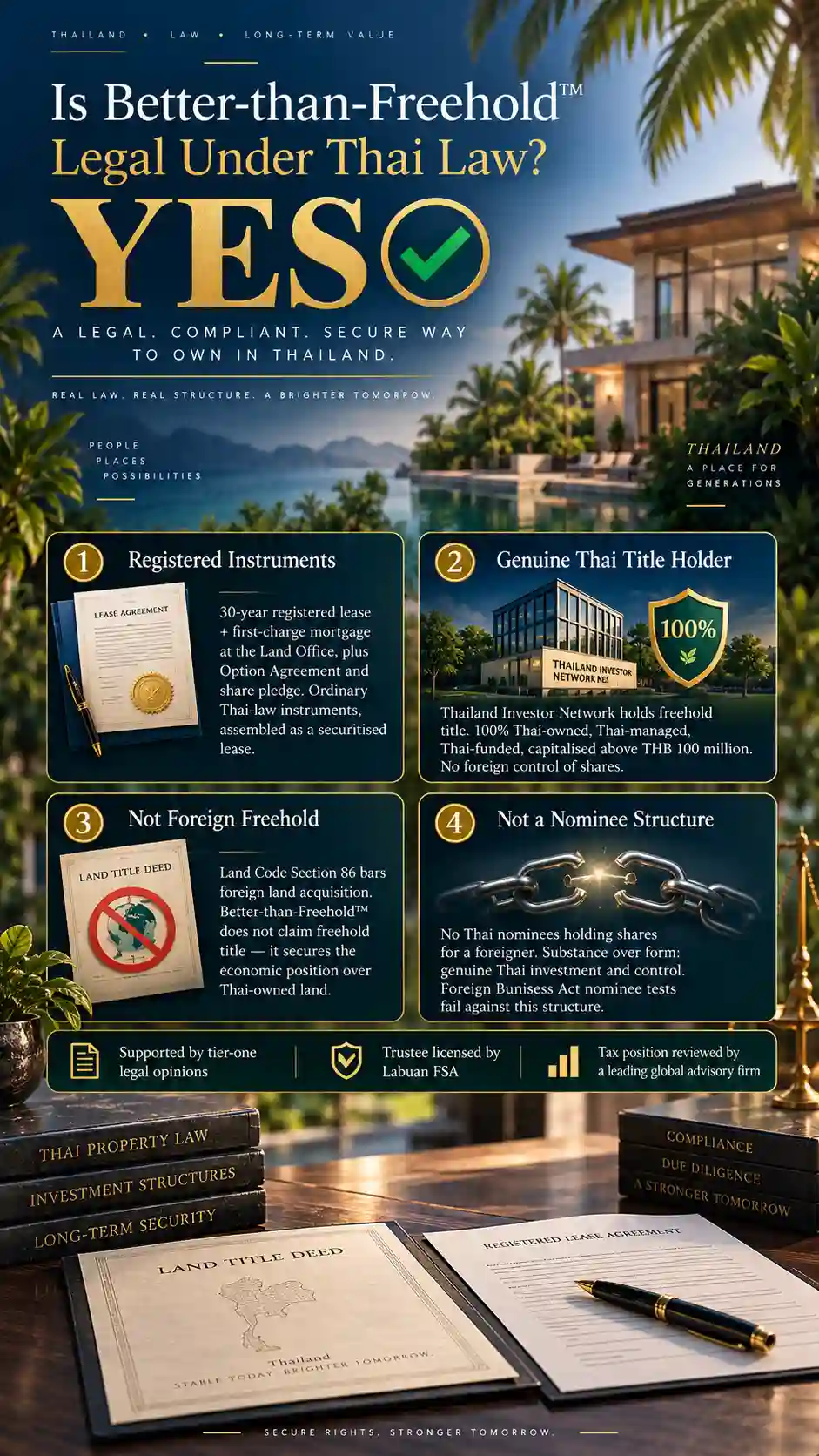
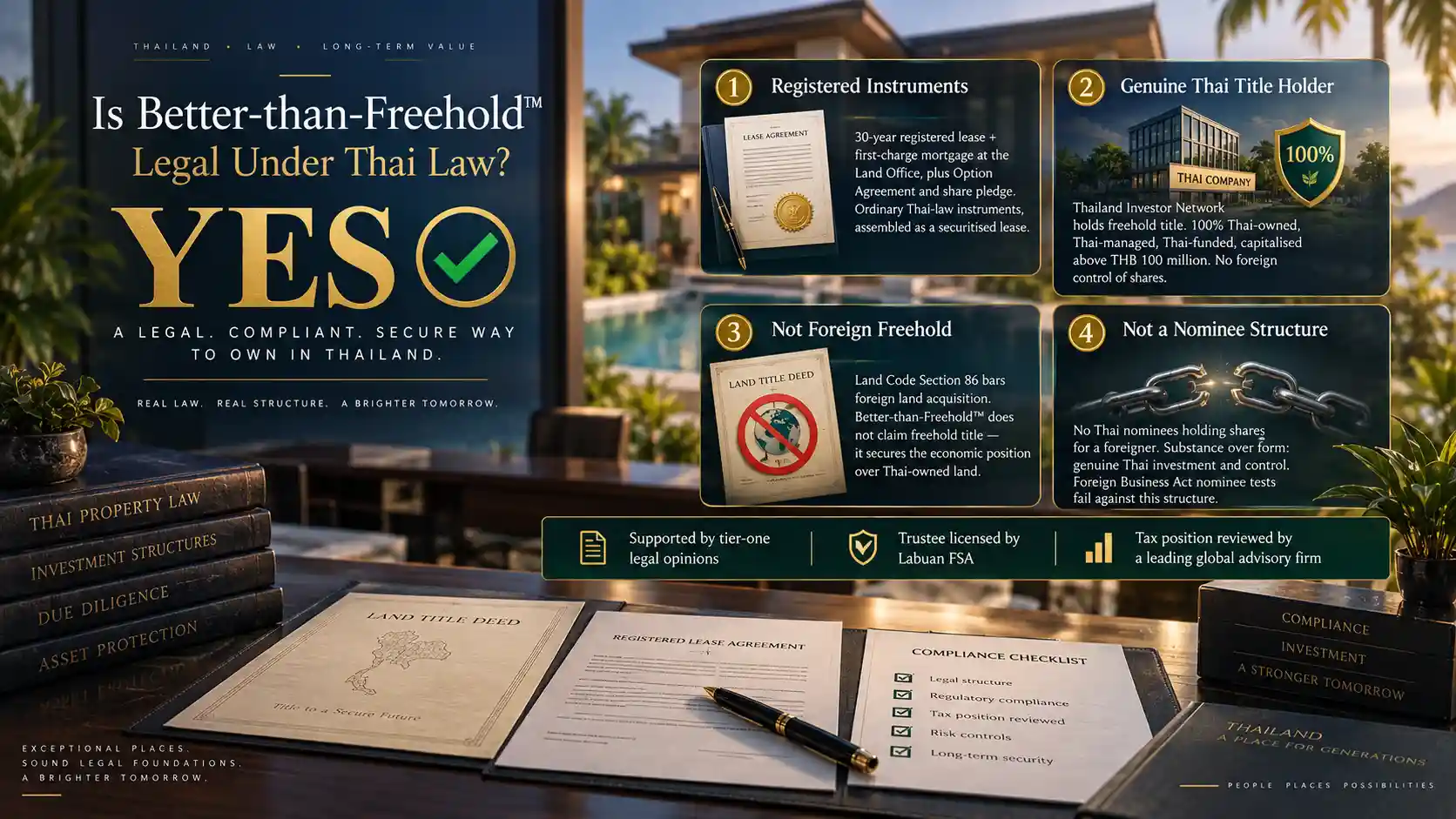
Yes. Better-than-Freehold™ is a registered lease and security package under Thai law, not a nominee structure and not foreign land ownership. Here is the legal basis and who reviewed it.
The legal basis, the professional review behind it, and what it does not claim #
Key takeaways
- Ordinary instruments, unusual assembly: a 30-year lease and a first-priority registered mortgage registered at the Land Office, plus an Option Agreement appended to the mortgage and a pledge of the owner's holding-company shares to the trustee.
- The Thai owner is genuinely Thai: Thailand Investor Network is 100% Thai-owned, Thai-managed, Thai-funded and capitalised above THB 100 million.
- No freehold is promised: Section 86 of the Land Code generally bars foreign land acquisition, and nothing here claims to change that; it secures the economic position, not the title deed.
- The review is tier-one and bounded: leading tier-one regional and Thai counsel reviewed the security agreements, and a leading global tax advisory firm the tax position. The trustee's Labuan Financial Services Authority licence is in progress.
Is Better-than-Freehold™ legal in Thailand? #
- What the Structure Actually Is
- What the Land Code Allows, and What It Forbids
- Why This Is Not a Nominee Structure
- Who Has Reviewed It, and What That Review Covers
- The Better-than-Freehold™ Solution
- FAQ Section
- Related Terms
- Expert Guidance
What the Structure Actually Is #
Better-than-Freehold™ is a securitised lease. A Thai-owned company holds freehold title and grants a registered 30-year lease to a corporate trustee acting for the investor, whose Labuan Financial Services Authority licence is in progress. Three instruments sit alongside it: a first-priority registered mortgage, an Option Agreement appended to that mortgage covering year-30 outcomes, and a share pledge.
Registered leases and mortgages have been recognised in Thai law for decades, both are entered in the register kept by the Department of Lands, and a registered lease travels with the land rather than with the person who granted it.
The assembly is what is unusual. Most foreign investors or buyers are currently offered a bare lease plus a renewal promise resting on the goodwill of whoever owns the land in thirty years, and here registered security stands in place of that promise. Detail sits on the structure page.
What the Land Code Allows, and What It Forbids #
Section 86 of the Land Code Act B.E. 2497 bars foreigners from acquiring land except under a treaty. Sections 97 and 98 treat a Thai-registered company as foreign for land purposes where foreigners hold more than 49 percent of the registered capital, or where foreign shareholders are more than half the total number of shareholders. Thai registration alone confers nothing.
Leasing, though, is not the same as acquisition. A foreign party may lawfully hold a registered leasehold interest and a registered mortgage over Thai land, which happens every day.
The design rests on that distinction. The investor holds rights, through the trustee's registered lease and mortgage, over land someone else owns, which Thai law permits, and makes no claim to the title, which it does not.
Why This Is Not a Nominee Structure #
A nominee structure uses Thai shareholders who did not genuinely invest, holding shares for the benefit of a foreigner who controls the company. Section 36 of the Foreign Business Act B.E. 2542 reaches both sides of that fiction, the Thai nominee and the foreign beneficiary, and the penalties fall on each of them.
The penalty is up to three years' imprisonment or a fine of THB 100,000 to 1,000,000 or both. The court orders the shareholding to cease, with daily fines of THB 10,000 to 50,000 until it does. Where land sits under such a company, the Department of Lands can direct forced disposal.
Thailand Investor Network fails every limb of that test. It is 100% Thai-owned, capitalised above THB 100 million from Thai sources with no foreign funding, holds title under its own name and management, and has no foreigner holding or controlling its shares.
Between September 2024 and July 2025, authorities took legal action against 873 nominee offenders. Thai shareholders must now evidence the source of their capital at registration, screening that hunts for foreign money behind Thai names. The risks nominee structures carry are examined separately.
Anyone already holding property through a high-risk Thai company should treat this as live, high-risk exposure, since detection no longer depends on a complaint. The Department of Special Investigation investigates, and a 23-agency enforcement pact signed in April 2026 shares the data. Assess it with a Thai-qualified adviser. A compliant divestment is the usual route out.
Who Has Reviewed It, and What That Review Covers #
Two leading law and advisory practices reviewed the framework: tier-one regional and Thai counsel co-drafted the underlying security agreements and produced the legal opinion covering the full security stack, and a leading global tax advisory firm reviewed the tax position. SPH Trustees Ltd, the corporate trustee that holds the investor's rights, has its Labuan Financial Services Authority licence in progress; once the licence is granted, the Authority will regulate the trustee rather than review the structure.
A legal opinion answers the questions counsel was asked, on the facts counsel was given, on the date it was written. It is not a court ruling. No adviser can certify a structure or claim that it is immune from challenge, tax treatment is more impacted by the investor's residency, and Labuan supervision, once the trustee's licence is granted, will cover the corporate trustee rather than Thai property law. Summaries are available through the compliance page.
The Better-than-Freehold™ Solution #
Better-than-Freehold™ answers the ownership question by separating title from economics. A Thai company genuinely owns the land, and the trustee holds registered rights over it for the investor.
Thailand Investor Network is genuinely Thai-owned and Thai-funded, with capital above THB 100 million and no foreign control of its shares.
The registered lease binds successors in title, so the land cannot be sold or re-mortgaged over your head; the mortgage ranks ahead of unsecured creditors, and the pledge and option give the trustee future protection and positions to enforce. Clear Blue Security Agents, a Thai lawyer-led independent security agency appointed by both parties, holds those enforcement rights independently.
A corporate trustee does not die, so the interest passes to the heirs of the trust's ultimate beneficial owner (UBO) without Thai probate, and the Option Agreement sets out the agreed contractual Year-30 arrangements. Financing to 50% loan-to-value (expected H1 2027, not yet live) is optional.
Free to start · No obligation · Your decision at every stage
FAQ Section #
Related Terms #
- What Is Better-than-Freehold™: legal definition of the compliant leasehold and security framework
- The Four Principal Instruments: how the lease, mortgage, Option Agreement and share pledge interlock
- Nominee Company Risks in Thailand: current prosecution patterns and why substance over form matters
- Foreign Business Act Thailand: the statute behind nominee penalties and Section 36 exposure
Expert Guidance #
The useful question is which named party holds what, under which registered instrument, and what happens when someone stops cooperating. The first part starts with the named entities in the structure and the one job each does.
Immediate Action Required #
If you are evaluating Better-than-Freehold™ or any competing structure, ask for the named entities, the registered instruments, and the opinion summaries, then take them to a Thai-qualified lawyer. See how BtF™ works, or contact our expert team for a compliance assessment.
Long-term Security Strategy #
Legal opinions are bounded: they answer the questions counsel was asked, on the facts given, on the date written. Ongoing compliance depends on the Thai title holder remaining genuinely Thai-owned and Thai-controlled, and on the registered instruments remaining correctly maintained. That is the substance test enforcement already applies. Our disclosure of Better-than-Freehold™ risks and limitations ranks counterparty failure and slow enforcement above a change in the law.
Free to start · No obligation · Your decision at every stage
Conclusion #
This structure is built on what Thai law permits rather than on the one thing it forbids.
This article is provided for general information only and does not constitute legal, tax, or investment advice. Laws and enforcement practices change; obtain advice tailored to your situation before acting.
About the Author: Andrew Moore FPFS, CDir
Chairman, Better-than-Freehold™

Andrew Moore has been an active investor in Thai property since 2004. He is a Chartered Director and a Fellow of the Personal Finance Society. He has invested in and built properties in several countries since the late 1990s and first invested in Thailand in 2004. Having owned homes in Bangkok, Samui, Phangan and Phuket he can offer a unique perspective on Thailand's property markets together with past and future trends in both ownership and investor opportunities.