
Thailand's Unsold Residential Inventory: BAM Confirms 7x Oversupply as 700,000 Homes Chase 100,000 Buyers
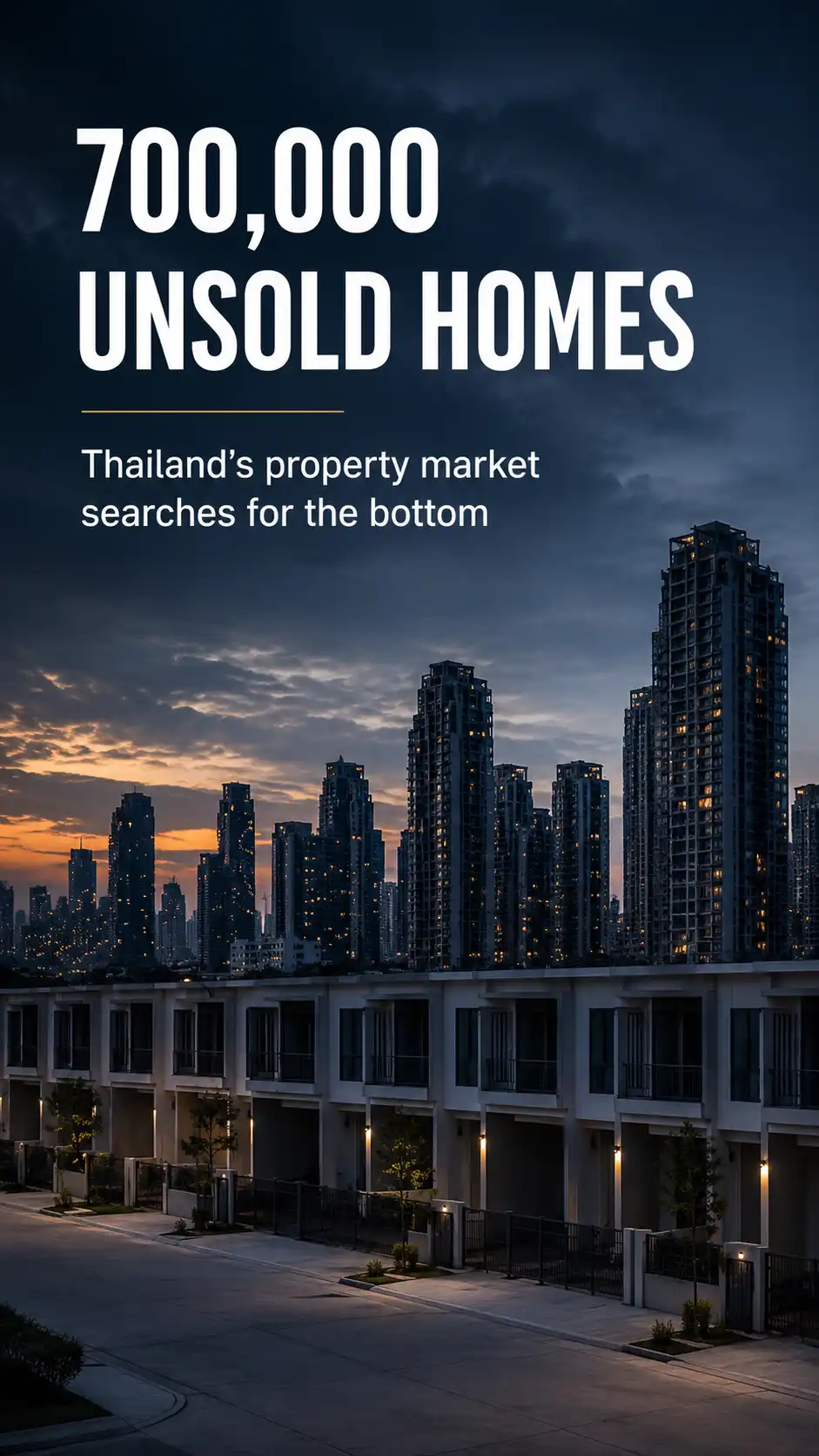
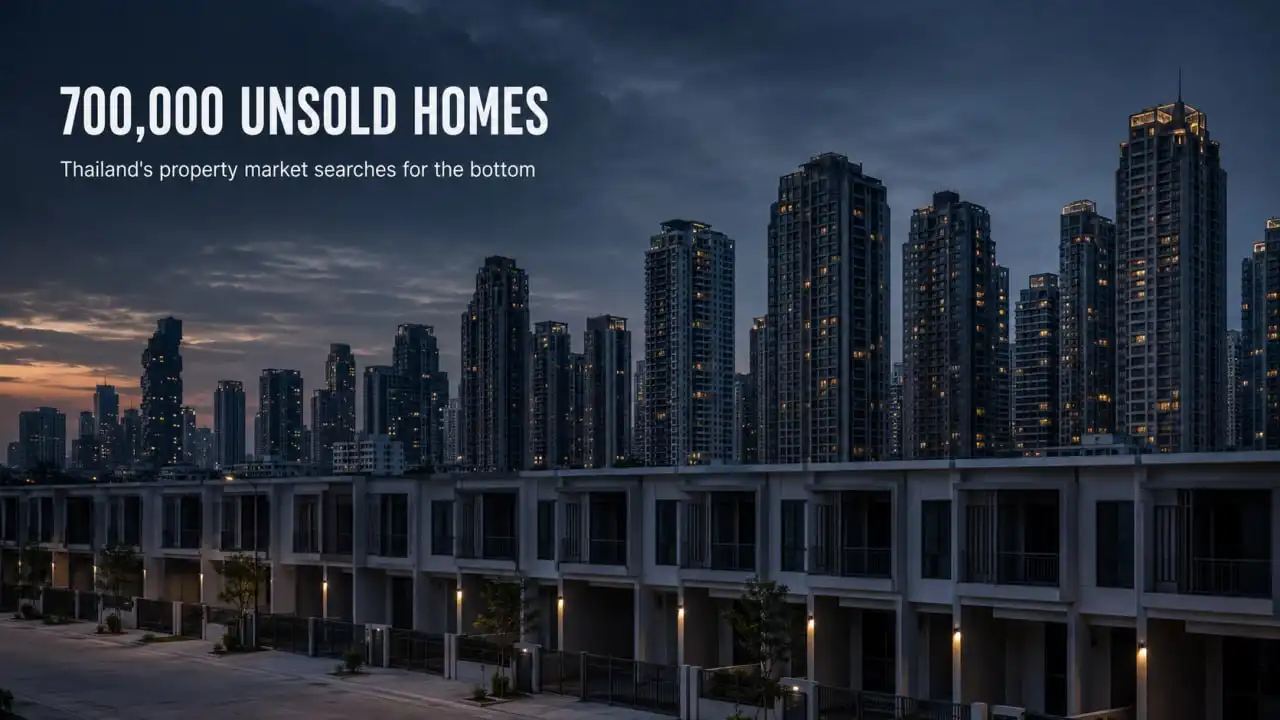
Thailand's largest distressed-asset manager says the property market has not yet reached its lowest point, with 700,000 unsold units against fewer than 100,000 able buyers. What the deepening correction means for foreign buyers seeking to secure Thai property compliantly.
Bangkok Commercial Asset Management (BAM), Thailand's largest asset management company, has confirmed the Thai property market has not yet reached bottom, disclosing roughly 700,000 unsold residential units against fewer than 100,000 households with genuine purchasing power, an oversupply of approximately seven times demand #
Key takeaways
- Thailand's property market has not bottomed, according to Dr Rak Vorrakitpokatorn, Chief Executive of Bangkok Commercial Asset Management Public Company Limited (BAM), speaking to Thai financial press in late June 2026.1
- The oversupply is roughly seven times demand: approximately 700,000 unsold residential units sit against fewer than 100,000 households with the financial capacity to buy, a distortion BAM attributes to a demographic "sandwich" of retirees still repaying mortgages and young workers refused credit.1
- BAM has pivoted from big-ticket deals to rapid small-asset disposal, replacing THB 1.5 to 2.3 billion transactions with a direct-instalment model that lets freelancers, riders and market traders pay BAM directly without a bank; the model collected over THB 1 billion in roughly five months.1
- Second-hand stock now exceeds 60% of the market, with new-build supply falling to around 30%, giving BAM, the country's largest holder of second-hand inventory, wide flexibility to cut prices. Hotels are the fastest-selling asset class.1
- Better-than-Freehold™ enables foreign buyers to act on distressed-market pricing compliantly, securing the investor's position through registered instruments rather than nominee structures that cannot withstand Thailand's 2026 enforcement regime.
What has BAM announced about Thailand's property market? #
- The Sandwich Crisis: 700,000 Homes, 100,000 Buyers
- From Big Deals to Small Tickets: BAM's New Model
- AI-Selected Debt Purchases and the Second-Hand Shift
- Hotels Lead the Recovery Trade
- Legal and Compliance Context for Foreign Buyers
- Impact on Foreign Property Buyers
- Better-than-Freehold™ Solution
- FAQ Section
- Related Terms
- Expert Guidance
The Sandwich Crisis: 700,000 Homes, 100,000 Buyers #
Thailand's residential market is carrying an inventory of roughly 700,000 unsold units whilst fewer than 100,000 households retain the capacity to service a purchase, according to figures disclosed by BAM's Chief Executive, Dr Rak Vorrakitpokatorn. The imbalance, approximately seven times supply over demand, is the sharpest public acknowledgement yet from a major Thai financial institution that the correction has further to run.
Dr Rak described the demand collapse as a "sandwich" problem rooted in Thai demographics. At the top of the age curve, older Thais are reaching retirement before completing their mortgage repayments; at the bottom, younger first-time workers cannot obtain credit from financial institutions at all. The population segment in the middle, those with both income and creditworthiness, is too small to absorb the stock. Asked whether the market had passed bottom, his answer was an unambiguous no.1
From Big Deals to Small Tickets: BAM's New Model #
BAM has restructured its business model around speed of disposal rather than transaction size, a shift its Chief Executive described as a change of paradigm. In the previous year, BAM recorded its strongest collections in a decade on the back of large single sales in the THB 1.5 billion to 2.3 billion range; in current conditions, it regards such deals as close to impossible.1
The replacement is a direct-instalment channel through which freelancers, delivery riders, domestic workers and market traders, the very groups banks decline, can pay for homes directly to BAM without passing through a financial institution. In a little over five months the model generated collections exceeding THB 1 billion, equivalent to a single large Chiang Mai asset sold the previous year, whilst spreading property access across thousands of smaller households.1 For the second half of 2026, BAM plans a "BAM Premium" segment carrying properties priced between THB 30 million and 50 million, aimed at wealthier buyers.1
AI-Selected Debt Purchases and the Second-Hand Shift #
BAM confirmed it will not repeat the industry's historic practice of bulk debt purchasing, and has instead applied AI-driven selection to its acquisitions for the past thirteen to fourteen months. Holding a non-performing-loan book roughly three times larger than its nearest competitor, BAM's Chief Executive said indiscriminate accumulation would bloat the portfolio; the new approach identifies what the market demands first, then sources matching supply.1
From a system-wide pool of roughly THB 80 billion in non-performing loans and assets expected from financial institutions this year, BAM acquired approximately THB 10 billion in the first half and expects to add a further THB 10 billion to 20 billion in the second half, concentrated on hotels, shopping centres and office buildings. With more than 30,000 detached houses and townhouses already in stock, it will slow purchases in those categories.1 The market's composition reinforces the strategy: second-hand properties now account for more than 60 percent of available stock, against roughly 30 percent new-build, strengthening the pricing power of the country's largest second-hand inventory holder.1
Hotels Lead the Recovery Trade #
Hotels are currently the easiest and fastest assets to sell in BAM's portfolio, according to Dr Rak, reflecting a tourism recovery now visible in significantly higher occupancy rates year on year. The hospitality segment's strength explains its prominence in BAM's second-half buying plans alongside retail centres and offices, and stands in contrast to the oversupplied low-rise residential categories where BAM is deliberately slowing acquisition.1
Legal and Compliance Context for Foreign Buyers #
A distressed market attracts opportunistic capital, and Thailand's enforcement agencies know it. Foreign nationals generally cannot hold freehold title to Thai land under the Land Code, and the historic workaround of nominee shareholding is now subject to the most aggressive enforcement campaign in decades. DBD Order No. 2/2568, effective 1 January 2026, requires Thai shareholders to evidence the source of their funds; DBD Order No. 1/2569, effective April 2026, added a written investment confirmation letter from the signing director when a change brought in a foreign director or a foreign minority partner; it never required a sworn statement, a six-month bank-statement audit or an interview. A 23-agency enforcement pact signed on 29 April 2026 coordinates the campaign across government.
The temptation in a falling market is speed: acquire the discounted asset first, worry about structure later. That sequencing is precisely backwards. A bargain acquired through a non-compliant vehicle is not a bargain; it is a contingent liability exposed to audit, forced sale and criminal referral. Compliance must come first, security second, and only then the commercial upside.
Impact on Foreign Property Buyers #
Foreign buyers face the most favourable negotiating conditions in years, but only those with compliant structures can act on them safely. With 700,000 units chasing 100,000 domestic buyers, and the country's largest asset manager openly prepared to cut prices to move inventory, leverage sits firmly with the purchaser. Discounted hotels, villas and condominiums are of little value, however, if the acquisition vehicle collapses under a DBD audit.
For existing owners already inside nominee structures, the deepening correction adds a second-order risk: a forced or distressed exit from a non-compliant holding into a falling market compounds legal exposure with financial loss. A documented conversion pathway into a substance-based structure, undertaken before scrutiny arrives, preserves both the asset and its value. For prospective buyers, the same logic favours entering through a structure built to withstand audit rather than one built to avoid it.
Better-than-Freehold™ Solution #
Better-than-Freehold™ addresses the ownership challenge through a securitised registered 30-year lease, supported by an Option Agreement, a first-priority registered mortgage, a 100% share pledge, and independent oversight from Clear Blue Security Agents (CBSA). The lease and mortgage are registered at the Land Office, and the structure is transparent to Thai authorities and consistent with the substance-based verification now applied nationwide.
Taken in order, the structure leads with compliance, then security, then benefits. Genuine Thai ownership rests with Thailand Investor Network (TIN), a 100% Thai-owned, high-capital property holding and management company that holds legal title and acts as Lessor, with the institutional substance designed to satisfy 2026 DBD financial-substance audits. The foreign investor's beneficial interest is held through SPH Trustees, an offshore trustee whose Labuan FSA licence is in progress, acting as Lessee through a bare trust, and is protected by four principal instruments, including a registered lease and mortgage, with a separate Option Agreement appended to the mortgage, and a share pledge. Because the corporate trustee does not die, the investment passes to heirs without probate.
Applied to today's market, the structure converts the correction from a hazard into an opportunity. Better-than-Freehold™ enables a foreign buyer to negotiate hard on distressed pricing, secure the property through registered rights rather than concealed control, and hold it through the cycle with succession, financeability and an exit mechanism already built in. None of the criteria enforcement agencies now screen for, hidden foreign capital, Thai shareholders who cannot evidence their funds, capital mismatched to land value, arise under the structure.
Free to start · No obligation · Your decision at every stage
FAQ Section #
Related Terms #
- Nominee Company Risks Thailand - Criminal and civil exposure for nominee shareholders and foreign principals
- Land Department Nominee Landholding Crackdown - The nationwide enforcement campaign running alongside the market correction
- Better-than-Freehold™ Structure Explained - How the securitised lease provides compliant, enforceable foreign investor rights
- Foreign Business Act Constraints - The framework prohibiting nominee arrangements that disguise foreign control
- Thailand Property Market Analysis - Broader market context for foreign investors
Expert Guidance #
BAM's disclosure matters because of who is speaking. The country's largest holder of distressed property, with the deepest transaction dataset in the market, has said plainly that the bottom has not arrived, and has reorganised its entire business model around that view. Foreign investors should treat the statement as a credible base case rather than pessimism: further price softening in oversupplied residential segments, continued strength in tourism-linked assets, and a widening flow of distressed stock reaching the market through 2026 and beyond.
Immediate Action Required #
For prospective buyers, the practical priority is preparation rather than haste: identify target segments where leverage is greatest, houses, villas and low-rise stock, and have a compliant acquisition structure ready before negotiating, so a discounted opportunity is never rushed into a non-compliant vehicle. For existing owners in nominee structures, the falling market sharpens the case for reviewing the holding now; a structured review of shareholding, source-of-funds records and capital adequacy should inform a conversion decision before enforcement reaches the property.
Long-term Security Strategy #
Market cycles turn; enforcement regimes do not turn back. Whatever the timing of Thailand's property recovery, the substance-based verification introduced through 2026 is a permanent feature of the landscape. Better-than-Freehold™ is designed for exactly this combination: it enables investors to buy well in a weak market and to hold securely through the recovery, with succession, financeability and exit mechanics resting on registered and contractual instruments rather than promises. Compliance is not an add-on to the structure; it is the foundation from which security and investor benefits are built.
For comprehensive assessment of market entry and Better-than-Freehold™ implementation, contact our expert team today.
Free to start · No obligation · Your decision at every stage
Conclusion #
BAM's assessment confirms what the inventory numbers imply: Thailand's property correction has further to run, with 700,000 unsold units, a demand base under 100,000 households, and the country's largest asset manager pivoting to rapid disposal and selective, AI-driven buying. Hotels lead the recovery trade whilst low-rise residential remains deeply oversupplied.
For foreign buyers, the moment carries a rare alignment: maximum negotiating leverage on price, at exactly the time Thailand's enforcement regime has made structural compliance non-negotiable. Those who prepare a compliant structure before they negotiate can capture the downturn's pricing on a foundation built to withstand regulatory scrutiny. Those who chase discounts through nominee shortcuts inherit both the market risk and the legal risk. The choice of structure, not the timing of the bottom, is the decision that will determine outcomes.
References #
This article is provided for general information only and does not constitute legal, tax, or investment advice. Laws and enforcement practices change; obtain advice tailored to your situation before acting.
Footnotes #
About the Author: Andrew Moore FPFS, CDir
Chairman, Better-than-Freehold™

Andrew Moore has been an active investor in Thai property since 2004. He is a Chartered Director and a Fellow of the Personal Finance Society. He has invested in and built properties in several countries since the late 1990s and first invested in Thailand in 2004. Having owned homes in Bangkok, Samui, Phangan and Phuket he can offer a unique perspective on Thailand's property markets together with past and future trends in both ownership and investor opportunities.