Thailand Intensifies Nominee Business Crackdown - 6,551 Illegal Foreign Entities Identified May 2026
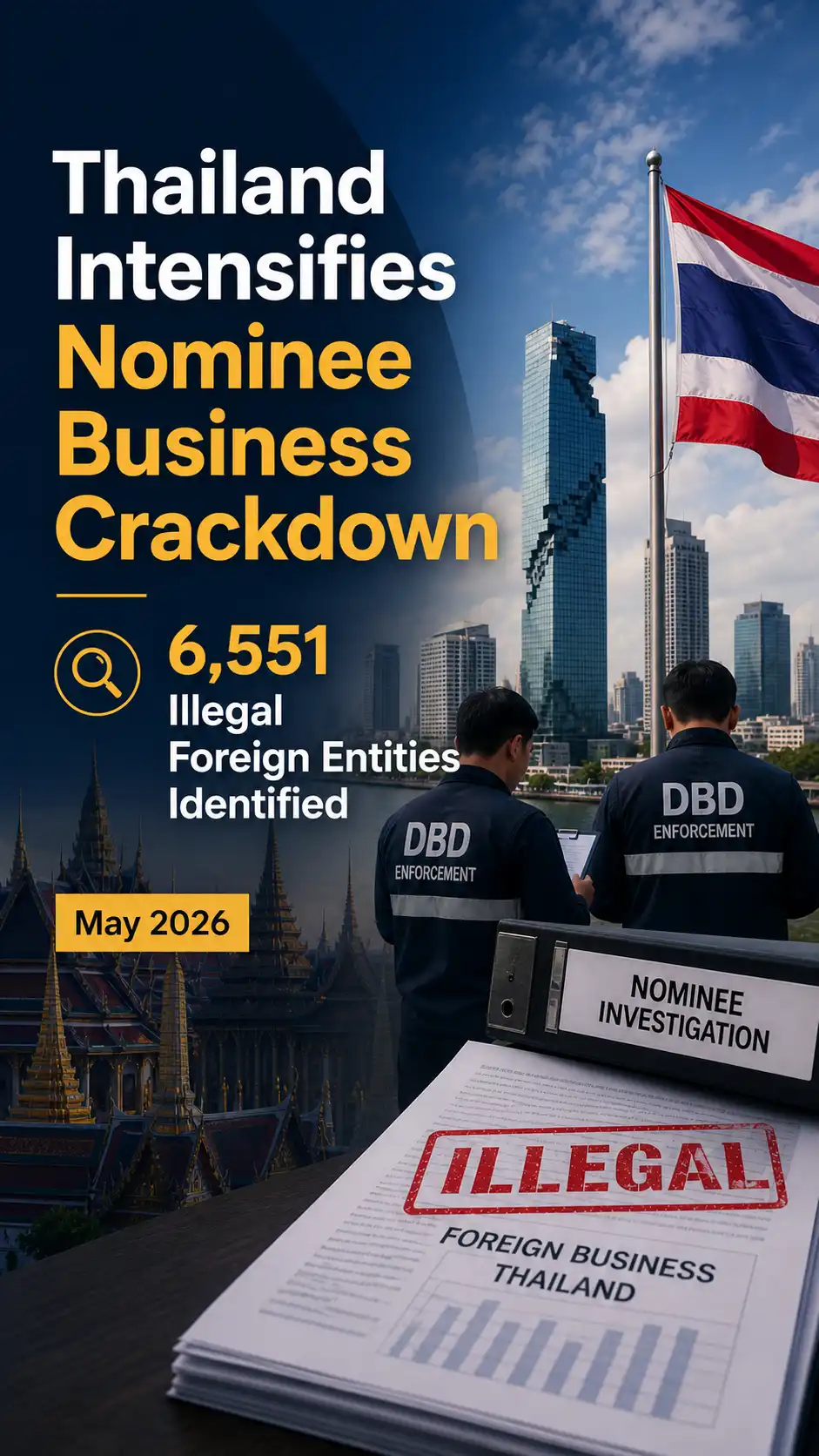
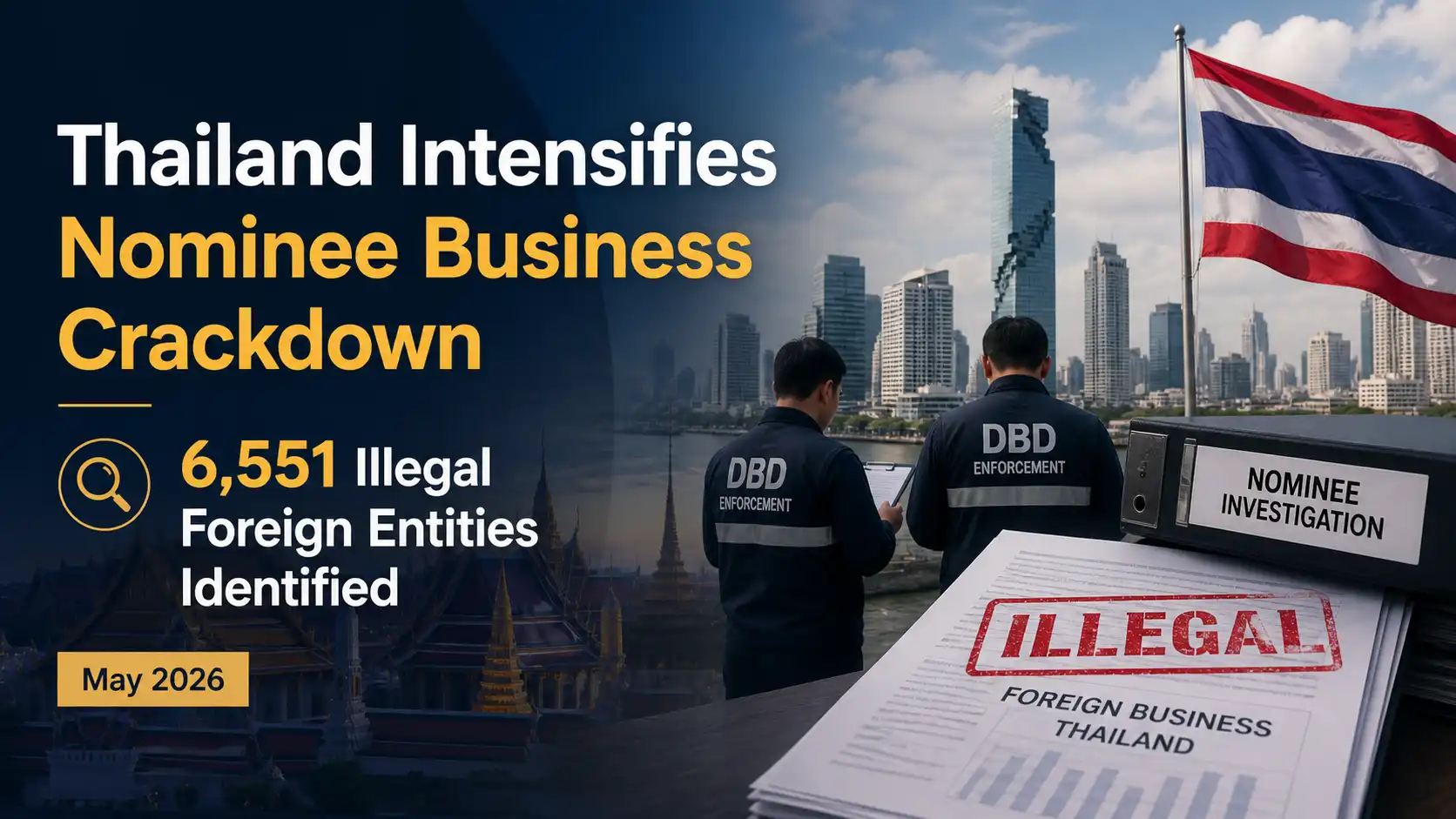
Thai government reports 60% drop in high-risk nominee companies and 6,551 suspected illegal foreign entities under intensified crackdown using linked databases and proactive investigations.
Thailand Intensifies Nominee Business Crackdown - 6,551 Illegal Foreign Entities Identified May 2026 #
Government reports 60% drop in high-risk companies as linked databases and proactive investigations widen enforcement net #
Key Takeaways
- Government confirms intensified crackdown with Prime Minister Anutin Charnvirakul directing decisive action across all illegal nominee operations, signalling no negotiated settlements and full prosecution of every identified case under the Foreign Business Act 1999.[1]
- High-risk nominee companies fell by 60% in Q1 2026 compared with the same period a year earlier, demonstrating that database integration and proactive screening are producing measurable detection results since operations were upgraded on 1 January 2026.[1]
- 6,551 foreign legal entities flagged as having entered Thailand and operated businesses without permission, with foreign shareholders allegedly holding 50% or more of entities operating in sectors reserved under the Foreign Business Act 1999 annexes.[1]
- Better-than-Freehold™ provides full Foreign Business Act compliance through transparent beneficial ownership, regulated trustee oversight, and registered Land Office structures, enabling foreign property holding without nominee exposure under the intensified enforcement regime.
What did the Thai government announce about nominee enforcement on 4 May 2026? #
Government spokesperson Rachada Dhnadirek confirmed that Thailand is intensifying its crackdown on nominee businesses through database linkages between agencies, proactive follow-up investigations, and tighter legal mechanisms aimed at preventing legal-entity status being misused for money laundering and illegal business operations.1
Quick Answer
Quick Answer: Operations upgraded on 1 January 2026 have already cut high-risk nominee companies by 60% in Q1 2026, with the Department of Business Development identifying 6,551 foreign legal entities suspected of operating without permission under the Foreign Business Act 1999. Prime Minister Anutin Charnvirakul has directed that no cases be cleared and every identified offence be pursued.1
Enforcement Snapshot - May 2026 #
| Metric | Figure | Source |
|---|---|---|
| Drop in high-risk nominee companies (Q1 2026 vs Q1 2025) | 60% | Government spokesperson, 4 May 20261 |
| Foreign legal entities flagged for FBA violations | 6,551 | Department of Business Development1 |
| Foreign shareholding threshold triggering investigation | 50% or more | Foreign Business Act 1999 annexes1 |
| Maximum prison term per offence | 3 years | Foreign Business Act 19991 |
| Fine range per offence | THB 100,000 – 1,000,000 | Foreign Business Act 19991 |
| Public reporting hotline | 1570 | Government spokesperson1 |
Table of Contents #
- What the announcement confirms
- How database integration is detecting nominee structures
- What the 6,551 figure represents
- Penalties and accomplice liability
- What this means for existing nominee holders
- Better-than-Freehold™ compliance pathway
- FAQ Section
- Related Terms
- Expert Guidance
What the announcement confirms #
The 4 May 2026 announcement marks an escalation rather than a new policy departure. Operations upgraded on 1 January 2026, aligned with the Department of Business Development's earlier registration tightening under Order No. 2/2568 (2025), and the May statement confirms those measures are now producing detection volume at scale.1
Three operational elements drive the current crackdown: database linkages between agencies, proactive follow-up investigations rather than complaint-driven enforcement, and legal tightening that closes prior procedural gaps.1 The Prime Minister's instruction that there will be no clearing of cases signals that enforcement officers do not have discretion to negotiate settlements with identified offenders.1
How database integration is detecting nominee structures #
Technology is being used to analyse and connect agency databases to screen legal entities at risk of operating illegal businesses.1 This cross-referencing approach links Department of Business Development corporate filings, Land Department title records, Anti-Money Laundering Office reporting flows, and Revenue Department data to surface inconsistencies that manual inspection historically missed.
The 60% reduction in high-risk companies in Q1 2026 reflects two parallel effects: detection of previously concealed structures and deterrent-driven voluntary winding-down by entities anticipating exposure.1 Both effects compound as the database integration matures, meaning the detection rate is expected to continue rising rather than plateau.
What the 6,551 figure represents #
The Department of Business Development reported that initial findings identified 6,551 foreign legal entities that had entered Thailand to operate businesses without permission and might have violated the law.1 The triggering criterion was foreign shareholding of 50% or more in entities operating in sectors listed in the annexes to the Foreign Business Act 1999 - sectors reserved for Thai nationals or requiring specific foreign business licences.1
This figure should be read as a starting position, not a closed enforcement docket. Each flagged entity now enters a follow-up investigation phase, where the Department of Business Development will assess registered share structures, beneficial ownership, capital sources, and operating activity. Entities that cannot demonstrate legitimate Thai majority ownership or appropriate Foreign Business Act permission face referral for prosecution.
Penalties and accomplice liability #
Offences under the Foreign Business Act 1999 carry a prison term of up to three years, a fine of THB 100,000 to THB 1,000,000, or both.1 Critically, those involved in, aware of, or who fail to prevent an offence may also face prosecution as accomplices.1
The accomplice provision extends exposure beyond the foreign principal and the Thai nominee shareholder. Lawyers, accountants, company secretaries, agents, and directors who participated in establishing or maintaining a nominee structure - or who knew it was operating illegally and did not prevent it - fall within the prosecutable circle. This aligns with the gatekeeper obligations established under Thailand's Anti-Money Laundering Act framework, where professional advisors carry independent reporting and due-diligence duties.
What this means for existing nominee holders #
Foreign property owners holding through Thai company structures with majority Thai nominee shareholders are directly within the population the Department of Business Development is now screening. The 50%-plus foreign shareholding trigger applies to apparent foreign ownership; database cross-referencing and beneficial ownership inquiries are designed to surface arrangements where foreign control exists despite Thai nominee shareholders being on the register.
Three practical consequences follow for existing nominee structures:
First, the window for voluntary restructuring continues to narrow. Entities flagged in the 6,551 cohort are already in the investigation pipeline; entities not yet flagged should not assume they remain undetected as database integration deepens.
Second, transfer or sale becomes constrained. Recent registration changes by default retrospectively lock in nominees on the share register of existing companies, whereby any transfer of shares or sale of the company is subject to capital requirement and proof tests. This reduces exit options for owners attempting to dispose of nominee-held property quickly.
Third, professional advisors face independent exposure. The accomplice provision means the lawyer who set up the structure, the accountant who filed its returns, and the agent who arranged the purchase all carry their own potential liability - not just the foreign principal.
Better-than-Freehold™ compliance pathway #
Better-than-Freehold™ addresses the Foreign Business Act compliance gap directly by removing the nominee structure entirely. Legal title is held by an independent Thai asset manager (TIN) under regulated trustee oversight from SPH Trustees, with the foreign holder's lease and option rights registered at the Land Office and enforced by an independent security agent.
How does Better-than-Freehold™ remove Foreign Business Act exposure? #
Foreign holders do not own shares in a Thai company under the Better-than-Freehold™ framework, so the Foreign Business Act 1999 annex restrictions do not apply to the holding structure. Beneficial ownership is fully transparent; there is no nominee shareholder, no concealed control, and no reliance on a Thai national acting as a proxy.
Can existing nominee holders convert to Better-than-Freehold™? #
Conversion is the primary route for foreign owners currently exposed under the intensified enforcement regime. The conversion pathway involves transferring legal title from the Thai company to the independent asset manager, registering the long-lease and option-to-renew structure at the Land Office, and winding up the original nominee company. Implementation typically completes within a 6–8 week window, subject to property type and Land Office processing.
FAQ Section #
When did Thailand upgrade nominee enforcement operations?˅
Government spokespersons confirmed upgraded operations began on 1 January 2026, with first-quarter 2026 results showing a 60% reduction in high-risk nominee companies.
What does the 6,551-entity figure mean?˅
The Department of Business Development identified 6,551 foreign legal entities suspected of operating businesses without permission, triggering follow-up investigation under the Foreign Business Act framework.
What penalties apply under the Foreign Business Act?˅
Offenders may face up to three years' imprisonment, fines of THB 100,000 to THB 1,000,000, or both, with accomplice liability extending to those involved in or aware of violations.
Can advisors also be prosecuted?˅
Yes. The government's accomplice language indicates exposure can extend beyond principals to facilitators who knowingly support or fail to prevent illegal nominee arrangements.
How are nominee structures being detected now?˅
Authorities are linking agency databases and conducting proactive investigations rather than relying only on complaints, improving detection of concealed beneficial ownership and control patterns.
How does Better-than-Freehold™ reduce this risk?˅
Better-than-Freehold™ removes nominee shareholding from the structure and relies on transparent, registered rights with independent oversight, reducing exposure to Foreign Business Act nominee enforcement.
Related Terms #
- DBD Tightens Foreign Business Registration - Nominee Crackdown 2026 - The 1 January 2026 registration changes that underpin the current enforcement wave
- AMLA 2025 Amendments - Gatekeeper obligations and accomplice exposure for professional advisors
- Foreign Business Act Restrictions Thailand - Sector annexes, shareholding thresholds, and permitted structures
- Nominee Company Risks - Core legal and criminal exposure tied to nominee structures
Expert Guidance #
The 4 May 2026 announcement is best read as confirmation that the enforcement regime introduced on 1 January 2026 is operating at scale and producing detection volume. The 60% reduction in high-risk companies and the 6,551 flagged entities are not the end of the enforcement programme - they are the visible first quarter of a multi-year operational commitment with bipartisan political support and institutional infrastructure already in place.
Immediate Action Required #
The immediate priority is structural assessment. Foreign owners holding property through Thai company structures should commission an independent review of share register, capital flow history, operational substance, and beneficial ownership documentation. Entities matching the Department of Business Development's screening criteria - foreign shareholding at or above 50% in reserved-sector activity - face heightened investigation probability.
Long-term Security Strategy #
The secondary priority is conversion pathway selection. Voluntary restructuring whilst not yet flagged offers materially better outcomes than restructuring under active investigation. Better-than-Freehold™ provides a documented compliant alternative with regulated trustee oversight, registered Land Office rights, and full Foreign Business Act 1999 compliance, removing the nominee exposure that drives current enforcement risk.
For comprehensive assessment of nominee exposure and Better-than-Freehold™ implementation, contact our expert team today.
Conclusion #
Thailand's nominee crackdown has moved from policy intent to operational result. The Q1 2026 figures - a 60% drop in high-risk companies and 6,551 entities flagged for Foreign Business Act 1999 investigation - confirm that database integration, proactive screening, and the Prime Minister's no-clearance directive are producing enforcement at scale.[1]
Existing nominee structures face narrowing options. Detection capability is rising as agency databases continue to integrate, transfer constraints are tightening under recent registration changes, and professional advisor accomplice exposure broadens the prosecutable circle around each non-compliant entity.
Better-than-Freehold™ provides the compliant alternative - transparent beneficial ownership, regulated trustee oversight, and registered Land Office structures that remove Foreign Business Act exposure entirely.
References #
Legal Disclaimer
This article is for informational purposes only and does not constitute legal advice. Nominee structure enforcement and Thai property law are complex and subject to change. For specific guidance regarding individual circumstances, consult qualified legal professionals familiar with Thai property law and Better-than-Freehold™ compliance solutions.
Footnotes #
About the Author: Andrew Moore

Andrew Moore has been an active investor in Thai property since 2004. He is a Chartered Director and a Fellow of the Personal Finance Society. He has invested in and built properties in several countries since the late 90's and first invested in Thailand 20 years ago. Having owned residencies in Bangkok, Samui, Phangan and Phuket he can offer a unique perspective on the island's property markets together with past and future trends in both ownership and investor opportunities.