
Is a 30-Year Lease in Thailand Safe? What It Protects and What It Does Not (2026)
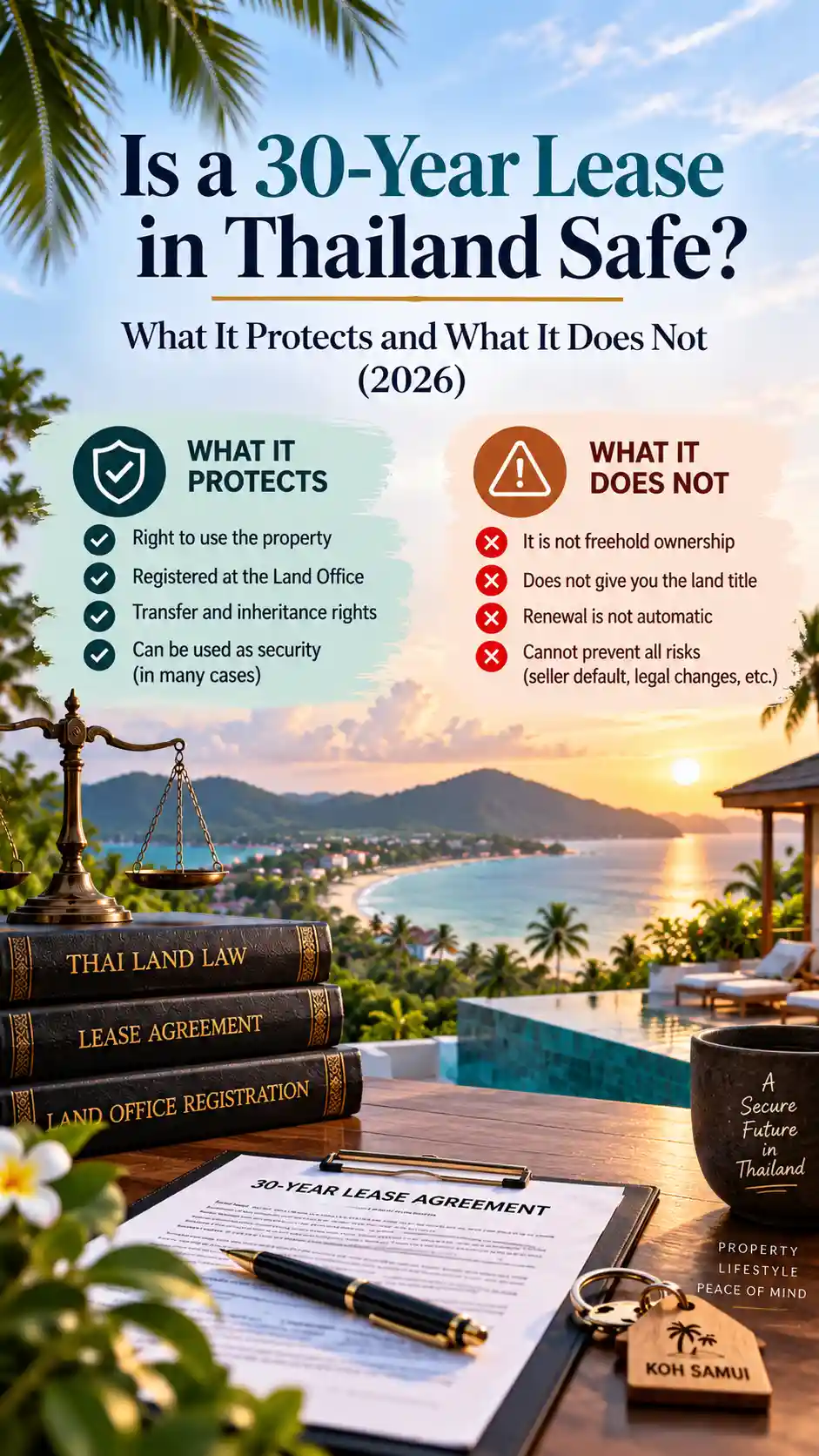
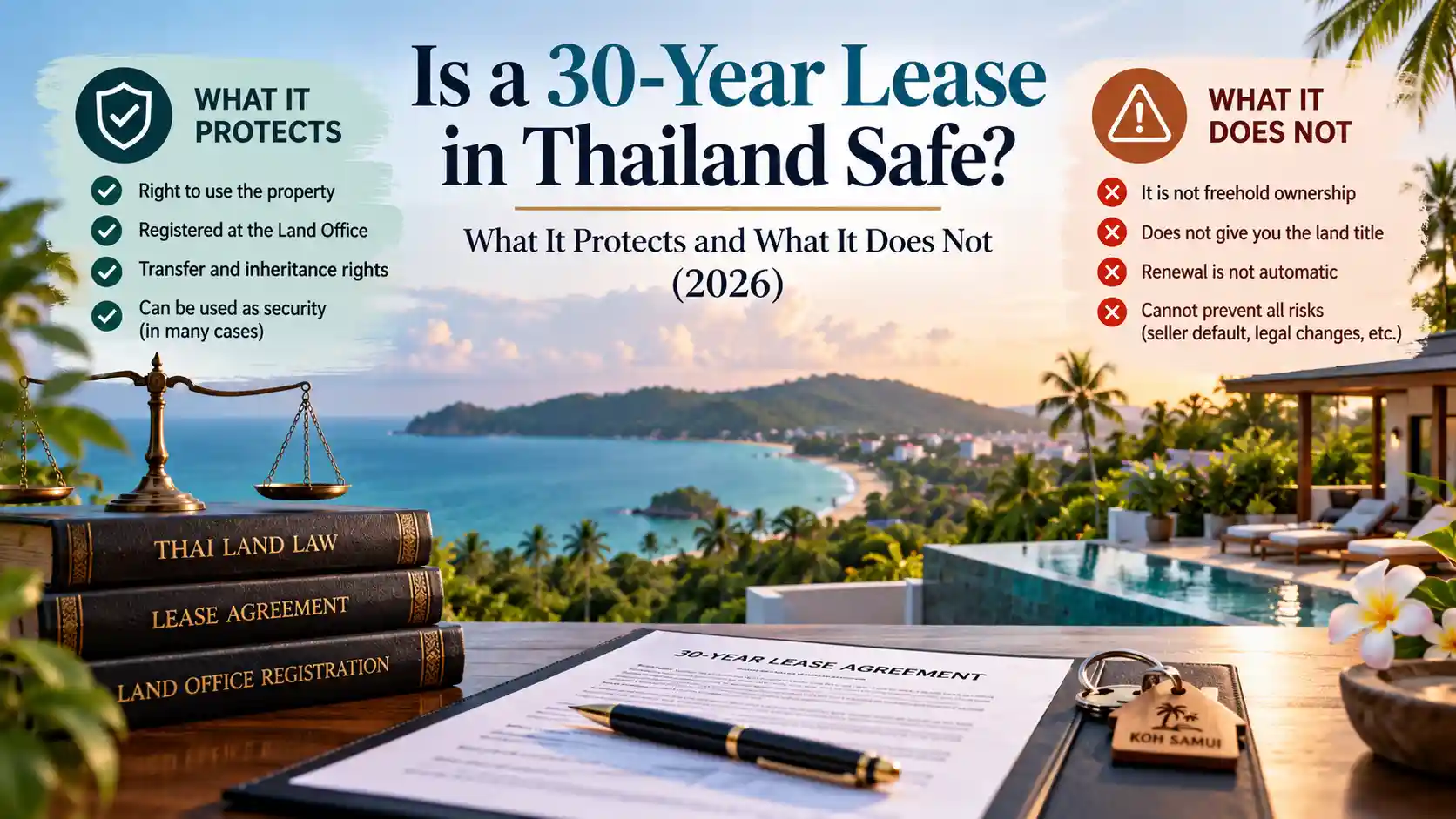
A registered 30-year lease in Thailand is a genuine legal right under Civil and Commercial Code section 540, but renewal promises beyond that term are personal covenants, not property rights. What the lease protects, and where it stops.
A registered 30-year lease is a real right; renewal promises beyond that term are not #
Key takeaways
- Registration is what makes the 30 years real: Civil and Commercial Code section 540 caps registrable lease terms, and only what is entered at the Land Office survives a change of freehold owner.
- Renewal promises are personal, not registered: "30+30+30" clauses bind the original landlord alone; heirs, buyers, and liquidators owe the tenant nothing beyond the registered term.
- The 99-year fix is shelved, not scheduled: the September 2025 proposal has no confirmed revival date, so plan around the existing 30-year cap.
- An Option Agreement replaces the promise: Better-than-Freehold™ records the year-30 pathway alongside the lease, mortgage, and share pledge from the outset, rather than leaving it to a future negotiation.
Is a 30-year lease in Thailand safe for a foreign buyer? #
- Why a Registered Lease Is Genuinely Safe
- What the Lease Does Not Protect
- Why 30+30+30 Renewal Promises Fail
- Is a Longer Registered Term Coming?
- How Better-than-Freehold™ Fixes the Gap
- FAQ Section
- Related Terms
- Expert Guidance
Why Is a Registered 30-Year Lease Genuinely Safe? #
A registered 30-year lease is safe because it is a real right: it binds the land itself, not just the person who signed it, and survives a change of freehold owner. Section 540 of the Civil and Commercial Code sets the statutory ceiling at 30 years, and registration at the Department of Lands is what converts a private agreement into something enforceable against the world, not merely against the landlord.
That distinction matters more than most buyers realise at signing. An unregistered lease, or one left inside a private contract never taken to the Land Office, is only a personal promise between two parties. A registered lease over three years, entered on the title deed itself, is different in kind. Sell the freehold, and the new owner inherits the tenant along with it; the lease does not evaporate because the landlord changed. This is the part worth the paperwork. Our leasehold versus freehold comparison scores where that registered right still falls short of what buyers assume they are buying.
Foreign buyers keep asking the same question in the wrong order. They want to know whether a 30-year lease is safe before asking what "safe" even means here. The honest answer splits in two. As a registered 30-year right, standing on its own statutory footing, the lease is as safe as Thai property law gets for a non-Thai national. As a stand-in for the freehold ownership that law does not allow foreigners to hold, it is something else entirely: a fixed-term interest with a hard stop, sometimes dressed up to look longer than it is.
What Does the Lease Not Protect? #
The lease does not protect a 90-year hold, equity growth, or a guaranteed inheritance, because none of those sits inside the 30-year registered term itself. Marketing sometimes implies the opposite, and the gap between what gets implied and what gets registered is exactly where buyers get exposed. Three failure points recur.
First, it is not a 90-year hold. Developers often pair the registered 30-year term with a written promise of two further renewals, producing the familiar "30+30+30" pitch. Only the first 30 years is registrable; the rest is a separate promise sitting outside the title. Second, it is not an equity asset. A lease is a right to occupy for a term, not a share of appreciating land value, and it depreciates toward zero as the term runs down regardless of what the underlying land value is. Third, it is not automatically an inheritance vehicle. The registered term itself can pass to heirs as an encumbrance for its remaining years, but any renewal promise attached to it usually does not, and a foreign lessee's practical control over what happens next depends entirely on who is left to negotiate with.
Why Do 30+30+30 Renewal Promises Fail? #
A renewal promise beyond the registered 30-year term is a personal covenant, not a real right, so it binds only the landlord who signed it, not that landlord's heirs, a buyer of the freehold, or a liquidator winding up a dissolved landlord company. Thai Supreme Court jurisprudence has held for decades that prepaid renewals on identical terms extending beyond the 30-year cap are void. Nothing about it is new or contested.
The mechanism is simple once you see it. Section 540 caps what the Land Department will register at 30 years; nothing longer can go on the chanote, so a renewal clause has nowhere to sit inside the registered system. It exists only on paper, as a private undertaking. If the landlord who made that promise dies, sells the land, or is dissolved as a company, the new party in control never agreed to it, and Thai law does not require them to honour it. A buyer inspecting the title at year 31 sees only that the lease term has expired; nothing on the public record shows a renewal was ever promised.
None of this means a fresh lease at year 30 is impossible. A landlord and tenant who both want to continue can simply negotiate and register a new 30-year term when the old one ends, and plenty of long-standing tenancies do exactly that. What fails is the pre-agreed automatic renewal, baked into the original contract, that binds a future, unknown counterparty. A genuinely fresh negotiation, entered into by whoever actually holds the freehold at the time, is different and lawful. A separate registered right does not escape the same ceiling either: Sap Ing Sith, created under the Sap-Ing-Sith Act B.E. 2562 (2019), also runs for a maximum of 30 years.
Is a Longer Registered Term Coming? #
A 99-year lease reform proposal was shelved in September 2025, and no confirmed revival timetable exists as this is written. Buyers should plan around the 30-year statutory cap as it stands today, not around legislation that might arrive, might not, and has stalled before.
Waiting for reform is not a strategy. It is a bet on a bill with no sponsor and no date. The Ministry of Commerce oversees the Foreign Business Act framework that governs how far foreign involvement in Thai landholding structures can go, and any change to lease-term limits would need separate legislative action entirely, not an administrative order. Structuring a purchase around a hoped-for extension puts the whole plan on a foundation nobody has actually built yet.
How Does Better-than-Freehold™ Fix the Renewal Gap Without Relying on a Promise? #
Better-than-Freehold™ replaces the renewal promise with a fourth instrument, a year-30 Option Agreement, recorded alongside the lease from day one rather than left to a future negotiation with an unknown landlord. It prescribes what happens at year 30 in advance, on paper the Land Office has already seen. What Better-than-Freehold™ is sets out the four contracted entities and the registered instruments they hold.
Compliance comes first. The lease and Option Agreement run through Thailand Investor Network, a 100% Thai-owned property holding and management company with institutional capital; it holds legal title and grants the registered 30-year lease with no foreign funding or foreign control for enforcement screening to find, because there genuinely is none. Registration and dissolution records for the corporate structures involved sit with the Department of Business Development, and anti-money laundering scrutiny of nominee-adjacent lease structures runs through AMLO. Security follows. SPH Trustees, a Labuan FSA-regulated trust company, holds the investor's rights across four registered instruments: the lease, the Option Agreement, a first-charge mortgage, and a share pledge, with Clear Blue Security Agents (CBSA) providing independent enforcement that does not wait on a dissolved company's cooperation. The benefits complete the picture. Because the trustee structure does not depend on one landlord's continued goodwill, resale proceeds can be achieved by assignment of the trust interest, succession passes to heirs without Thai probate, and financing to 50% loan-to-value is anticipated to come online as well (expected Q1 2027).
The difference is not a better sales script. A registered instrument binds successors because it is a real right; a renewal clause does not, because it never was one. Year 30 under this structure is a defined pathway recorded now, not a hope that whoever owns the freehold by then feels like keeping an old promise.
Free to start · No obligation · Your decision at every stage
FAQ Section #
Related Terms #
- Leasehold vs Freehold in Thailand: where a 30-year lease falls short, and what closes the gap
- Sap Ing Sith and ROLA Property Rights: another 30-year registered right with the same statutory ceiling
- What Is Better-than-Freehold™: the structure's legal framework and components
- How to Buy Property in Thailand Legally: the 2026 step-by-step for condo, lease, and compliant structures
Expert Guidance #
Before signing a lease with a renewal clause, or relying on one already in a contract, the question worth asking is not whether the clause is well written but whether it is registrable at all. A structural comparison against an Option Agreement answers that in a way a contract read-through cannot.
Immediate Action Required #
Ask counsel to confirm what is actually entered on the title versus what sits only in the private contract. Treat any "30+30+30" marketing claim as a registered 30-year term plus an unenforceable promise until proven otherwise. Contact the Better-than-Freehold™ advisory team for a confidential comparison against an Option Agreement structure.
Long-term Security Strategy #
How Better-than-Freehold™ works sets out how the year-30 pathway gets recorded from the outset. Plan around the existing 30-year cap; do not structure a purchase around legislation that has already stalled once.
Free to start · No obligation · Your decision at every stage
Conclusion #
A 30-year lease in Thailand is exactly as safe as Section 540 makes it, and no safer than that. Registered, it is a real right that survives a change of ownership. Beyond year 30, whatever is written into the contract is only as good as a landlord who might no longer exist, no longer control the land, or no longer wish to be bound. Foreigners cannot buy freehold land in Thailand, and a lease dressed up as 90 years does not change that arithmetic. Better-than-Freehold™ structures replace the renewal promise with a suite of registered instruments from day one, which is the part of the transaction that was always missing.
This article is provided for general information only and does not constitute legal, tax, or investment advice. Laws and enforcement practices change; obtain advice tailored to your situation before acting.
About the Author: Andrew Moore FPFS, CDir
Chairman, Better-than-Freehold™

Andrew Moore has been an active investor in Thai property since 2004. He is a Chartered Director and a Fellow of the Personal Finance Society. He has invested in and built properties in several countries since the late 1990s and first invested in Thailand in 2004. Having owned homes in Bangkok, Samui, Phangan and Phuket he can offer a unique perspective on Thailand's property markets together with past and future trends in both ownership and investor opportunities.