
Hua Hin Nominee Company Enforcement: DBD Investigation 2026
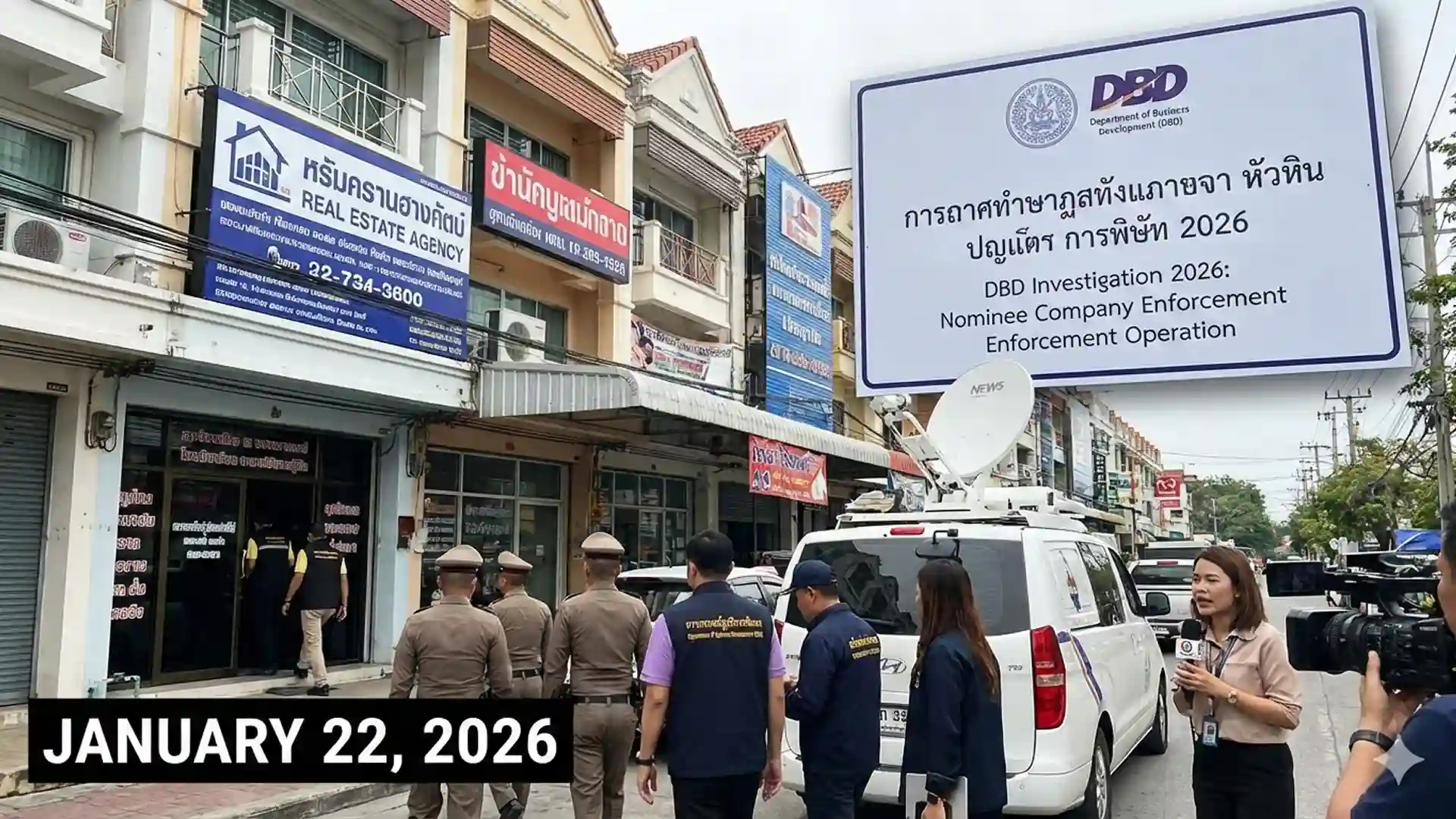
Hua Hin foreign property owners face systematic DBD investigations targeting nominee companies. Understand enforcement patterns, compliance requirements, and Better-than-Freehold™ protection strategies.
Prachuap Khiri Khan Property Owners Receive Formal Compliance Requests Under Systematic Investigation #
Key takeaways
- Department of Business Development investigators issue formal compliance requests to property-owning companies throughout Hua Hin and Prachuap Khiri Khan, requiring comprehensive documentation demonstrating genuine Thai shareholder investment whilst creating one-year response deadlines for over 7,000 corporate entities under systematic scrutiny.
- Enforcement evolution transforms from historical spot-checks toward data-driven investigations coordinating multiple government agencies, including the Central Investigation Bureau, Land Office, Revenue Department, and Anti-Money Laundering Office, creating immediate compliance imperatives through integrated database analysis.
- Criminal penalties reach three years imprisonment and/or a fine of THB 100,000 to 1,000,000 whilst AMLO can provisionally seize or freeze assets under AMLA section 48, creating substantial exposure for foreign property owners, Thai nominees, and professional service providers facilitating nominee structures.
- Better-than-Freehold™ implementation is structured in accordance with the applicable Thai legal and regulatory frameworks through genuine Thai ownership without foreign funding or control, creating property rights through offshore trust structures and designed to avoid prosecution exposure. Financing to 50% loan-to-value is a future workstream, expected from H1 2027 and not yet live.
What enforcement actions are occurring in Hua Hin requiring immediate property owner response? #
Foreign property owners throughout Hua Hin and wider Prachuap Khiri Khan face immediate compliance challenges as the Department of Business Development escalates systematic investigations into nominee company structures affecting property ownership rights. According to information presented at a 14 January 2026 seminar organised by MBMG Group and Hua Hin Accounting & Law, over 7,000 corporate entities in the province face heightened scrutiny under Thailand's intensified enforcement campaign targeting nominee abuse in property ownership, creating urgent compliance requirements for foreign investors1.
Hua Hin Enforcement Overview #
| Enforcement Aspect | Current Status | Impact Level | Compliance Requirement | Better-than-Freehold™ Advantage |
|---|---|---|---|---|
| DBD Investigation Scope | 7,000+ Prachuap entities | Critical | Document response within 1 year | Complete compliance framework |
| Agency Coordination | Multi-department integration | High | Enhanced verification | Transparent governance |
| Criminal Penalties | Up to 3 years + ฿1M fines | Severe | Immediate action required | Designed to avoid nominee arrangements |
| Asset Seizure Risk | Provisional AMLO freezing | Critical | Professional assessment | Registered security protection |
| Professional Liability | Equivalent criminal exposure | High | Enhanced due diligence | Professional administration |
| Market Impact | Liquidity constraints | Moderate-High | Compliant alternatives | Premium positioning capability |
Table of Contents #
- Systematic Investigation Details
- Nominee Classification Criteria
- Immediate Legal Exposure
- Legal and Compliance Context
- Impact on Hua Hin Property Investors
- Better-than-Freehold™ Compliance Protection
- Enforcement Timeline and Next Steps
- FAQ Section
- Professional Guidance Recommendations
Systematic Investigation Details #
Department of Business Development investigators issue formal compliance requests to property-owning companies throughout Prachuap Khiri Khan, requiring comprehensive documentation demonstrating genuine Thai shareholder investment and operational legitimacy1.
What documentation requirements apply to Hua Hin property owners? #
Property owners receive one-year response deadlines whilst authorities examine shareholding authenticity, capital contribution sources, and operational reality through systematic document review processes. Required documentation includes share registration books, share certificates, investment receipts demonstrating genuine capital contribution, share transfer records, company and shareholder bank statements, comprehensive financial statements, and dividend distribution records.
Many property owners discover these documents were never properly prepared during company formation, creating immediate compliance exposure, whilst professional remediation strategies require comprehensive documentation reconstruction and legal verification, ensuring regulatory acceptance.
Systematic database integration enables real-time identification of high-risk corporate structures through cross-agency information sharing between the Department of Business Development, the Central Investigation Bureau, the Land Office, the Revenue Department, and the Anti-Money Laundering Office. Tourism and real estate sectors face particular scrutiny, with Prachuap Khiri Khan identified as a priority enforcement province alongside Phuket, Pattaya, Samui, and other coastal destinations.
How does multi-agency coordination enhance detection capabilities? #
Technology-driven surveillance through AI pattern recognition identifies suspicious ownership structures, including circular shareholding arrangements, foreign-sourced capital funding Thai shareholders, and operational control by non-Thai nationals despite paper compliance. Real-time data sharing enables comprehensive detection capabilities, whilst coordinated prosecution actions ensure systematic enforcement rather than isolated inspections.
Professional service provider involvement, including accountants and lawyers establishing original company structures faces equivalent criminal liability exposure under current enforcement patterns. Seminar speakers, including Janjira Sumanus (MBMG Group CEO), Natthapol Trichote (MBMG lawyer), and Winai Panithaarakchai (tax auditor), emphasised fundamental enforcement transformation requiring immediate compliance responses1.
Nominee Classification Criteria #
Authorities examine three critical indicators establishing nominee structure classification, creating criminal liability exposure and asset seizure risks.
What factors determine nominee company classification? #
Capital source verification determines whether Thai shareholders provided genuine investment or received foreign funding, creating nominee arrangements. Foreign funding of Thai shareholdings triggers immediate nominee classification regardless of formal ownership percentages, whilst documentation demonstrating genuine Thai capital investment provides compliance protection.
Operational control assessment identifies actual decision-making authority through examination of management practices, voting patterns, and strategic control mechanisms. Foreign operational control, despite Thai majority shareholding, creates nominee classification whilst genuine Thai management demonstrates compliance legitimacy.
Economic benefit analysis reveals ultimate profit recipients through dividend distributions, shareholder loan arrangements, and indirect benefit structures. Consistent zero-profit declarations combined with shareholder loan reliance create operational legitimacy concerns, whilst proper profit distribution and tax payment demonstrate genuine business activity.
How do authorities verify genuine Thai shareholder investment? #
Bank statement analysis traces capital sources, funding share purchases, whilst verifying that Thai shareholders possessed genuine financial capacity for investment amounts. Investment receipt verification confirms proper payment documentation whilst examining transaction timing and funding sources, creating comprehensive capital source validation.
Operational activity assessment determines whether companies generate genuine commercial revenue rather than existing solely for property ownership purposes. Rental income generation combined with proper tax declarations demonstrates operational legitimacy, whilst pure asset-holding companies without revenue create enforcement red flags requiring enhanced scrutiny.
Immediate Legal Exposure #
Foreign property owners throughout Hua Hin operating through Thai companies with nominee shareholders face immediate prosecution risk under the Foreign Business Act and Land Code provisions.
What criminal penalties apply to foreign property owners? #
Criminal sanctions include imprisonment terms up to three years for Foreign Business Act violations, whilst financial penalties range from 100,000 baht to one million baht, depending on violation severity and company asset values. Asset freezing allows AMLO to provisionally seize or freeze assets under AMLA section 48; forfeiture itself goes through the courts.
Deportation and blacklisting affect future Thailand residence and travel access, whilst combined penalties across multiple violations could create exposure exceeding ten years imprisonment if the predicate offence provisions in the proposed AMLA amendments, which are not yet law, are enacted.
Recent Phuket prosecutions demonstrate enforcement reality with 23 defendants convicted, including foreign nationals and Thai nominees facing suspended prison sentences, heavy fines, and company dissolution orders. Hua Hin enforcement follows identical patterns requiring immediate compliance strategies protecting property ownership rights.
Who faces professional service provider liability? #
Thai nominees enabling foreign ownership circumvention face equivalent criminal prosecution, including imprisonment, substantial fines, and permanent criminal records affecting future employment and travel opportunities. Professional service providers, including lawyers, accountants, and property agents, facilitating nominee structures face license revocation, professional sanctions, and criminal liability.
Corporate entities identified as nominee vehicles face court-ordered cessation of the shareholding under FBA s.36, and their land faces forced disposal under the Land Department. Better-than-Freehold™ implementation is designed to avoid these exposure risks through a leasehold and security framework structured in accordance with Thai law, separating legal title from beneficial interests.
Legal and Compliance Context #
Thailand's enforcement evolution reflects a systematic commitment to nominee structure elimination aligned with international anti-money laundering standards and Financial Action Task Force compliance requirements.
How would the proposed 2025 AMLA amendments affect Hua Hin property enforcement? #
The proposed 2025 AMLA amendments would explicitly classify nominee arrangements as money laundering predicate offences, enhancing penalties whilst expanding enforcement capabilities through technology integration and professional gatekeeper liability provisions. Legal action against 873 nominee offenders between September 2024 and July 2025 demonstrates a sustained enforcement commitment, creating immediate compliance imperatives.
Historical tolerance for nominee company structures has transformed into zero-tolerance prosecution, creating a fundamental market transformation requiring compliant alternative solutions. Foreign Business Act provisions restrict foreign participation in land trading and designated business categories, whilst Land Code restrictions generally prevent direct foreign land acquisition.
Better-than-Freehold™ compliance operates through genuine Thai ownership without foreign funding or control, whilst providing beneficial ownership rights through offshore trust structures, creating comprehensive regulatory adherence and designed to avoid prosecution exposure.
What compliant alternatives address enforcement requirements? #
Registered long-term leases provide 30-year occupation rights renewable through separate option agreements whilst maintaining legal compliance, though financing limitations and inheritance complexities constrain investor appeal. Usufruct arrangements grant lifetime property usage rights without ownership transfer, though termination upon death creates succession planning challenges.
Superficies agreements enable building ownership separate from land title, though Prachuap Khiri Khan authorities rarely approve such structures, creating implementation limitations. Better-than-Freehold™ provides strong advantages through structuring in accordance with the applicable Thai legal and regulatory frameworks, combining genuine Thai legal title, beneficial property rights, inheritance planning flexibility, and professional enforcement through registered security interests. Financing to 50% loan-to-value is a future workstream, expected from H1 2027 and not yet live.
Impact on Hua Hin Property Investors #
Immediate compliance verification requirements create urgent assessment needs for existing property-owning company structures throughout Hua Hin and wider Prachuap Khiri Khan.
How should current property owners respond to DBD letters? #
Immediate professional assessment through qualified legal advisors experienced in Thai property law and compliance frameworks enables risk evaluation and strategy development, addressing individual circumstances and exposure levels. Documentation collection, including company registration, shareholding records, financial statements, and transaction histories, supports compliance verification and response preparation.
Conversion evaluation toward compliant alternatives, including Better-than-Freehold™ implementation, provides strong protection whilst maintaining beneficial property rights and supporting long-term investment security. Proactive engagement with authorities through prepared responses and comprehensive documentation demonstrates regulatory cooperation, whilst proper legal representation ensures rights protection.
What market consequences affect Hua Hin property values? #
Market liquidity constraints emerge as nominee-dependent properties face buyer resistance and financing unavailability, whilst pricing pressure affects non-compliant holdings, creating valuation uncertainty and transaction difficulties. Professional service availability concentrates amongst advisors implementing compliant conversion strategies.
Institutional investment opportunities require established legal frameworks, such as Better-than-Freehold™, meeting regulatory standards and professional governance requirements. Better-than-Freehold™ properties command premium pricing reflecting legal certainty whilst maintaining market liquidity through compliant beneficial interest transfer mechanisms.
Better-than-Freehold™ Compliance Protection #
Better-than-Freehold™ implementation is structured in accordance with the applicable Thai legal and regulatory frameworks and designed to avoid nominee structure risks, whilst maintaining beneficial property rights and enabling comprehensive investment advantages.
How does Better-than-Freehold™ ensure Hua Hin compliance? #
Genuine Thai ownership through Thailand Investor Network operates without foreign funding or control, designed to avoid the nominee classification indicator and structured in accordance with the Foreign Business Act and the Land Code. No foreign shareholding or operational control exists whilst beneficial ownership rights operate through Labuan trust structures providing investment protection.
Registered security interests, including the first-priority mortgage, together with the share pledge, ensure contractual enforcement whilst Clear Blue Security Agents provides independent administration, monitoring compliance and protecting investor interests. Financing to 50% loan-to-value is a future workstream, expected from H1 2027 and not yet live.
What conversion process applies to existing Hua Hin properties? #
Typical implementation requires eight to sixteen weeks, including legal documentation, authority registration, and compliance verification, whilst professional coordination ensures efficient completion, maintaining property rights throughout conversion. Financing or deferred payment is being developed as a future workstream, with first loan products due to come online in H1 2027, whilst ongoing professional administration ensures sustained regulatory compliance.
Market positioning improves through a compliant structure, creating buyer confidence and premium pricing capability, whilst liquidity enhancement enables sophisticated investor access and institutional participation. Better-than-Freehold™ conversion is designed to avoid prosecution exposure whilst providing long-term investment security through professional governance frameworks.
Enforcement Timeline and Next Steps #
Systematic investigations continue expanding with the Department of Business Development announcing plans to examine tens of thousands of companies nationwide, whilst Prachuap Khiri Khan maintains priority enforcement status.
What enforcement evolution should Hua Hin owners anticipate? #
Information sharing intensifies between regulatory agencies, including Anti-Money Laundering Office coordination, enabling comprehensive detection capabilities and coordinated prosecution actions. Professional service provider scrutiny expands, targeting accountants, lawyers, and agents establishing or maintaining nominee structures, creating industry-wide compliance imperatives.
Market transformation accelerates toward compliant ownership solutions as sophisticated investors prioritise legal certainty whilst developers implementing Better-than-Freehold™ gain competitive advantages through foreign buyer accessibility and institutional investor appeal. Better-than-Freehold™ adoption increases amongst property developers and existing owners seeking conversion from nominee structures toward sustainable compliance frameworks.
Free to start · No obligation · Your decision at every stage
FAQ Section #
Professional Guidance Recommendations #
Hua Hin's enforcement intensification requires immediate professional assessment and proactive compliance strategies protecting property ownership rights whilst avoiding criminal exposure.
Immediate Action Required #
Professional legal assessment through qualified advisors experienced in Thai property law enables risk evaluation and optimal strategy development, addressing individual circumstances. Documentation preparation supports compliance verification and regulatory response whilst demonstrating cooperation with investigating authorities.
Better-than-Freehold™ Implementation Benefits #
Structuring in accordance with the applicable Thai legal and regulatory frameworks is designed to avoid prosecution exposure through genuine Thai ownership and trust-held beneficial interests, whilst financing to 50% loan-to-value is a future workstream, expected from H1 2027 and not yet live. Professional governance supports sustained regulatory adherence, whilst market positioning advantages attract sophisticated buyers and institutional investors.
Hua Hin property owners require immediate compliance verification and conversion strategies protecting investment value whilst reducing legal exposure. Better-than-Freehold™ provides strong solutions structured in accordance with the applicable Thai legal and regulatory frameworks, maintaining beneficial property rights and enabling long-term investment security.
For immediate assessment of Hua Hin property holdings and Better-than-Freehold™ conversion strategies ensuring regulatory compliance and investment protection, contact our expert team today.
Free to start · No obligation · Your decision at every stage
Conclusion #
Department of Business Development enforcement throughout Hua Hin and Prachuap Khiri Khan creates immediate compliance imperatives for foreign property owners operating through nominee company structures, requiring urgent professional assessment and proactive conversion strategies protecting ownership rights.
Over 7,000 corporate entities face systematic investigation through integrated database analysis1, coordinating multiple government agencies, whilst one-year response deadlines create immediate action requirements. Criminal penalties reaching three years imprisonment and/or a fine of THB 100,000 to 1,000,000 combine with asset seizure provisions creating substantial exposure for foreign owners, Thai nominees, and professional facilitators.
Better-than-Freehold™ implementation is structured in accordance with the applicable Thai legal and regulatory frameworks through genuine Thai ownership, designed to avoid nominee classification whilst maintaining beneficial property rights through offshore trust structures. Financing to 50% loan-to-value is a future workstream, expected from H1 2027 and not yet live. Professional governance supports comprehensive investment protection whilst enabling premium market positioning.
Hua Hin property owners must implement immediate compliance strategies through Better-than-Freehold™ conversion, designed to avoid prosecution exposure whilst protecting long-term investment security within Thailand's transformed regulatory environment requiring sophisticated legal frameworks and professional administration.
References #
This article is provided for general information only and does not constitute legal, tax, or investment advice. Laws and enforcement practices change; obtain advice tailored to your situation before acting.
Footnotes #
-
Hua Hin Today. (2026, January). "Foreign Property Owners in Hua Hin Face Scrutiny Under Nominee Crackdown." https://huahintoday.com/hua-hin-news/foreign-property-owners-in-hua-hin-face-scrutiny-under-nominee-crackdown/ ↩ ↩2 ↩3 ↩4
About the Author: Andrew Moore FPFS, CDir
Chairman, Better-than-Freehold™

Andrew Moore has been an active investor in Thai property since 2004. He is a Chartered Director and a Fellow of the Personal Finance Society. He has invested in and built properties in several countries since the late 1990s and first invested in Thailand in 2004. Having owned homes in Bangkok, Samui, Phangan and Phuket he can offer a unique perspective on Thailand's property markets together with past and future trends in both ownership and investor opportunities.