
Hua Hin Nominee Raids: Suspects Blame Advisers as Police Expose an Online Registration Loophole
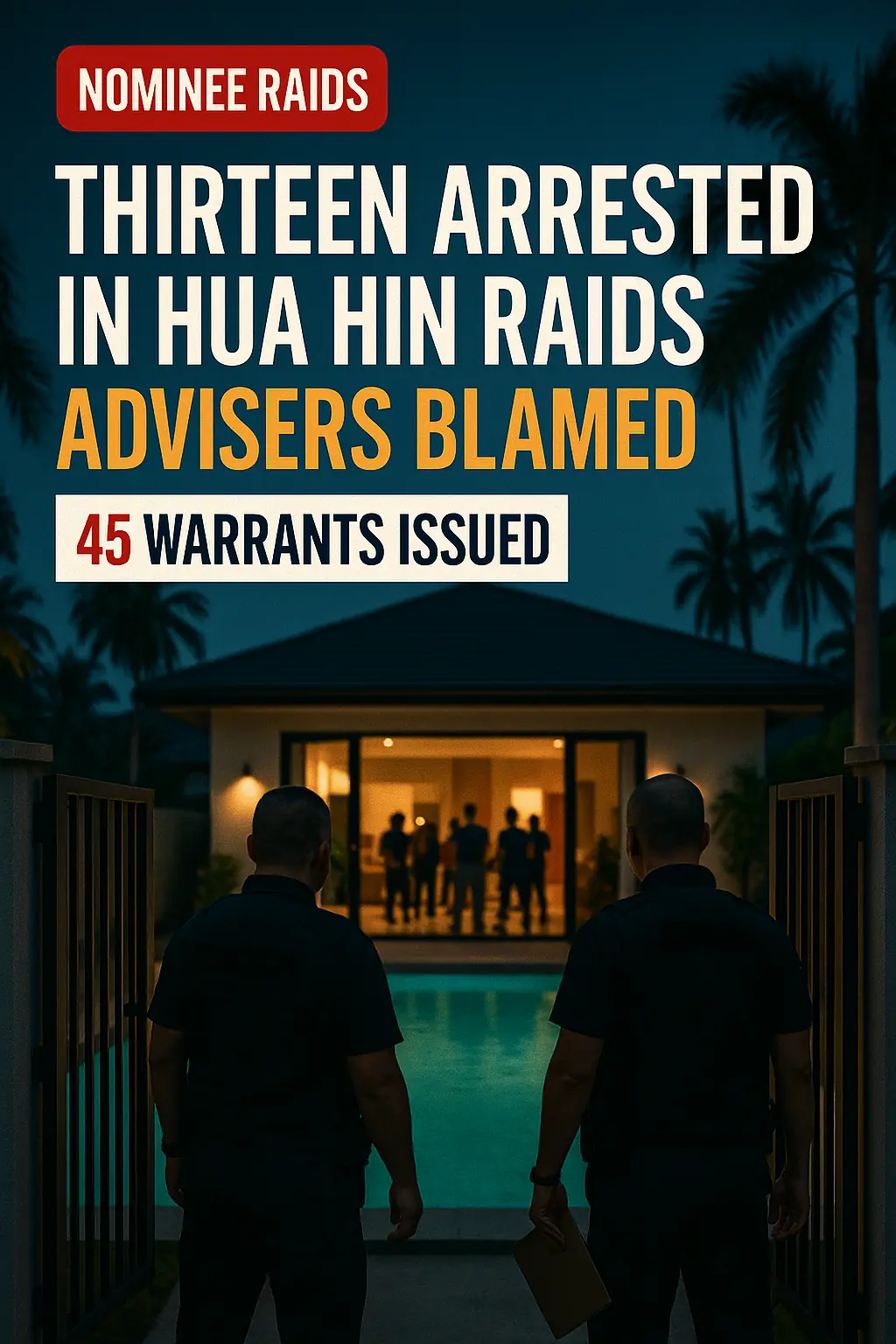
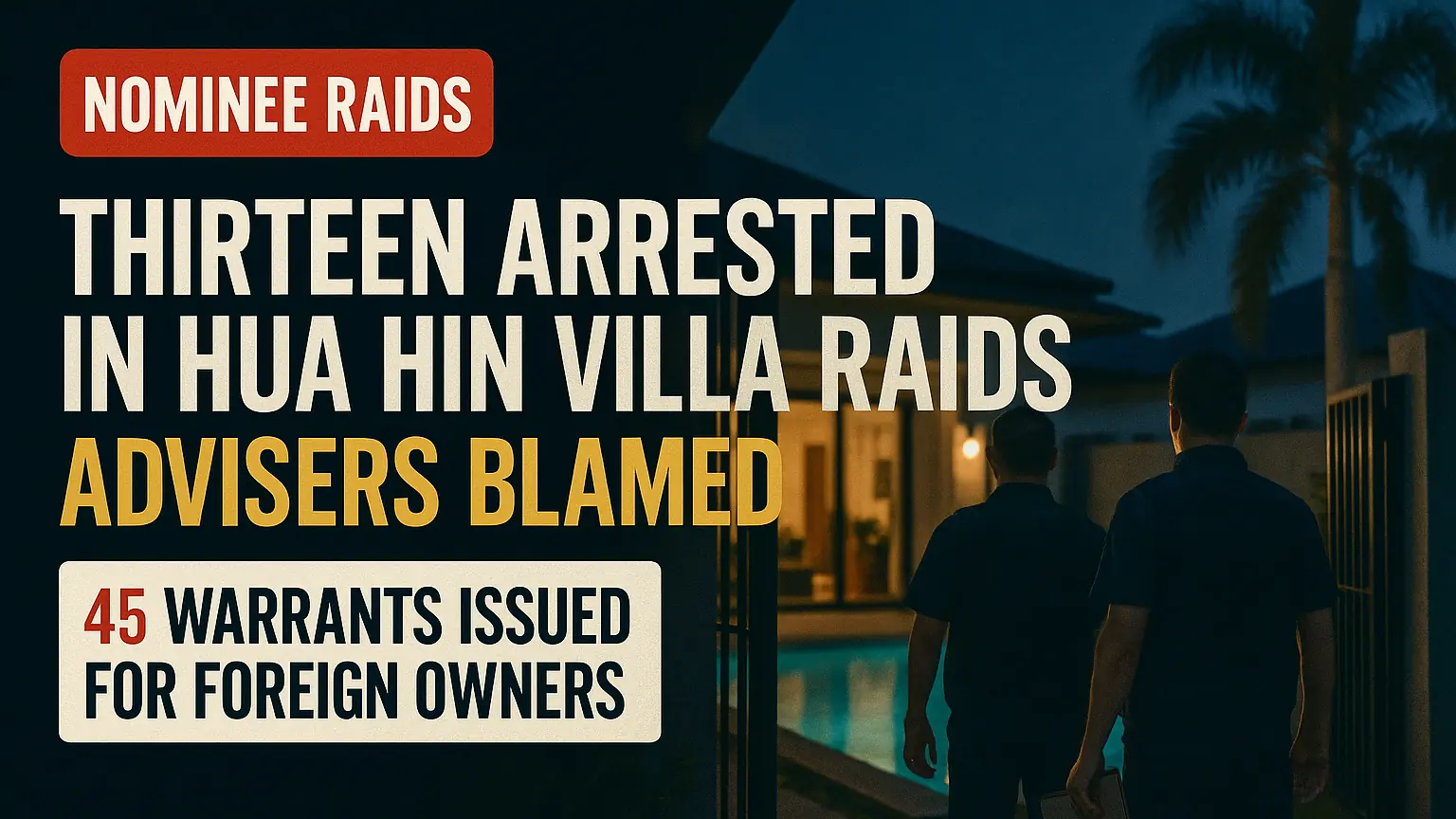
Thai police arrested 13 foreign nationals in Hua Hin's Phase 6 nominee crackdown. New reporting details an online company-registration loophole, a DBD tightening since 1 August, and a police pledge to examine law firms and accounting offices.
Thailand's Nominee Crackdown Reaches Hua Hin's Villa Market #
Officers arrested 13 foreign nationals in Thap Thai subdistrict under Phase 6.12 The Thaiger lists three British, four Chinese, and one each from Italy, France, the Netherlands, Austria, the Philippines and the United States, with six companies allegedly holding the villas, worth THB 10 to 20 million apiece.1 Deputy National Police Chief Pol Gen Samran Nualma, who leads the campaign, said 15 locations were searched and that no particular nationality is targeted.3
Police sought 45 arrest warrants, all involving foreigners.13 Representatives linked to 39 Thai companies were summoned; many claimed they did not know the foreigners involved.3
Key takeaways
- 13 arrested: eight nationalities, six companies linked to the raided villas.1 Police say 15 locations were searched.3
- An online loophole: wholly Thai firms gain foreign shareholders within six months, no further documentation.4
- Advisers on notice twice: suspects blame law firms; police will now examine advisers too.13
- Better-than-Freehold™ takeaway: a genuinely funded shareholder leaves nothing to manipulate and no adviser exposed.
What Happened in the Hua Hin Raids? #
- What the Arrested Told Officers
- The Online Registration Loophole
- Why Hua Hin Matters
- What This Means for Owners and Buyers
- The Better-than-Freehold™ Solution
- FAQ Section
- Related Terms
- Expert Guidance
What the Arrested Told Officers #
Some of the 13 gave officers the same account: they wanted to own property, and law firms and accounting companies had advised them to set up the companies.1 It remains an assertion by people under arrest, not a court finding.
That claim now has company: Samran said law firms and accounting offices will also be examined, a separate track from what suspects allege.3
Good faith is no defence under the Foreign Business Act: section 36 reaches the Thai nominee and the foreign beneficiary alike, up to three years and/or THB 100,000 to 1,000,000, plus court-ordered cessation of the shareholding or joint operation. Gatekeeper liability and lawyer liability mean a named firm carries its own exposure, and cannot advise independently on unwinding it.
The Online Registration Loophole #
Officials described the mechanism plainly. A company registers with Thai shareholders holding it all, then foreign shareholders join within six months through online changes without further documentation.4 The gap is not the law; it is the unchecked edit afterwards.
The Department of Business Development, under the Ministry of Commerce, said it has tightened controls since 1 August 2026.3 Thousands of foreign-linked registrations could previously be processed monthly; only five foreign shareholding registrations have been recorded since, according to the reported account.3
Why Hua Hin Matters #
More than 3,000 companies in Prachuap Khiri Khan hold land; foreigners hold shares in over 1,500, 849 are considered potentially suspicious, and 33 were targeted in the latest operation.3 Governor Sittichai Sawatsaen said the province reviewed 2,980 land-development companies, including 1,811 in Hua Hin, and identified 80 where foreign shareholders appeared to exceed the permitted 49 per cent threshold.3 On 25 August the Deputy Interior Minister reported that Surat Thani had gone wider, screening all 25,864 companies on its register.
Six phases have now run, worth an estimated THB 2.539 billion; Phase 6 is the first to reach Hua Hin rather than Phuket or the Andaman coast.3 Owners holding this way in Pattaya, Samui or Chiang Mai should read it as a preview.
What This Means for Owners and Buyers #
Exposure does not depend on being raided, or on having known: an owner already inside a high-risk or at-risk property-owning company carries the same risk. Samran said foreigners found to have acquired property illegally will be required to sell and repatriate the proceeds; failing a sale, authorities may seek court approval for auction.3 The Land Department can still force disposal, and the courts can order cessation of the shareholding separately.
A planned divestment, eight to sixteen weeks today, keeps that timetable with the owner. A buyer should ask not whether a structure is common, but whether it survives a registry check.
The Better-than-Freehold™ Solution #
Compliance comes first. Thailand Investor Network, a 100% Thai-owned property holding and management company, holds legal title, with no foreign funding or control to flag.
Security follows. SPH Trustees, a Labuan FSA-regulated trust company, holds the lease and option rights, backed by four security instruments (the lease and mortgage registered at the Land Office, the Option Agreement appended to the mortgage, and a share pledge) and enforced by Clear Blue Security Agents (CBSA), with mortgage enforcement through the Thai courts as a last resort.
The benefits complete the picture: financing to 50% LTV as a future workstream (expected H1 2027, not yet live), resale by assignment of trust interest, and succession without Thai probate.
Free to start · No obligation · Your decision at every stage
FAQ Section #
Related Terms #
- Nominee Company Risks in Thailand - the pattern behind the raid
- Foreign Business Act Thailand - nominee and beneficiary alike
- Gatekeeper Liability in Thailand - the adviser's exposure
- Lawyer Liability Under AMLA - the law firm's stake
Expert Guidance #
Immediate Action Required #
Do not wait for a knock on the door. Contact the Better-than-Freehold™ advisory team for a confidential compliance assessment.
Long-term Security Strategy #
A planned divestment, not a raid, sets the timetable.
Free to start · No obligation · Your decision at every stage
Conclusion #
Thirteen arrests made the headline. The loophole explains what happens next. None of the 13 has been convicted; a registry check cares only who paid.
References #
This article is provided for general information only and does not constitute legal, tax, or investment advice. Laws and enforcement practices change; obtain advice tailored to your situation before acting.
Footnotes #
-
The Thaiger. (2026, August 10). "13 foreigners arrested in Hua Hin nominee property crackdown." https://thethaiger.com/news/hua-hin/13-foreigners-arrested-in-hua-hin-nominee-property-crackdown ↩ ↩2 ↩3 ↩4 ↩5 ↩6 ↩7
-
Bangkok Post. (2026, August 10). "13 foreigners netted in property-nominee blitz in Hua Hin." https://www.bangkokpost.com/thailand/general/3299370/13-foreigners-netted-in-propertynominee-blitz-in-hua-hin ↩
-
Pattaya Mail, reporting the Thai News Agency. (2026, August 11). "Hua Hin foreign property network exposed after Thai nominees hand over control." ↩ ↩2 ↩3 ↩4 ↩5 ↩6 ↩7 ↩8 ↩9 ↩10 ↩11 ↩12 ↩13
-
Khaosod English. (2026, August 11). "Hua Hin property firms probed over alleged nominee scheme," carrying the Department of Business Development's account and quoting Director-General Poonpong Naiyanapakorn. https://www.khaosodenglish.com/news/2026/08/11/hua-hin-property-firms-probed-over-alleged-nominee-scheme/ (The Thai News Agency account at 3 reported this window as two months; the DBD's own figure of six months is followed here.) ↩ ↩2
About the Author: Andrew Moore FPFS, CDir
Chairman, Better-than-Freehold™

Andrew Moore has been an active investor in Thai property since 2004. He is a Chartered Director and a Fellow of the Personal Finance Society. He has invested in and built properties in several countries since the late 1990s and first invested in Thailand in 2004. Having owned homes in Bangkok, Samui, Phangan and Phuket he can offer a unique perspective on Thailand's property markets together with past and future trends in both ownership and investor opportunities.