
The DBD Has Sent Its 36,277-Company File to the Police, AMLO and Every Provincial Governor

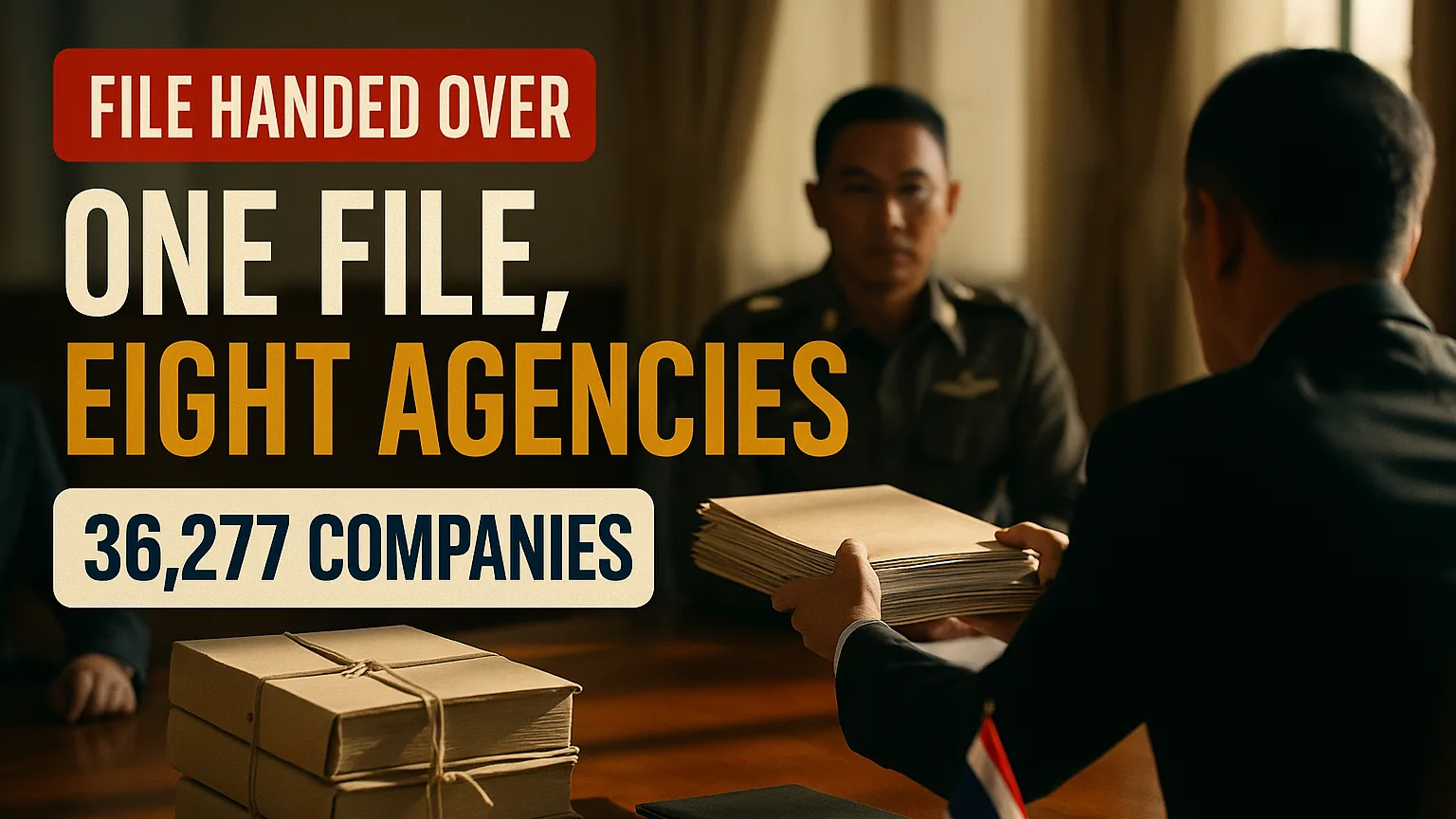
The Department of Business Development has dispatched its foreign-co-invested landholding dataset to eight agencies, from the Royal Thai Police to every provincial governor, each empowered to act under its own statute.
The DBD Has Handed Its Screening File to Eight Agencies With Eight Different Statutes #
Key takeaways
- Eight recipients: provincial administration, the Land Department, every governor, the DSI, the police, AMLO, the BOI and the IEAT.1
- What moved: property, corporate registration, shareholder and financial-statement data, sent "last week".2
- The caveat still stands: not all 36,277 are nominees; flagged cases have already been referred on.1
- Better-than-Freehold™ takeaway: no Thai name standing in for a foreigner means no file for any of the eight to open.
What Exactly Did the DBD Send, and to Whom? #
- Who Got the File, and What Will Each Agency Do With It?
- What Data Actually Moved?
- Why Poonpong's Caveat Still Leads the Story
- The Numbers Behind the File, in Brief
- What This Means for Owners and Buyers
- The Better-than-Freehold™ Solution
- FAQ Section
- Related Terms
- Expert Guidance
Who Got the File, and What Will Each Agency Do With It? #
Eight bodies, eight jobs. The BOI and the IEAT will check whether promotion-certificate holders hold their land lawfully; the police will investigate; AMLO will follow the money.1 One department, Poonpong says bluntly, cannot handle a problem this size alone.
What Data Actually Moved? #
More than a headcount changed hands. Bangkok Post reports that "last week" the department submitted property, corporate registration, shareholder and financial-statement data.2 Its list names six of the eight; MGR Online's is fuller, naming the police and the governors too, as a direct quote from Poonpong.1 InfoQuest records the same undertaking to supply registration, shareholder and financial-statement data.3
Why Poonpong's Caveat Still Leads the Story #
The Director-General has repeated the same warning twice now. Not every company among the 36,277 is a nominee; some are genuine joint ventures, and flagged cases had already been referred on separately.1 A shareholding band, on its own, still cannot tell a lawful partner from a front.
The Numbers Behind the File, in Brief #
The scale has not changed since 7 September, only its custodians have. The 36,277 entities hold 305,838 land plots totalling 1,064,265.38 rai, plus 76,840 condominium units, current to 4 September.3 The DBD opened this pool in August. One new figure: against Thailand's total area of 321,081,144 rai, that 1.06 million rai is roughly 0.33% of the country.1
What This Means for Owners and Buyers #
For anyone already inside a high-risk property-owning company, the trigger for a file no longer has to start at the DBD. A governor, a police officer or an AMLO analyst can now open one independently. The orderly route out is divestment: eight to sixteen weeks, shortening to under four weeks as Better-than-Freehold™ grows.
Confirmed findings still carry the same penalties: up to three years and/or THB 100,000 to 1,000,000 under FBA section 36, reaching the Thai nominee and the foreign beneficiary, plus court-ordered cessation of the shareholding and forced disposal of the land. AMLO's part rests on its existing remit, not the unenacted amendment, which is now before a House committee.
The Better-than-Freehold™ Solution #
Compliance comes first. Better-than-Freehold™ structures place no Thai name between a foreign investor and the land; Thailand Investor Network, a 100% Thai-owned property holding and management company, holds legal title in its own right.
Security follows. A registered 30-year lease and first-priority registered mortgage sit at the Land Office, with the Option Agreement appended to the mortgage.
The benefits complete the picture. No shareholding band, nothing for eight agencies to trace.
Free to start · No obligation · Your decision at every stage
FAQ Section #
Related Terms #
- Nominee Company Risks in Thailand - how nominee structures hide, and where enforcement looks first
- The DBD's 36,277-Entity Screening Pool - the pool this file measures
- Anti-Money Laundering Act Thailand - AMLO's existing powers
- Foreign Business Act Thailand - the statute behind section 36
Expert Guidance #
Immediate Action Required #
Assume a copy already sits with your governor. Review the structure this month, not after a letter arrives. Contact the Better-than-Freehold™ advisory team for a confidential compliance assessment.
Long-term Security Strategy #
A structure that never enters a shareholding register cannot be flagged, however many agencies read the file.
Free to start · No obligation · Your decision at every stage
Conclusion #
The file has left the ministry that built it. Eight agencies, each with its own statute, now hold the same dataset. For a genuine joint venture, that changes little. For a structure built to hide a foreign owner, the request to explain the shareholding no longer comes from just one place.
References #
This article is provided for general information only and does not constitute legal, tax, or investment advice. Laws and enforcement practices change; obtain advice tailored to your situation before acting.
Footnotes #
-
MGR Online / Manager. (2026, September). "เปิดตัวเลขให้เห็นกันจะจะ นิติบุคคลที่มีต่างชาติร่วมลงทุน ถือครองที่ดินล้านไร่ อาคารชุด 76,840 ห้อง." https://mgronline.com/business/detail/9690000087596 ↩ ↩2 ↩3 ↩4 ↩5 ↩6 ↩7
-
Bangkok Post. (2026, September 8). "Agencies set to probe over 36,000 nominee companies." https://www.bangkokpost.com/business/general/3315688/agencies-set-to-probe-over-36000-nominee-companies ↩ ↩2
-
InfoQuest. (2026, September). "พณ.-มท. อัพเดทข้อมูลต่างชาติถือครองที่ดิน-อสังหาฯ ในไทย." https://www.infoquest.co.th/2026/644437 ↩ ↩2
About the Author: Andrew Moore FPFS, CDir
Chairman, Better-than-Freehold™

Andrew Moore has been an active investor in Thai property since 2004. He is a Chartered Director and a Fellow of the Personal Finance Society. He has invested in and built properties in several countries since the late 1990s and first invested in Thailand in 2004. Having owned homes in Bangkok, Samui, Phangan and Phuket he can offer a unique perspective on Thailand's property markets together with past and future trends in both ownership and investor opportunities.