
Thais Warned Against Acting as Nominees - Government Targets Thai Facilitators in Foreign Business Crackdown May 2026
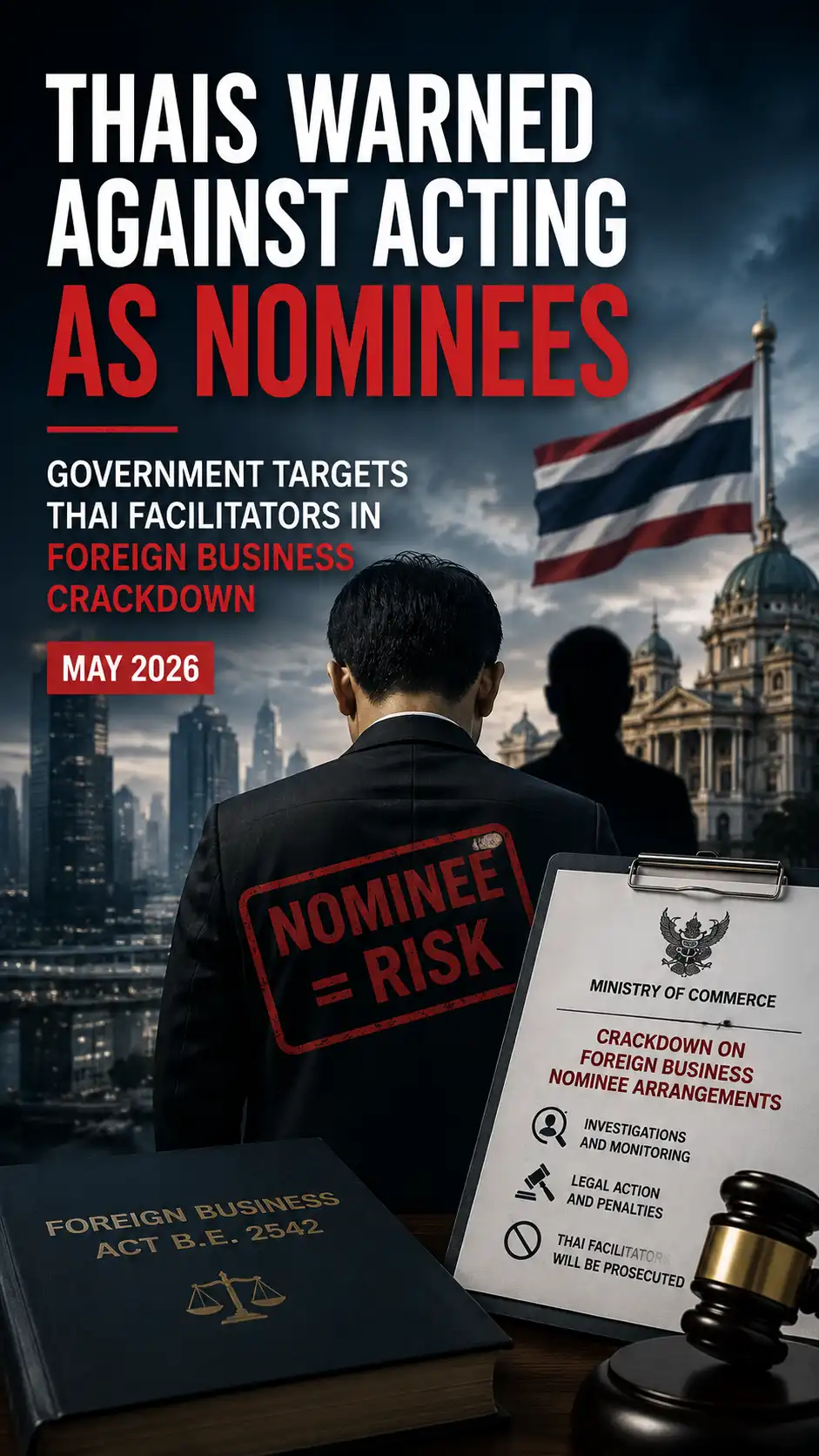
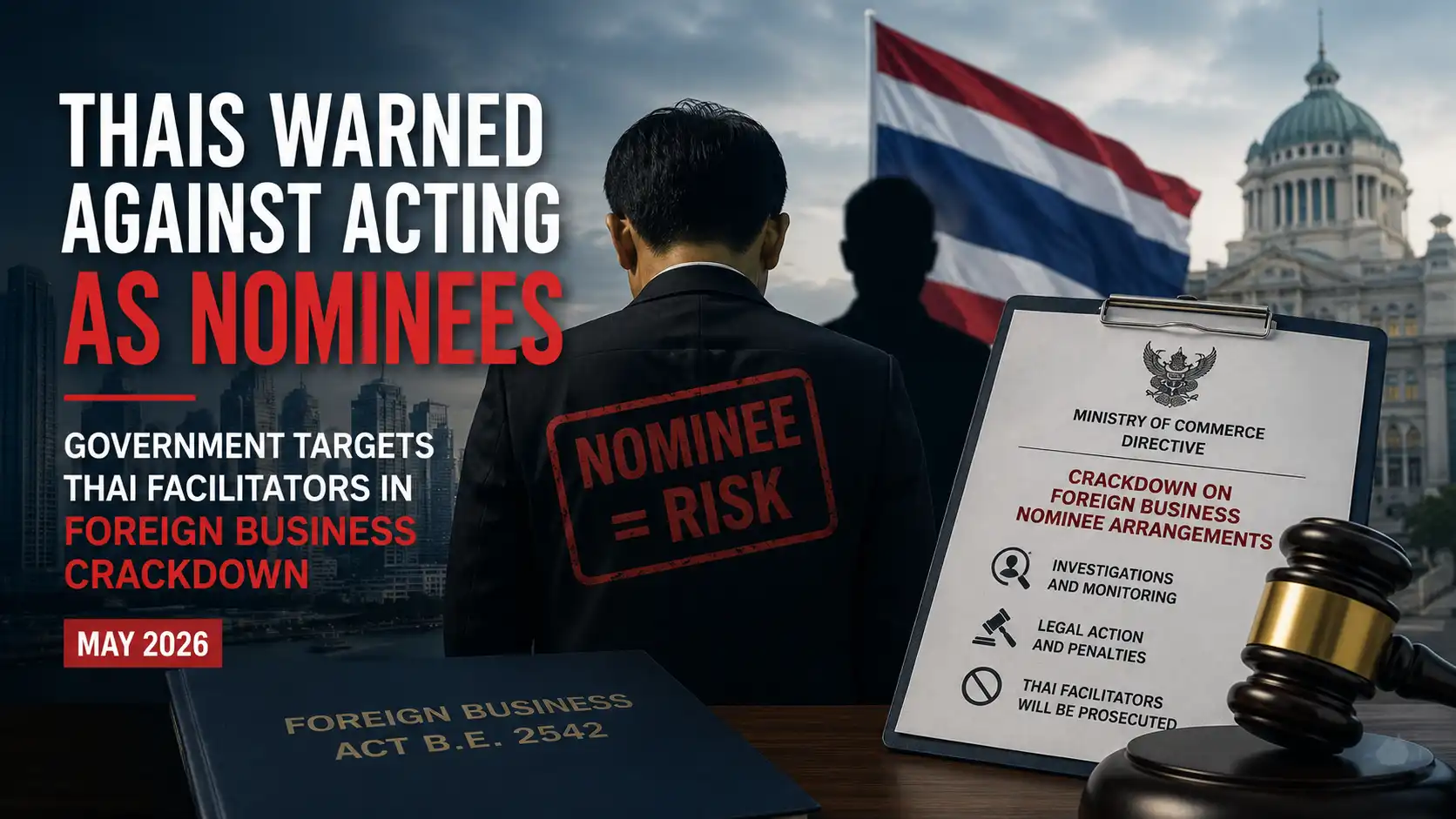
Thai government issues direct warning to citizens not to act as nominees for foreign businesses, with Foreign Business Act Section 36 carrying up to three years' prison and/or a fine of THB 100,000 to 1,000,000 for those who knowingly assist or fail to prevent offences.
Government spokeswoman urges citizens to report nominee structures to 1570 hotline as accomplice liability under Foreign Business Act Section 36 is reinforced #
Key takeaways
- Government spokeswoman Rachada Dhnadirek issued a direct public warning on 5 May 2026 against Thai citizens lending their names to foreign-controlled businesses, signalling that prosecution of Thai facilitators is now a stated enforcement priority alongside foreign principals.1
- Foreign Business Act 1999 Section 36 exposes Thai accomplices to up to three years' imprisonment, fines between 100,000 and 1 million baht, or both, and captures those who knowingly support, or fail to prevent, an offence when they are in a position to do so.12
- DBD director-general Poonpong Naiyanapakorn confirmed that the Department is coordinating with the Department of Special Investigation, the Royal Thai Police, and tax authorities to widen probes into nominee networks.1
- Better-than-Freehold™ removes Thai nominee dependency through a genuinely independent Thai company holding registered legal title, designed to avoid accomplice exposure for Thai shareholders, directors, and the lawyers, accountants, and agents who advise them.
What did the Thai government tell the public on 5 May 2026 about acting as nominees? #
Government spokeswoman Rachada Dhnadirek confirmed that authorities are intensifying a nationwide campaign against illegal nominee structures and warned the public not to assist businesses in concealing foreign ownership.1 Citizens are urged to report suspected violations through the 1570 hotline, with the Department of Business Development working alongside the Department of Special Investigation, the Royal Thai Police, and tax authorities.1
Table of Contents #
- Public Warning at a Glance
- Why the warning shifted onto Thai facilitators
- How this connects with wider enforcement
- What this means for foreign property owners
- How Better-than-Freehold™ removes nominee dependency
- FAQ Section
- Related Terms
- Expert Guidance
Public Warning at a Glance #
| Element | Detail | Authority Cited | Implication |
|---|---|---|---|
| Direct public warning | Thais told not to assist foreign-controlled nominee structures | PM's Office spokeswoman | Citizen-level enforcement front opened |
| Tip-off hotline | 1570, open for public reports | DBD | Crowdsourced enforcement channel |
| Accomplice penalty | Up to 3 years prison, 100k-1m baht fine, or both | FBA 1999, Section 36 | Thai facilitators face individual exposure |
| Inter-agency probes | DBD, DSI, Royal Thai Police, tax authorities | DBD director-general | Single offence triggers parallel investigations |
| PM's public vow | Protect Thailand's economic and security interests | PM Anutin Charnvirakul | Political cover for sustained enforcement |
Why has the warning shifted onto Thai facilitators? #
The escalation reflects an enforcement reality the Department of Business Development has acknowledged for several months: tightening company registration rules constrains the supply of new nominee structures, but it does not address the substantial existing stock, and that stock relies on Thai citizens lending their names.3
Earlier measures targeted the registration moment. DBD Order 2/2568, which took effect on 1 January 2026, required Thai shareholders in foreign-linked companies to provide bank statements and traceable evidence of fund sources, and the DBD has reported a reduction of more than 65% in nominee registration attempts.3 A further registration order is expected to tighten verification at the point of partnership amendment or signatory change.3
The new warning targets the human layer the registration system cannot reach: Thai citizens already named on share registers, partnership documents, and authorized signatory records.
What does Section 36 actually capture? #
Section 36 of the Foreign Business Act 1999 reaches three categories of Thai citizen: those who allow their name to be used as a shareholder, those who knowingly support a foreign-controlled business operating without permission, and those who, being in a position to prevent an offence, fail to do so.1 The third limb is the one most foreign owners and their professional advisors have historically discounted.
Failure-to-prevent liability does not require active facilitation. A Thai director who continues to sign documents for a company they recognize to be foreign-controlled, or a lawyer who certifies share transfers without addressing apparent nominee characteristics, may fall within scope.
How does this connect with the wider enforcement framework? #
The 5 May warning sits within a coordinated framework that has tightened steadily through late 2025 and the first half of 2026. The DBD's "Quick Big Win" policy reduced the number of high-risk nominee companies by approximately 60% in the first quarter of 2026, and on 29 April 2026 twenty-three state agencies signed a coordination pact at Government House, presided over by Deputy Prime Minister and Commerce Minister Suphajee Suthumpun, to share registration and financial data in real time and operate joint surveillance mechanisms.4
Field activity has matched the policy. Between October 2025 and late April 2026, the DBD and partner agencies inspected 27 locations across 10 provinces, investigating 4,372 foreign-linked companies; 256 were found operating in categories closed to foreigners, and 4,116 fell within categories requiring prior approval.4 Six high-risk sectors are under particular focus: tourism services, real estate, e-commerce and logistics, hotels and resorts, agriculture and construction.5
What does the warning mean for foreign property owners? #
The structural pressure on existing owners has tightened. Property held through a Thai limited company with foreign minority shareholders, where the Thai majority does not in substance fund or control the company, now sits squarely within the enforcement net.
Three second-order consequences follow. First, exit routes narrow as fewer Thais are willing to remain exposed under Section 36. Second, professional advisors providing nominee setup or maintenance services face their own accomplice exposure. Third, transaction friction increases across registration, transfer, financing, and resale as counterparties intensify diligence.
How Better-than-Freehold™ Removes the Nominee Dependency #
Better-than-Freehold™ is structured to avoid Thai nominee reliance. Foreign investors gain enforceable property rights through a structure that does not require any Thai individual to lend their name to circumvent the Foreign Business Act.
How does the Better-than-Freehold™ structure avoid these constraints? #
Legal title is held by Thailand Investor Network (TIN), an independent Thai property holding and management company operating in its own right under Thai company law, not as a nominee for the foreign investor. SPH Trustees Ltd, an offshore trustee whose Labuan FSA licence is in progress, holds the registered lease, mortgage and appended Option Agreement on behalf of the investor. Clear Blue Security Agents (CBSA) acts as independent enforcement agent to ensure the structure performs as documented.
Compliance comes first: the structure operates within the Foreign Business Act, the Land Code, and AMLA rather than around them. Security follows: rights are registered at the Land Office, enforceable in Thai court, and protected by independent third parties. Benefits then follow: a 30-year registered lease with contractual year-30 mechanisms, clean inheritance, offshore assignment without Land Office re-registration, where tax treatment depends on the investor, the transaction and current law, and financing to 50% loan-to-value as a future workstream, expected from H1 2027 and not yet live.
Free to start · No obligation · Your decision at every stage
FAQ Section #
Related Terms #
- Thailand Nominee Crackdown Intensifies May 2026 - Earlier announcement on inter-agency coordination and illegal foreign entities identified
- Proposed 2025 AMLA Amendments - How nominee arrangements would become predicate offences under the proposed AMLA amendments
- Foreign Business Act Restrictions Thailand - Statutory framework for foreign business activity, including Sections 36 and 37 penalties
- DBD Tightens Foreign Business Registration: Nominee Crackdown 2026 - Registration-stage controls under DBD Order 2/2568
Expert Guidance #
Immediate Action Required #
For Thai citizens currently named on share registers of foreign-linked companies, the immediate priority is verifying whether substance matches form. A genuine Thai shareholder with traceable funding and real ownership rights has a defensible position. A nominee should seek independent advice now, not after inspection.
Long-term Security Strategy #
For foreign property owners holding through Thai limited companies, the key question is whether the structure can withstand Section 36 and Section 37 scrutiny. If either limb fails, the structure remains exposed regardless of age. Better-than-Freehold™ provides a compliant conversion pathway designed to avoid both exposures through a restructured holding model.
For tailored guidance on nominee exposure and compliant transition options, contact our expert team.
Free to start · No obligation · Your decision at every stage
Conclusion #
The 5 May 2026 warning marks a clear enforcement shift in how the Thai government applies the Foreign Business Act against nominee structures. Registration tightening remains in force, but authorities are now directly pressuring the Thai facilitators that make those structures possible.1
Section 36 has always carried personal liability for Thai accomplices. What changed is visible intent, reinforced by inter-agency machinery and the 1570 reporting channel.1
Better-than-Freehold™ removes the dependency that this warning targets, giving foreign investors registered, enforceable rights without relying on nominee shareholding.
References #
This article is provided for general information only and does not constitute legal, tax, or investment advice. Laws and enforcement practices change; obtain advice tailored to your situation before acting.
Footnotes #
-
Bangkok Post. (2026, May 5). "Thais urged not to act as local nominees." https://www.bangkokpost.com/thailand/general/3249537/thais-urged-not-to-act-as-local-nominees ↩ ↩2 ↩3 ↩4 ↩5 ↩6 ↩7 ↩8 ↩9
-
Globe News Bangkok. (2026, May 5). "Public Warned Against Acting As Nominees for Foreign Firms." https://www.globe.co.th/news/thailand/public-warned-against-acting-as-nominees-for-foreign-businesses/ ↩
-
Nation Thailand. (2026, Mar 9). "DBD to tighten foreign business registration rules to curb nominee arrangements." https://www.nationthailand.com/business/economy/40063541 ↩ ↩2 ↩3
-
Chiang Rai Times. (2026, Apr 30). "Thailand Launches Massive Crackdown On Foreign Nominee Businesses." https://www.chiangraitimes.com/business/thailand-launches-massive-crackdown-on-foreign-nominee-businesses/ ↩ ↩2
-
Thai Enquirer. (2026, Apr). "Commerce Ministry intensifies nominee crackdown across six high-risk sectors." https://x.com/ThaiEnquirer/status/1991350819904712842 ↩
About the Author: Andrew Moore FPFS, CDir
Chairman, Better-than-Freehold™

Andrew Moore has been an active investor in Thai property since 2004. He is a Chartered Director and a Fellow of the Personal Finance Society. He has invested in and built properties in several countries since the late 1990s and first invested in Thailand in 2004. Having owned homes in Bangkok, Samui, Phangan and Phuket he can offer a unique perspective on Thailand's property markets together with past and future trends in both ownership and investor opportunities.