
Nominee Probe Moves Inland to Sakon Nakhon: 53 Suspect Companies Built on Villagers' Stolen ID Cards, and Law Firms Named as the Next Target
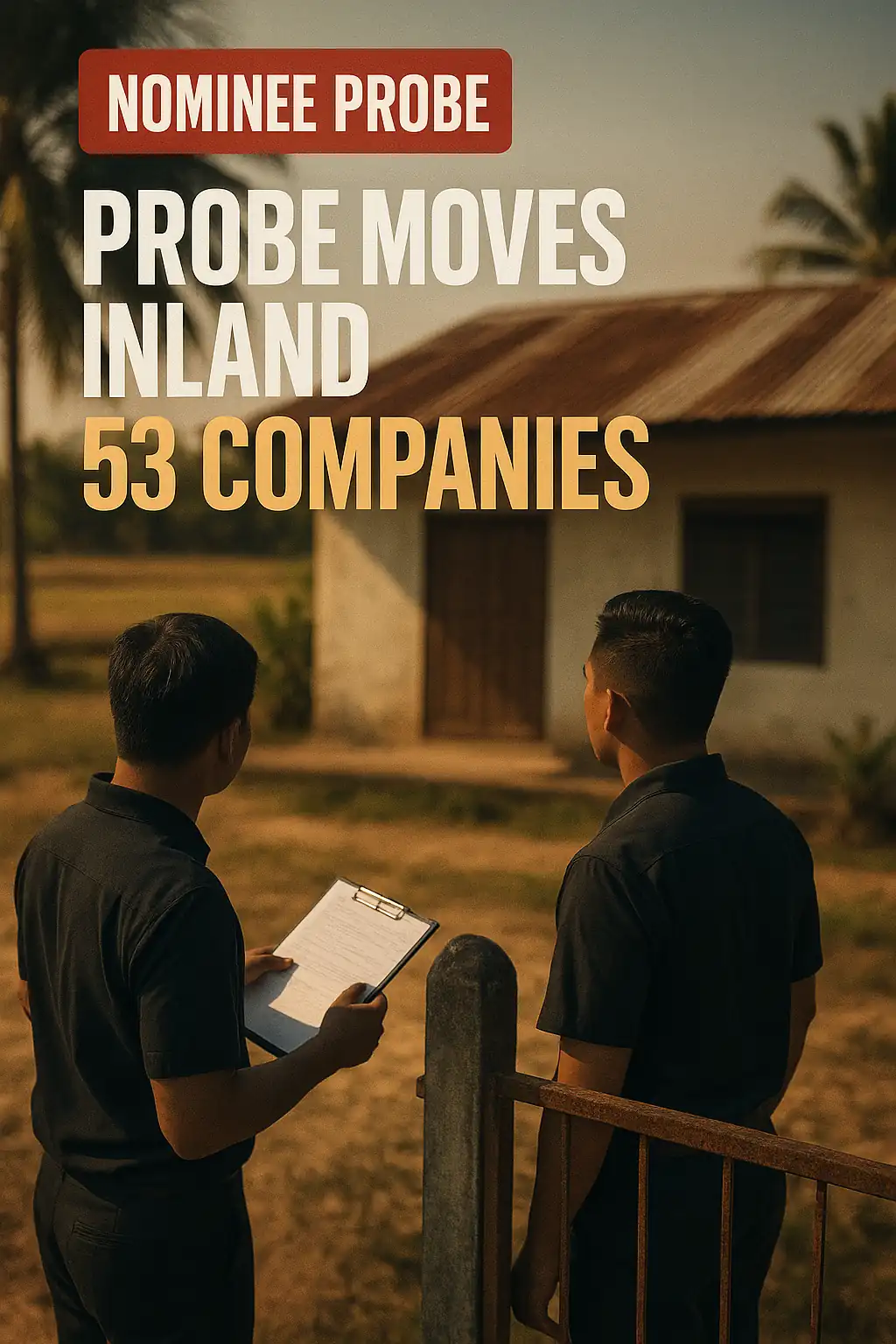
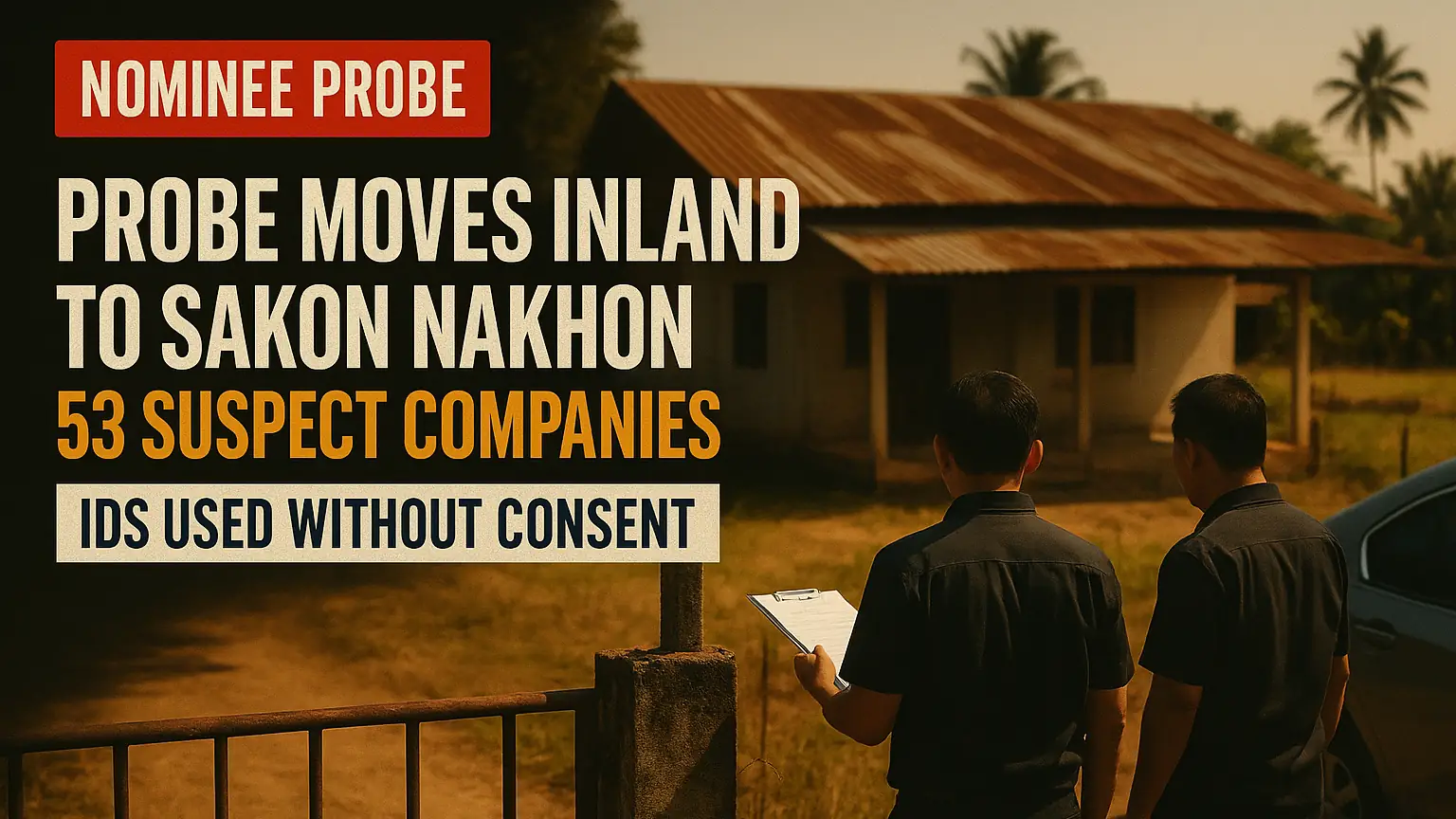
Sakon Nakhon has no foreign property market, yet officials found 53 suspect companies built on stolen villager ID cards. The Interior Ministry and DBD gave different counts, and a Deputy Minister named law firms as the next enforcement target.
The Nominee Campaign Reaches a Province With No Foreign Property Market #
Key takeaways
- Two counts, kept separate: 53 companies per the Interior Ministry, 43 Chinese-owned; 35 per the DBD, a day earlier.12
- The villagers didn't know: around 50 say their ID cards and house registration papers were used, and sold on, without consent.12
- The next target: accounting companies and law firms, not just the operators.1
- Better-than-Freehold™ takeaway: no Thai shareholder, no shell address, nothing to find.
What Happened in Sakon Nakhon on 17 August? #
- How Did a Broker Turn Villagers' ID Cards Into Companies?
- Why Don't the Ministry and DBD Counts Match?
- What Does an Inland Province Change About Detection?
- Why Are Accountants and Law Firms Now in the Frame?
- What Does This Mean for Existing Owners?
- The Better-than-Freehold™ Solution
- FAQ Section
- Related Terms
- Expert Guidance
How Did a Broker Turn Villagers' ID Cards Into Companies? #
A woman from Khok Si Suphan allegedly sourced the paperwork, one household at a time. The Department of Business Development (DBD), under the Ministry of Commerce, announced on 16 August that 35 companies had entirely Chinese shareholders across three districts.2 According to The Thaiger, the alleged broker paid residents 500 to 1,000 baht per document set and sold them on at 1,500 baht each, for what most believed was an "online business", and inspectors who later visited the addresses found no office and no activity, only occupied homes whose owners said nobody had asked.2
Why Don't the Ministry and DBD Counts Match? #
The Interior Ministry gave 53 on 17 August, 43 wholly Chinese-owned, without naming its four districts; the DBD had reported 35 the day before, across Khok Si Suphan, Mueang and Phu Phan, plus 14 under review in Sawang Daen Din.12 Neither figure supersedes the other. On the method, both agree: villagers' documents ended up on a register none of them had seen.
What Does an Inland Province Change About Detection? #
The property market disappears from the equation entirely. Earlier phases sat inside a visible market: Phuket, Hua Hin, Koh Samui. Sakon Nakhon has none of that, yet the Interior Ministry's count reached 53. The trigger has moved from what a company owns to whether its paperwork survives scrutiny; since 1 August the DBD has required bank statements from Thai co-investors, with financial-trail checks running across 16 risk provinces.3
The identity-theft element isn't the reader's situation. The detection method is, for anyone inside a high-risk property-owning company: an unmatched address, unevidenced funds, a register entry that fails a site visit.
Why Are Accountants and Law Firms Now in the Frame? #
Polapee put it plainly: "The investigation will not stop with a list of the companies but will continue to pinpoint the masterminds, the Chinese operators, their Thai accomplices, accounting companies and law firms involved."1
Money laundering under AMLA section 60 carries one to ten years or a THB 20,000 to 200,000 fine, or both, section 61 extends the same to consenting directors, and an adviser who built the structure shares the client's enforcement frame, unable to give impartial advice about fixing it. See our gatekeeper liability and lawyer liability under AMLA coverage.
What Does This Mean for Existing Owners? #
Nothing here requires a beachfront villa to apply to you. A high-risk property-owning company carries the same tells wherever it sits. Section 36 of the Foreign Business Act reaches nominee and beneficiary alike, up to three years and/or THB 100,000 to 1,000,000; the Land Department can force disposal, and the courts can order cessation of the shareholding separately. A planned divestment still runs eight to sixteen weeks, expected to shorten to under four as Better-than-Freehold™ grows.
The Better-than-Freehold™ Solution #
Compliance comes first. Thailand Investor Network, a 100% Thai-owned property holding and management company, holds legal title directly, with no foreign shareholder to flag.
Security follows. SPH Trustees Ltd, a Labuan FSA-regulated trust company, holds the lease and option rights through four security instruments (the lease and mortgage registered at the Land Office, the Option Agreement appended to the mortgage, and a share pledge), enforced by Clear Blue Security Agents (CBSA), with mortgage enforcement through the Thai courts as a last resort.
The benefits complete the picture: financing to 50% LTV as a future workstream (expected H1 2027, not yet live), resale by assignment of trust interest, and succession without Thai probate.
Free to start · No obligation · Your decision at every stage
FAQ Section #
Related Terms #
- Nominee Company Risks in Thailand - the pattern behind every phase
- Gatekeeper Liability - advisers now in the enforcement frame
- Lawyer Liability Under AMLA - the exposure facing named law firms
- Foreign Business Act Thailand - the penalty reaching nominee and beneficiary
Expert Guidance #
Immediate Action Required #
Don't assume an inland or modest property protects you. The detection method doesn't care what the company owns. Contact the Better-than-Freehold™ advisory team for a confidential compliance assessment.
Long-term Security Strategy #
If your adviser built it, they have their own position to manage first. No shareholder list, no question asked.
Free to start · No obligation · Your decision at every stage
Conclusion #
Fifty-three companies per the Interior Ministry, 35 per the DBD a day earlier; the counts don't reconcile, and nothing suggests adding them together. Both agree on the method: stolen ID cards, sold cheap. A minister now names the accounting and law firms that assembled the result.
References #
This article is provided for general information only and does not constitute legal, tax, or investment advice. Laws and enforcement practices change; obtain advice tailored to your situation before acting.
Footnotes #
-
Bangkok Post. (2026, August 17). "Proxy companies probe expands into Northeast." Post Reporters. https://www.bangkokpost.com/thailand/general/3303127/proxy-companies-probe-expands-into-northeast ↩ ↩2 ↩3 ↩4 ↩5 ↩6 ↩7
-
The Thaiger. (2026, August 17). "Broker sold villagers' IDs to register 35 Chinese nominee firms." Ryan Turner. https://thethaiger.com/news/northern-thailand/broker-sold-villagers-ids-to-register-35-chinese-nominee-firms ↩ ↩2 ↩3 ↩4 ↩5 ↩6
-
Nation Thailand. (2026). "DBD tightens nominee crackdown, orders financial-trail checks in 16 risk provinces." https://www.nationthailand.com/news/general/40068701 ↩
About the Author: Andrew Moore FPFS, CDir
Chairman, Better-than-Freehold™

Andrew Moore has been an active investor in Thai property since 2004. He is a Chartered Director and a Fellow of the Personal Finance Society. He has invested in and built properties in several countries since the late 1990s and first invested in Thailand in 2004. Having owned homes in Bangkok, Samui, Phangan and Phuket he can offer a unique perspective on Thailand's property markets together with past and future trends in both ownership and investor opportunities.