
Koh Samui Nominee Sweep Reaches Phase Seven: 59 Companies, 31 Rai and Villas Sold by Share Transfer

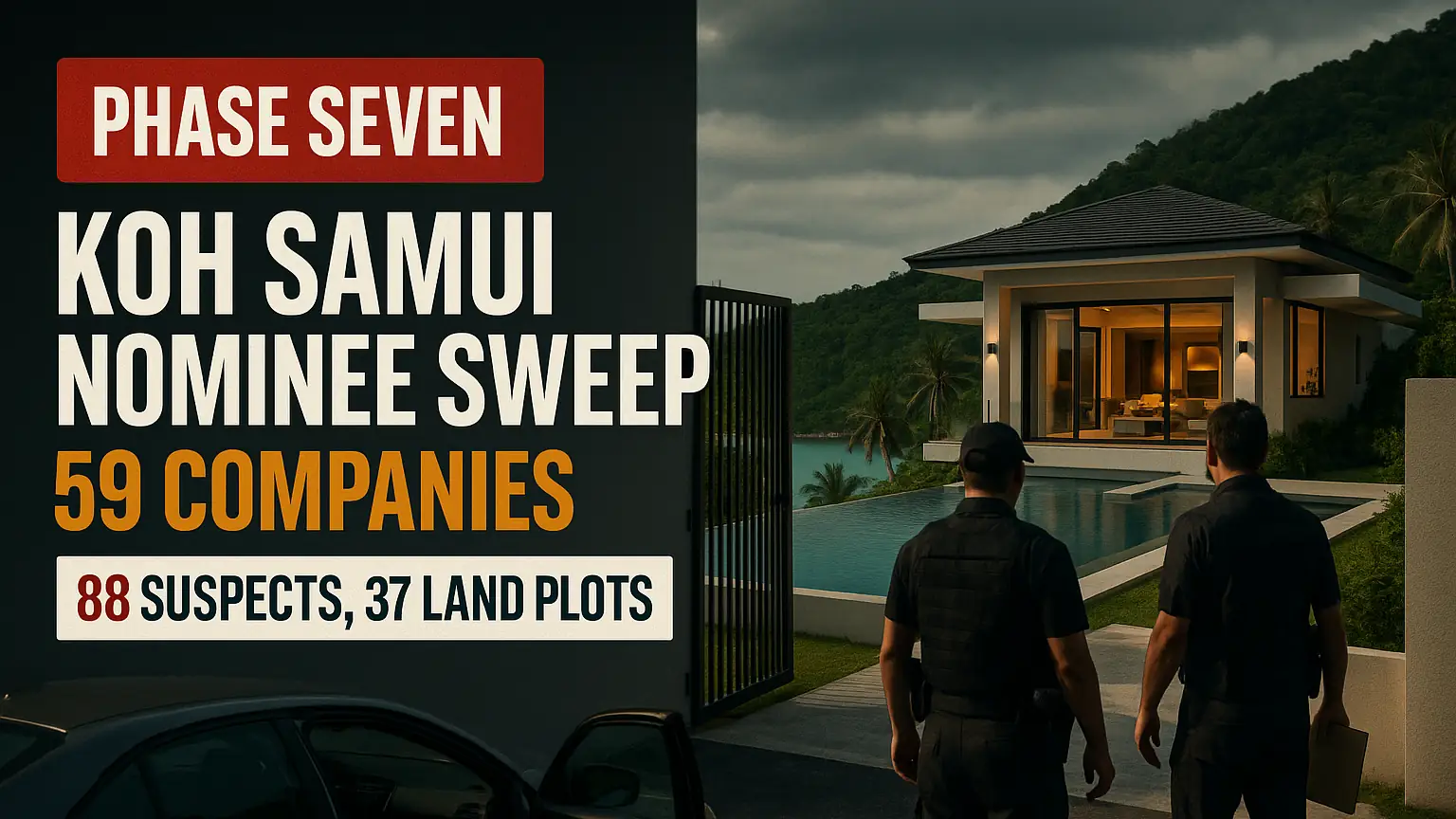
Phase 7 of Thailand's nominee crackdown screened 12,906 Koh Samui companies down to 59, filing 60 complaints against 88 suspects. Investigators flagged villas sold by share transfer to dodge tax, alongside a parallel Koh Phangan raid a day earlier.
Thailand's Nominee Screening Reads the Register Before Koh Samui's Seventh Raid #
Key takeaways
- The funnel narrowed hard: 12,906 companies reviewed, 8,254 with foreign shareholders, 875 flagged, 59 carried forward.12
- The share-transfer sale: villas changed hands by transferring shares, sidestepping transfer tax and corporate income tax.1
- A separate Phangan operation: 104 companies, 124 plots flagged the day before, with a 30-day deadline attached.34
- Better-than-Freehold™ takeaway: a 100% Thai-owned holding company has no foreign shareholder to screen and no shares to sell around the tax.
What Happened on Koh Samui on 15 August? #
- How Did Officials Narrow 12,906 Companies to 59?
- Why Does the Share-Transfer Sale Matter?
- What Happened on Koh Phangan the Day Before?
- What Does This Mean for Existing Owners?
- The Better-than-Freehold™ Solution
- FAQ Section
- Related Terms
- Expert Guidance
How Did Officials Narrow 12,906 Companies to 59? #
The screening ran before the raid, not after it. Every one of the island's 12,906 registered companies was reviewed; 8,254 had foreign shareholders; 875 showed nominee characteristics; 59 were selected, holding 37 plots across 31 rai worth an estimated THB 1.2 billion.12 Around 300 personnel executed the warrants, the Department of Business Development among the agencies taking part, across five company groups; 14 arrested so far.12
Why Does the Share-Transfer Sale Matter? #
Four German-linked companies show the mechanism plainly. Investigators found luxury hillside villas, their construction permits suspected of being obtained improperly, sold by transferring company shares rather than the land itself, avoiding transfer tax and corporate income tax on the proceeds.1
It is not the clean exit it looks on paper. A compliant buyer pays the standard 2% transfer fee. The reduced 0.01% rate is for Thai nationals only, not foreign buyers. Selling the company hides that liability, exactly what investigators listed as evidence of nominee intent. Buyers offered a Samui villa by share transfer should treat it as a stop sign until counsel has checked the company, as our Koh Samui villa buying guide explains.
What Happened on Koh Phangan the Day Before? #
A separate operation ran on Friday 14 August, with its own figures. Deputy Interior Ministers Polapee Suwunchwee and Worasit Liengprasit inspected five luxury hotels, none holding the required licences.3 Officials found 104 companies where foreigners held more shares than Thais, owning 124 plots including a ten-rai sea-view property, the Ministry of Commerce's DBD tracing ownership.3 Khaosod reports a 30-day deadline for remedial action followed, without specifying what it covers.4
What Does This Mean for Existing Owners? #
Six phases now sit behind Saturday's raid. The campaign has examined 238 companies and 272 plots covering 184 rai, valued at roughly THB 2.8 billion, with 178 arrest warrants issued.1
An owner holding through a high-risk property-owning company on Samui or Phangan carries that exposure whether or not their name has come up yet. Section 36 of the Foreign Business Act reaches the Thai nominee and foreign beneficiary alike: up to three years, THB 100,000 to 1,000,000, plus court-ordered cessation of the shareholding. The Land Department can force disposal. A planned divestment still runs eight to sixteen weeks. A raid does not shorten that.
The Better-than-Freehold™ Solution #
Compliance comes first. Thailand Investor Network, a 100% Thai-owned property holding and management company, holds legal title directly, with no foreign shareholder to flag under Anti-Money Laundering Act screening.
Security follows. SPH Trustees, a Labuan FSA-regulated trust company, holds the lease and option rights through four security instruments (the lease and mortgage registered at the Land Office, the Option Agreement appended to the mortgage, and a share pledge), enforced by Clear Blue Security Agents (CBSA), with mortgage enforcement through the Thai courts as a last resort.
The benefits complete the picture: financing to 50% LTV as a future workstream (expected H1 2027, not yet live), resale by assignment of trust interest, and succession without Thai probate.
Free to start · No obligation · Your decision at every stage
FAQ Section #
Related Terms #
- Nominee Company Risks in Thailand - the pattern behind every phase
- Foreign Business Act Thailand - the penalty reaching nominee and beneficiary alike
- Anti-Money Laundering Act Thailand - the screening behind the register review
- Thailand Property Market Analysis - the growth provinces under scrutiny
Expert Guidance #
Immediate Action Required #
Don't wait to find out whether your company is one of the 875. That fact doesn't improve with time. Contact the Better-than-Freehold™ advisory team for a confidential compliance assessment.
Long-term Security Strategy #
A planned divestment sets its own timetable. A forced one does not.
Free to start · No obligation · Your decision at every stage
Conclusion #
Fifty-nine companies identified, 60 complaints filed, 88 suspects named. The method was a register review, not a raid on a tip. Koh Phangan's 104 companies sit alongside Koh Samui's 59, a separate result, not one combined total. Remember the share-transfer sale, a route sold as a clean exit that investigators read as evidence of nominee intent.
References #
This article is provided for general information only and does not constitute legal, tax, or investment advice. Laws and enforcement practices change; obtain advice tailored to your situation before acting.
Footnotes #
-
Bangkok Post. (2026, August 15). "60 illegal nominee firms found on Koh Samui." Online Reporters. ↩ ↩2 ↩3 ↩4 ↩5 ↩6 ↩7 ↩8 ↩9
-
เดลินิวส์ / Daily News. (2026, August 15). Phase 7 Koh Samui nominee operation. https://www.dailynews.co.th/news/6109617/ ↩ ↩2 ↩3 ↩4
-
Thai Examiner. (2026, August 15). "International reservations system used by hotels targeted in latest Koh Phangan crackdown by ministers." James Morris and Son Nguyen. ↩ ↩2 ↩3
-
ข่าวสด / Khaosod. (2026, August 14). "2 Deputy Ministers of Interior Investigate Nominee Land Ownership on Koh Phangan; Foreigners Hold Majority Shares in 104 Companies." https://www.khaosod.co.th/politics/news_10360051 ↩ ↩2
About the Author: Andrew Moore FPFS, CDir
Chairman, Better-than-Freehold™

Andrew Moore has been an active investor in Thai property since 2004. He is a Chartered Director and a Fellow of the Personal Finance Society. He has invested in and built properties in several countries since the late 1990s and first invested in Thailand in 2004. Having owned homes in Bangkok, Samui, Phangan and Phuket he can offer a unique perspective on Thailand's property markets together with past and future trends in both ownership and investor opportunities.