
Company Dissolutions Rose 12.5% in the First Half of 2026, and the Capital Behind Them More Than Tripled
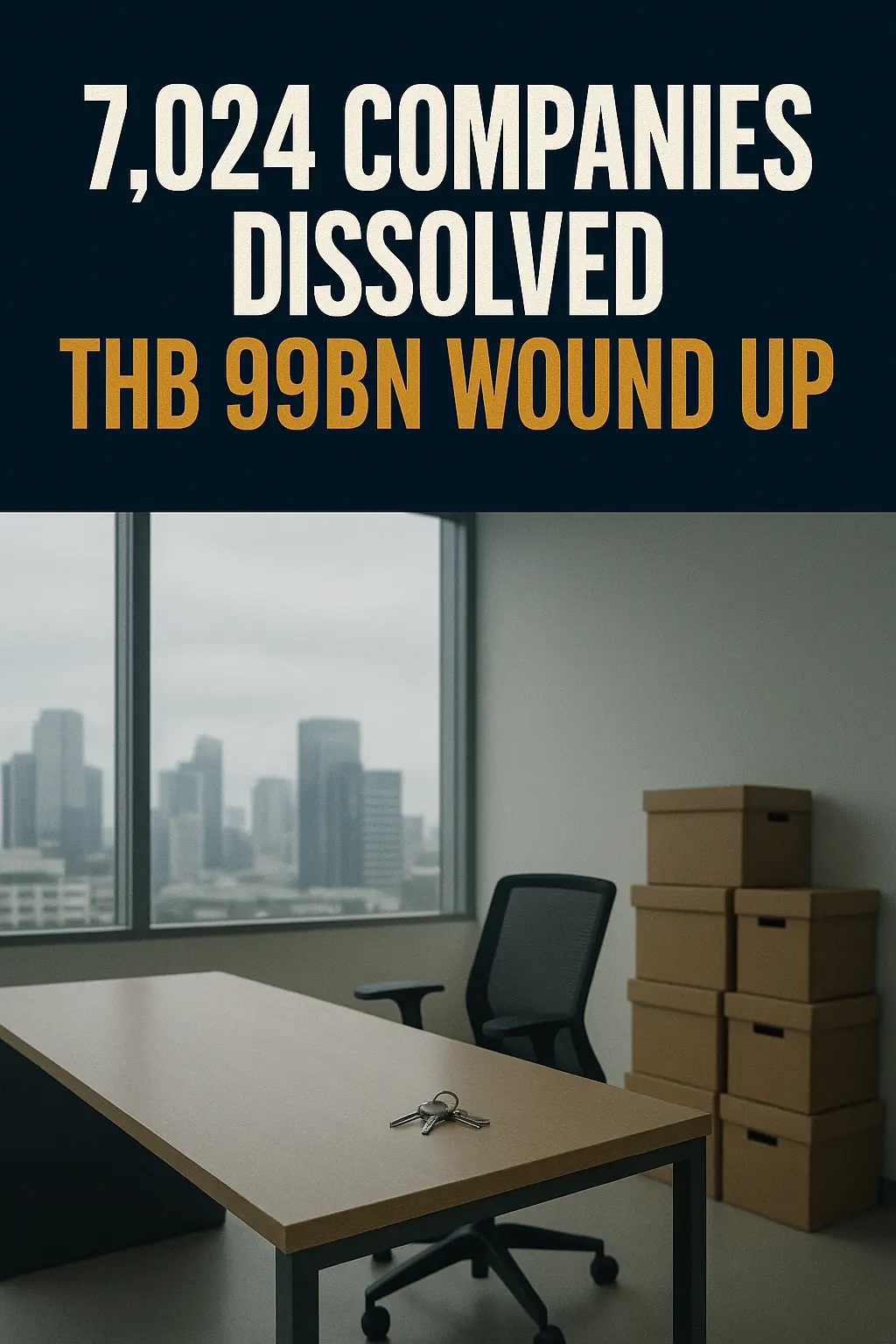
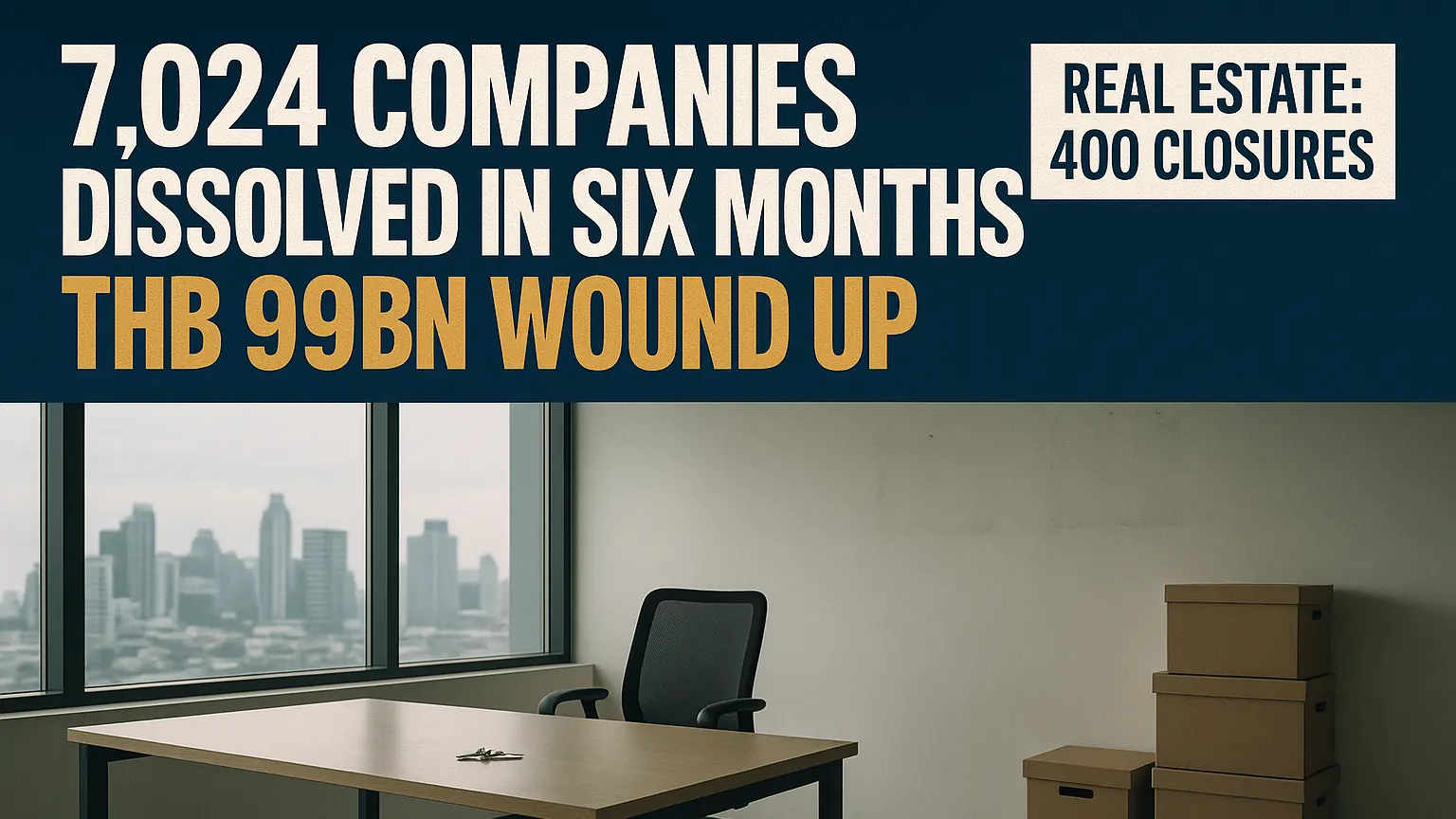
Thailand's DBD recorded 7,024 company dissolutions in the first half of 2026, carrying nearly THB 99 billion in registered capital. Real estate accounted for 400 of them.
The Companies Winding Up in Thailand Are Getting Much Larger #
According to Department of Business Development figures reported by the Bangkok Post on 3 August, 7,024 businesses filed for dissolution between January and June 2026, up 12.5 per cent year on year.1 The registered capital attached to them reached nearly THB 99 billion, more than three times the prior-year total.12 Property owners should read the second number, not the first.
Key takeaways
- Volume rose modestly: 7,024 dissolutions in the first half of 2026, against 6,244 a year earlier.13
- Capital rose sharply: nearly THB 99 billion wound up, an increase of roughly 224 per cent.12
- Real estate accounted for 400 closures: carrying THB 4.21 billion, with construction, electrical installation and advertising also among the heaviest sectors.12
- Better-than-Freehold™ takeaway: dissolving the company that holds your property does not resolve how the property was held.
What Do the First-Half 2026 Dissolution Figures Actually Show? #
- Why the Capital Figure Matters More Than the Count
- Where Property Sits in the Data
- What Winding Up a Land-Holding Company Involves
- The Better-than-Freehold™ Solution
- FAQ Section
- Related Terms
- Expert Guidance
Why the Capital Figure Matters More Than the Count #
A 12.5 per cent rise in closures is unremarkable. A 224 per cent rise in the capital behind them is not.
The gap describes what kind of company is closing. Last year's dissolutions were dominated by small businesses carrying little capital. In 2026, well-capitalised companies joined them, which is why the capital total more than tripled while the headcount barely moved.12 The Ministry of Commerce data does not break the figures down by shareholder nationality.
That matters for foreign owners. A property-holding company is a capitalised entity by construction: it exists to hold an asset, not to trade. Companies of that shape sit in the group that grew.
Where Property Sits in the Data #
Real estate accounted for 400 dissolutions carrying THB 4.21 billion.12 That is under six per cent of the total, so property is not leading this wave.
Be precise about what the data is not. These are dissolution filings, not nominee findings, and nothing in them identifies which companies held property through structures that would not survive scrutiny. Thailand's nominee enforcement campaign and this rise in closures are running at the same time. The figures do not establish that one produced the other.
What Winding Up a Land-Holding Company Involves #
Closing a company that holds land is not the same as selling the land. That is where owners often find the difference.
The asset does not dissolve with the entity. It has to go somewhere: a transfer recorded at the Department of Lands, a price, a tax position, a buyer. If the shareholding was built around Thai shareholders who did not fund their shares, dissolution does not close that question. It surfaces it, with paperwork attached. Exposure under the Foreign Business Act attaches to how the company was held, not to whether it still exists.
For anyone already in a nominee structure, winding up is an exit from the company, not from its history. Our guide to nominee company risks in Thailand sets out where that exposure sits.
For anyone weighing divestment, the effect is liquidity. More structures unwinding means more assets reaching the market as a company sale, which is slower and narrower than a clean transfer. The Bank of Thailand reports subdued domestic demand alongside it. Our Thailand property market analysis covers where that leaves pricing.
The Better-than-Freehold™ Solution #
Better-than-Freehold™ replaces the company with four principal instruments: a 30-year registered lease, a first-priority registered mortgage, a year-30 Option Agreement appended to the mortgage, and a share pledge. No investor-owned company means no dissolution event, and no Thai co-shareholder whose funding has to be defended.
The difference shows on exit. A registered lease transfers as a document. A company-held property transfers as a company, history attached.
Free to start · No obligation · Your decision at every stage
FAQ Section #
Related Terms #
- Nominee Company Risks in Thailand - what the enforcement campaign targets and how exposure arises
- Foreign Business Act - the statute governing foreign shareholding in Thai companies
- Thailand Property Market Analysis - conditions shaping pricing and liquidity
Expert Guidance #
Immediate Action Required #
Establish what your holding company owns and how its shares were funded, before deciding whether to wind it up. Dissolution timing is a choice. The paperwork it generates is not. Contact the Better-than-Freehold™ advisory team for a confidential compliance assessment.
Long-term Security Strategy #
Hold property through instruments that transfer on their own terms. An exit that depends on selling a company inherits every question that company has raised.
Free to start · No obligation · Your decision at every stage
Conclusion #
The headline is the 12.5 per cent rise in closures. The number that matters to a property owner is the 224 per cent rise in capital behind them: the companies winding up are now substantial ones. For owners holding through a company, the question is not whether to close it. It is what closing it puts on the record.
References #
This article is provided for general information only and does not constitute legal, tax, or investment advice. Laws and enforcement practices change; obtain advice tailored to your situation before acting.
Footnotes #
-
Bangkok Post. (2026, August 3). "Business closures rise by 12.5% in first half." https://www.bangkokpost.com/business/general/3287014/business-closures-rise-by-125-in-first-half ↩ ↩2 ↩3 ↩4 ↩5 ↩6 ↩7 ↩8
-
Thailand News. (2026, August 12). "Thailand Faces Surge in Business Closures as Economic Pressures Widen." https://www.thailandnews.co/2026/08/thailand-faces-surge-in-business-closures-as-economic-pressures-widen/ ↩ ↩2 ↩3 ↩4 ↩5 ↩6
-
Nation Thailand. "Economic downturn leads to 6,244 business closures in H1 2025, says DBD." https://www.nationthailand.com/business/economy/40053399 ↩
About the Author: Andrew Moore FPFS, CDir
Chairman, Better-than-Freehold™

Andrew Moore has been an active investor in Thai property since 2004. He is a Chartered Director and a Fellow of the Personal Finance Society. He has invested in and built properties in several countries since the late 1990s and first invested in Thailand in 2004. Having owned homes in Bangkok, Samui, Phangan and Phuket he can offer a unique perspective on Thailand's property markets together with past and future trends in both ownership and investor opportunities.